Blue Agate Stone: Spiritual Meaning, Symbolism, and Daily Use

Table of Contents
- 10-Second Executive Summary / The Verdict Box
- What Is Blue Agate? Geology, Banding, and Why Blue Is Rare
- Blue Agate Meaning and Symbolism: Water, Calm, and Truth
- Blue Lace Agate vs. Dyed Blue Agate: What Buyers Should Know
- Spiritual Meaning and Healing Properties
- Blue Agate in Daily Use: Wear, Home, and Workspace
- Cleansing, Charging, and Care
- How to Choose Authentic Blue Agate (Buying Checklist)
- Decision Table: Which Blue Agate Is Right for You?
- FAQ: Blue Agate Meaning, Color, and Care
- What does blue agate stone mean spiritually?
- Is blue agate a natural stone or is it dyed?
- How do you cleanse and care for blue agate?
- Closing Thought
- Sources
Blue agate is a banded chalcedony whose meaning is most often tied to calm, clear communication, and emotional steadiness — but the stone itself is usually a natural blue-lace agate, and naturally blue agate is rare. Most vivid "blue agate" sold today is dyed, so the meaning you feel and the material you buy are two separate questions. In short: appreciate the symbolism, but verify natural color and banding before you purchase.
10-Second Executive Summary / The Verdict Box
- Direct Verdict: Blue agate is often associated with calm, truthfulness, and gentle communication in modern crystal practice. Its material identity is a banded chalcedony (microcrystalline quartz). Naturally blue material is uncommon, and deep uniform blues are almost always dyed.
- Mohs Hardness: 6.5–7 (quartz/chalcedony range) — durable for daily wear but vulnerable to scratching by harder materials and to long-term dye fade.
- Geology: Agate forms in volcanic cavities where silica-rich water deposits quartz layer by layer; typical colors are white, gray, yellowish-brown, and reddish-brown, with blue and green occasionally observed.
- Best Use Scenarios: A pocket stone for grounding rituals, a communication talisman for conversations you want to approach calmly, a home accent for quiet spaces, or jewelry — provided you accept the care requirements of dyed specimens.
- Integrity Flag: Ask for natural color, no dye, and no chemical stabilization. The Lumina Grade AAA Integrity Standard represents natural rough, zero chemical resin-filling, and no irradiation or dye treatment.
What Is Blue Agate? Geology, Banding, and Why Blue Is Rare
Blue agate is a pale blue banded variety of agate, which is itself a banded form of chalcedony — a microcrystalline quartz mineral. The Smithsonian notes that agates typically form in cavities within volcanic rock, where silica-rich water deposits quartz crystals layer by layer parallel to the cavity wall. That layered growth is what creates the bands you see in a finished stone. According to museum collections, agates are commonly white, gray, and yellowish-brown to reddish-brown, but shades of blue and green are sometimes observed. That "sometimes" is the key word: blue is not the standard output of agate formation.
The rarity has a practical consequence. Because true blue agate is uncommon, much of the saturated blue material on the market has been dyed to achieve a uniform tone. When you see a deep, even cobalt or royal blue with no variation between bands, that is usually a sign of treatment rather than a mineral trait. Natural blue lace agate, by contrast, tends to show pale, delicate blue bands with visible white layering and subtle tonal variation — its beauty is in the softness, not the saturation.
One more distinction matters: blue lace agate is not the only stone called "blue agate." Vendors sometimes apply the term to dyed chalcedony, to blue-toned banded stones from various localities, or even to glass-like imitations. The mineralogical reference for blue lace agate describes it simply as a pale blue banded variety of agate (chalcedony). Reading the banding — fine, parallel, visibly layered — remains the most reliable natural cue.
Blue Agate Meaning and Symbolism: Water, Calm, and Truth
In modern crystal symbolism, blue agate is most often associated with water imagery: calm surfaces, gentle current, and the idea of moving around obstacles rather than through them. This is cultural and personal symbolism, not a physical property of the mineral. It is often described as a "throat-adjacent" stone in popular practice — associated with clear speech and honest expression — because of its soft blue tone rather than any verified physiological effect.
The symbolism usually clusters around three themes:
- Calm: Blue agate may support a personal ritual of pausing before reacting. Many people keep it as a visual reminder of steadiness in tense moments.
- Truth: It is often associated with speaking plainly and kindly, and with keeping your words aligned with your intentions.
- Grounding: Because agate is a dense, layered stone, it is routinely used as a tactile anchor in meditation or quiet reflection.
It is worth being honest about boundaries here: these are cultural and contemplative associations. Blue agate is not a medical treatment, and no crystal regulates your nervous system or resolves anxiety. What it can do is serve as a focus object — a tangible cue that helps you return to a calm intention you have already chosen.
Blue Lace Agate vs. Dyed Blue Agate: What Buyers Should Know
This is the comparison that matters most for anyone searching "blue agate meaning." The two materials look related but are not interchangeable:
- Blue lace agate: Pale, often semi-translucent, with fine white banding and natural tonal variation. Color sits inside the band structure rather than floating uniformly across it. Rarity means smaller, more modest pieces are typical.
- Dyed blue agate: Saturated, uniform blue with less internal contrast and often more opaque appearance. Dye can concentrate in fractures or between bands. Over time, sunlight and wear may cause fading.
Neither is "fake" as a stone — dyed agate is still agate — but they carry different value, care needs, and symbolic weight for collectors. If natural origin is the reason you are drawn to blue agate, buy from sellers who state treatment clearly. The Lumina Grade AAA Integrity Standard asks exactly this: natural rough, no chemical resin-filling, and no irradiation or dye — the standard to hold any vendor to when natural color is your priority.
Spiritual Meaning and Healing Properties
The spiritual meaning of blue agate is best understood as a lens for reflection rather than a treatment claim. Practitioners often associate it with:
- Clear communication: Holding the stone before a difficult conversation and setting an intention to speak honestly and gently.
- Emotional steadiness: Using it as a tactile cue to slow a reaction and choose a response rather than a reflex.
- Truthfulness: Keeping it in view during journaling as a reminder to write without self-editing.
These are symbolic and meditative uses that may support your own reflection practice. They are not medical or therapeutic outcomes, and blue agate should not be used in place of professional care. What is verifiable is the stone's physical character: its layered banding, its hardness in the quartz range, and its durability as a daily object — the properties that make it a reliable anchor for ritual in the first place.
Blue Agate in Daily Use: Wear, Home, and Workspace
Because agate is a quartz-family mineral, it is practical for everyday life. Concrete ways to work with it:
- Wear it as a conversation talisman. A bracelet or pendant keeps a calm-communication intention close. Set the intention once — "speak plainly and kindly" — and let the stone be the reminder, not the source of the calm.
- Keep a pocket stone for transition moments. A small tumbled piece can be held before a meeting, a call, or a hard conversation as a pause cue.
- Place it in a quiet corner. A cluster or slice on a desk or bedside table works as a visual anchor for a slower pace. Blue tones often read as restful in a room without competing with other decor.
- Use it as a journaling object. Position it beside your notebook as a "truth" reminder for honest writing sessions.
One honest note on durability: at Mohs 6.5–7, agate resists everyday wear but can be scratched by harder stones and can be damaged by household cleaners. Keep it away from harsh chemicals, especially dyed pieces, and avoid prolonged sun exposure to slow dye fade.
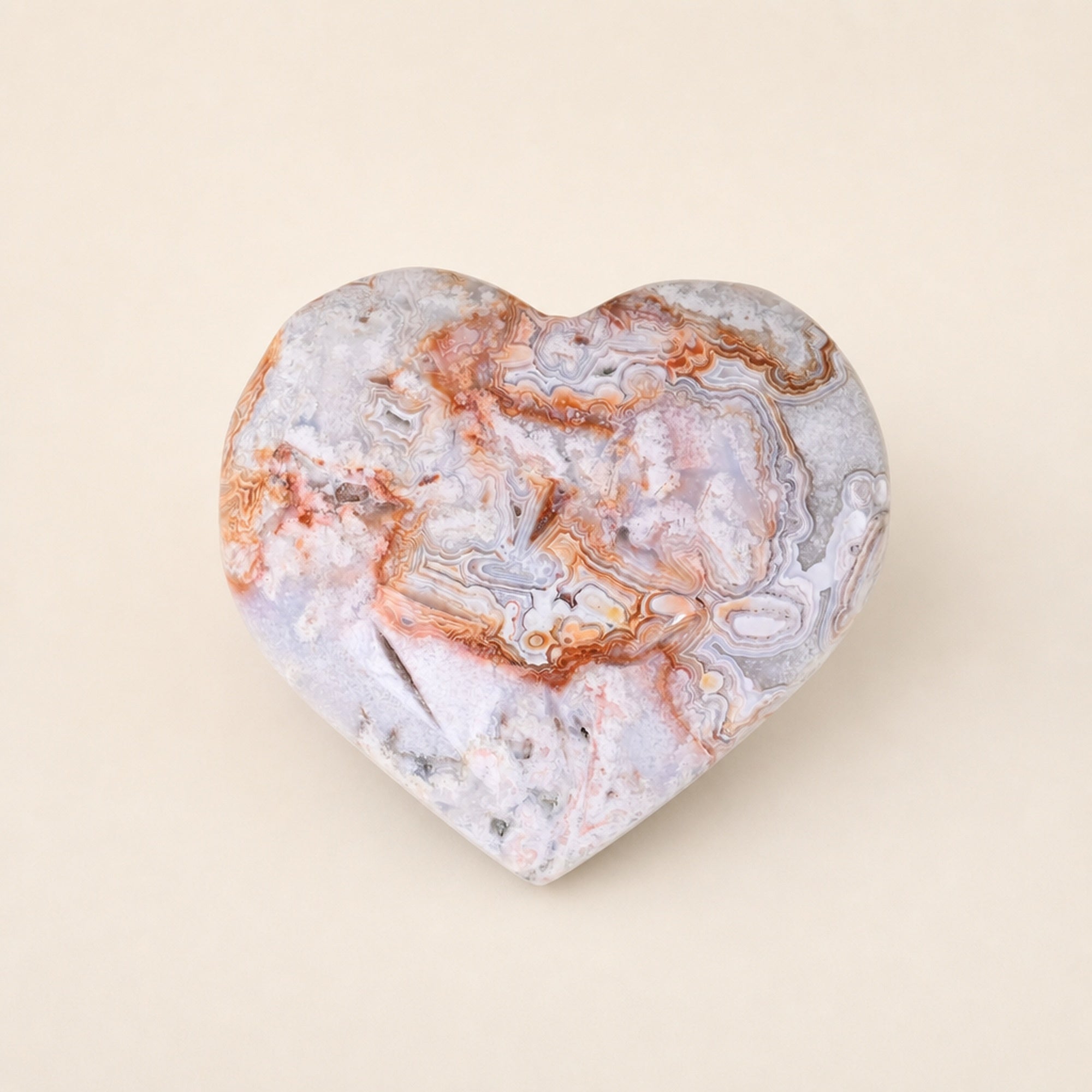
A related stone-family option
Crazy Lace Agate Heart Stone – Joyful Movement
This is a related variety in the same stone family, not a Agate product. We only identify jewelry as Agate when that exact material is verified.
Explore this related optionCleansing, Charging, and Care
Ritual cleansing is a personal practice, not a scientific requirement, but caring for the physical stone is straightforward and practical. A simple routine that respects both:
- Wipe, don't soak, dyed pieces. Use a soft, slightly damp cloth. Prolonged soaking can stress dye and any stabilizing treatment in chemically treated stones.
- Use brief cool water for natural pieces. Natural agate tolerates a quick rinse and air-dry. Avoid sudden temperature changes and prolonged water exposure.
- Cleanse symbolically, not harshly. Many people prefer moonlight, a quiet rest overnight, or simply a dry cloth wipe. These are intention-based practices, not measurable effects.
- Store separately. Keep agate away from harder minerals and jewelry to avoid scratches. A soft pouch prevents abrasion.
- Keep chemistry out. Avoid bleach, acetone, and jewelry cleaners on dyed material. Warm water and a mild soap-free wipe are enough.
A useful rule: the more processed the stone, the more cautious the care. Natural blue lace agate is forgiving; a brightly dyed specimen is not.
How to Choose Authentic Blue Agate (Buying Checklist)
The core question for buyers is not aesthetic — it is whether the color is natural. Work through this checklist at the point of sale:
- Read the banding. Natural blue lace agate shows fine, parallel white-blue banding with tonal variation. Uniform color with little structure suggests dye.
- Check the color depth. Pale, delicate blue is typical of natural material; saturated cobalt or royal blue is generally treated.
- Ask about treatment — in writing. Request explicit disclosure of dye, resin-filling, and irradiation. A confident seller will state it clearly.
- Look at the transaction, not the marketing. "Natural color" claims should match the price of genuine blue lace agate, which is rarer and often quieter in appearance than dyed pieces.
- Hold vendors to a standard. Use the Lumina Grade AAA Integrity Standard as a benchmark: natural rough, zero chemical resin-filling, no irradiation or dye. It is a simple way to compare any offer against clear integrity criteria.
- Inspect for fragility. Hairline cracks, chips on band edges, and dye pooling in fractures are practical signs of lower material quality.
The honest comparison, once more: natural blue lace agate is scarcer, quieter in color, and often smaller; dyed blue agate is brighter, more abundant, and more likely to fade. Neither is wrong to own — but the meaning you attach to "natural" only holds if the material is natural.
Decision Table: Which Blue Agate Is Right for You?
Use this table to decide which material fits your purpose before you spend money on it.
| Buyer Goal | Best Fit | What to Verify | Trade-Off |
|---|---|---|---|
| Natural origin matters most | Pale blue lace agate with fine white banding | Written treatment disclosure; visible parallel banding; tonal variation | Smaller pieces; softer color; higher price per size |
| Bright color for visual impact | Dyed blue agate | Clear dye disclosure; avoid evidence of dye pooling in fractures | Possible fade; avoid soaking and prolonged sun |
| Daily wear jewelry | Either, if care is realistic | Mohs 6.5–7 durability; setting protects edges | Cleaners and hard stones can scratch or degrade it |
| Ritual or meditation anchor | Any blue agate, chosen for feel | Comfort in the hand; reliable banding | Physical properties are stable; symbolism is personal |
| Integrity-first shopping | Natural, untreated material | Lumina Grade AAA Integrity Standard criteria | May need to wait for genuine blue lace agate stock |
FAQ: Blue Agate Meaning, Color, and Care
What does blue agate stone mean spiritually?
Blue agate is often associated with calm, honest communication, and quiet grounding — water-like symbolism in modern crystal practice. These are cultural and personal associations, not verified healing effects.
Is blue agate a natural stone or is it dyed?
Both exist: naturally blue agate is a pale blue banded chalcedony, but naturally blue material is uncommon, so many saturated blue pieces are dyed. Look for fine white banding and pale tonal variation as cues of natural color, and ask sellers for written treatment disclosure.
How do you cleanse and care for blue agate?
Wipe with a soft, slightly damp cloth and store it separately to avoid scratches; avoid bleaching agents and prolonged soaking, especially for dyed pieces. Agate is durable at Mohs 6.5–7 but can be scratched by harder stones.
Closing Thought
The meaning of blue agate is not only in the color others sell you — it is in the intention you bring to the stone. A pale, honestly labeled blue lace agate with visible banding will carry your calm-and-truth practice just as well as the brightest dyed specimen, and often more honestly. Choose with the banding, ask about treatment, and let the stone's quiet patterning do its symbolic work.
Sources
- Mindat — Blue Lace Agate: Mineral information, data and localities
- Smithsonian National Museum of Natural History — Quartz (var. agate)
Disclaimer: This article discusses cultural and personal symbolism alongside mineral properties. It is not medical advice and does not claim therapeutic outcomes. © 2026 Lumina Quartz.