Crystal Bracelets for Anxiety and Panic Attacks: A Complete Guide to Amethyst, Rose Quartz, and More
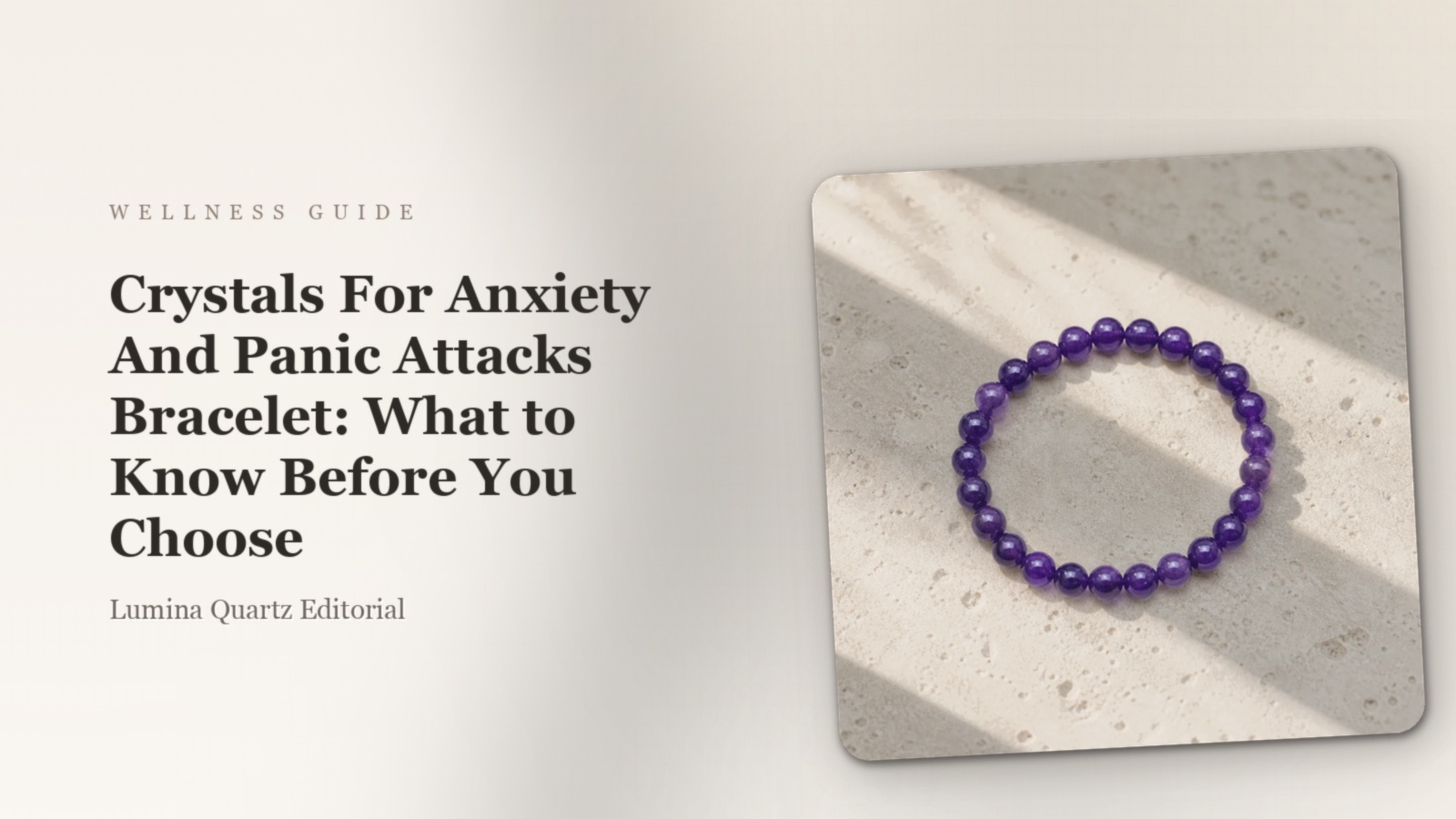
Table of Contents
- Introduction: Understanding Crystals for Anxiety
- Key Takeaways
- What Crystal Bracelets Are (and What They Are Not)
- The Role of Touch and Intention
- Expectation, Ritual, and Honest Limits
- Crystals People Commonly Choose
- Amethyst: The Calming Stone
- Rose Quartz: The Stone of Self-Kindness
- Lepidolite: The Emotional Soother
- Hematite: The Grounding Stone
- Smoky Quartz: The Stress Absorber
- Other Helpful Crystals: Rhodonite, Sodalite, Moss Agate
- Matching the Stone to the Moment
- How to Choose the Right Bracelet for Your Needs
- How to Wear and Care for Your Crystal Bracelet
- Important Considerations Before You Buy
- Frequently Asked Questions
- Related Reading
- Sources
Introduction: Understanding Crystals for Anxiety
There are moments when the breath catches, the chest tightens, and the mind begins to race ahead into places we do not want to go. Anxiety and panic attacks can feel like a storm that arrives without warning, leaving us searching for anything solid to hold onto. In those moments, we often reach for what is near—a warm cup of tea, a familiar song, the hand of a loved one. For many, a crystal bracelet for anxiety and panic attacks has become another quiet anchor, something to notice and to hold.
Crystals have been used for centuries across cultures as tokens of comfort, focus, and spiritual grounding. A bracelet, worn close to the pulse, keeps that quiet presence with you throughout the day. But before you choose one, it helps to understand what these stones are—and what they are not. This guide offers a gentle, honest look at how people actually use crystal bracelets, which stones are often chosen, how to shop for a genuine piece, and where the honest limits of a bracelet sit.
Key Takeaways
- A crystal bracelet is not a medical treatment and is not a substitute for care from a doctor or licensed therapist. Many people use one as a tactile cue and a personal ritual.
- Amethyst, rose quartz, lepidolite, hematite, and smoky quartz are among the stones most often chosen for calm, balance, and grounding associations.
- What people describe as helpful is usually the touch, the routine, and the reminder—not a measurable effect on the body.
- Quality and authenticity matter. Real stones vary from bead to bead; perfectly uniform beads at a very low price deserve a second look.
- Rose quartz, amethyst, and smoky quartz are light-sensitive. Mineralogical records note that rose quartz can bleach quickly under prolonged UV exposure, so storing these pieces away from direct sun helps preserve their colour.
- Cleansing and charging are rituals rather than maintenance for a measurable property. Many people find the routine itself a calming habit.
- If anxiety or panic attacks are affecting your sleep, work, or relationships, that is a reason to talk with a qualified professional—not a reason to buy a different stone.
What Crystal Bracelets Are (and What They Are Not)
Crystals are minerals formed deep within the earth over long spans of time. Some traditions hold that each stone carries its own energy or vibration, and that wearing or holding one can feel supportive. That is a belief and a cultural practice, not a measured physical property. There is no evidence that a stone changes brain chemistry, stops a panic attack, or treats a mental health condition.
What is much easier to describe is the experience. A bracelet keeps a smooth, cool object against your skin. It has weight, texture, and temperature. When your attention is stretched thin, noticing something specific and physical gives your mind a small place to land. If you subscribe to the metaphysical view, that layer is yours to enjoy. If you do not, the bracelet can still work as a reminder—a piece of jewellery that means "pause" to you and nobody else.
The Role of Touch and Intention
Think about how natural it is to reach for something when you feel overwhelmed—a stress ball, a blanket, a cup of tea. Touch is one of our earliest and most familiar ways of settling ourselves. A crystal bracelet offers that same kind of familiarity. Running your fingers over the beads gives you something concrete to focus on while a wave of feeling passes.
Intention adds another layer. When you choose a bracelet knowingly—when you hold it and say to yourself, "I choose calm" or "I am grounded"—you are making a small promise and attaching it to an object you will see all day. Every time you catch a glimpse of the stone on your wrist, the promise repeats itself. This is not magic; it is a reminder you designed for yourself.
Expectation, Ritual, and Honest Limits
Expectation shapes experience. When people approach a ritual with curiosity and hope, they often report feeling steadier afterwards—and the reverse is also true. That is worth knowing, but it is not the same as a stone treating a condition, and it is not a reason to delay care that actually works.
It also helps to be precise about what a bracelet can and cannot do. A bracelet can give you a cue to slow down and breathe. It can mark the start of a routine. It can be pleasant to look at. A bracelet cannot diagnose anything, cannot replace therapy or medication, and cannot be relied on during a genuine crisis. Keeping those two lists separate is what lets you enjoy the first list without overstating the second.
Crystals People Commonly Choose
There are many crystals that people associate with calm and steadiness. Responses are personal, and no stone suits everyone. The following are the stones most often reached for, along with what makes each one pleasant to wear.
Amethyst: The Calming Stone
Amethyst is the stone most commonly associated with a settled mind, and its violet colour has been linked to tranquillity in various traditions for centuries. In practice, people tend to choose it as an evening companion—a visual cue that the day is winding down. If your anxious moments cluster around bedtime, an amethyst bracelet is often the first one people try, simply because it is easy to notice and pleasant to hold.
Rose Quartz: The Stone of Self-Kindness
Anxiety often comes with a harsh inner voice—the sense that you should be coping better than you are. Rose quartz, with its soft pink glow, is traditionally associated with compassion, warmth, and self-acceptance, which makes it a comforting choice for anyone whose worry turns quickly into self-criticism. It is also one of the oldest stones in human history: rose quartz beads dating back to 7000 BC have been found in the region once known as Mesopotamia, and quartz crystals were valued by the ancient Egyptians as talismans. If your anxiety is tangled up with perfectionism or a tendency to be hard on yourself, rose quartz can serve as a small daily reminder to speak to yourself the way you would speak to a friend. Our Rose Quartz Bracelet – Self-Kindness was designed with exactly that intention in mind.
Lepidolite: The Emotional Soother
Lepidolite is a lesser-known but much-loved stone, typically found in shades of soft purple, pink, and grey. It is a lithium-bearing mica, and you will sometimes see its lithium content presented as though it were meaningful for health. It is not. A stone is not a supplement, a dose, or a treatment, and an element locked inside a mineral has no bearing on how you feel. What lepidolite does offer is a distinctive look and a soft, muted presence that many people describe as soothing to keep nearby during difficult seasons—an association, not an effect.
Hematite: The Grounding Stone
Hematite is a metallic, mirror-smooth stone with a weighty feel that many people find instantly steadying to hold. If your anxiety shows up as a sense of being unmoored—lightheaded, floaty, disconnected—hematite's density can be reassuring in a purely sensory way. It is traditionally associated with courage, stability, and rootedness. Many wearers keep a hematite bracelet on the wrist they notice most, so that a hand brushing against it during the day becomes a quiet reminder to plant both feet on the floor and breathe.
Smoky Quartz: The Stress Absorber
Smoky quartz ranges from pale translucent grey to deep, almost opaque brown. In crystal traditions it is described as a stone of gentle release—associated with letting go of tension, worry, and the low hum of a long day. Unlike the bright clarity of amethyst, smoky quartz carries a quieter, earthier character that tends to appeal to people who feel overstimulated or emotionally depleted. For those whose difficult moments peak in busy, crowded, or loud places, smoky quartz is a common everyday choice.
Other Helpful Crystals: Rhodonite, Sodalite, Moss Agate
Beyond the better-known stones, a few others are frequently chosen. Rhodonite, with its black-veined pink surface, is traditionally associated with emotional healing and forgiveness—often picked up by people working through old hurts. Sodalite, a deep blue stone flecked with white, is linked in crystal lore to clear thinking and calm expression, which appeals to those whose worry arrives as mental spirals and long, overthinking nights. Moss agate, green and patterned like a forest floor, is associated with nature, patience, and steady growth, and it tends to appeal to people who feel most settled outdoors. In every case, the stone is a reminder you chose—not a remedy.
Matching the Stone to the Moment
Crystal choices are personal, so it helps to start from the shape of your experience rather than from the stone itself. The table below pairs common situations with the stones people most often choose for them, why they choose them, and where the honest boundary sits.
| What you notice | Stones people often choose | What the bracelet is actually doing | Honest boundary |
|---|---|---|---|
| Racing, repetitive thoughts, especially at night | Amethyst, sodalite | Acting as a visible cue that the day is winding down | It will not treat insomnia; persistent sleep problems deserve professional advice |
| A harsh, self-critical inner voice | Rose quartz | Standing in as a reminder to speak to yourself kindly | It is not a substitute for therapy or counselling |
| Feeling scattered in crowded, loud places | Smoky quartz, hematite | Giving you one small, familiar thing to notice | It will not stop a panic attack from starting or ending |
| Feeling unmoored, floaty, or disconnected | Hematite | Offering a weighted, cool sensation against the skin | It is jewellery, not a grounding device or medical aid |
| Long stretches of flat emotional fatigue | Lepidolite, moss agate | Being a slow, unhurried object you associate with patience | It is not a mood treatment, supplement, or source of any mineral dose |
| Worry tied to old hurts | Rhodonite | Marking a personal intention around forgiveness | It is not trauma therapy; trained support is for that |
| Stone | Typical look | Hand feel | Care note | Choose it if |
|---|---|---|---|---|
| Amethyst | Translucent violet to deep purple | Cool, moderate weight, smooth | Light-sensitive; keep out of prolonged direct sun | You want an evening or wind-down cue |
| Rose quartz | Pale pink, often cloudy or milky | Smooth, slightly waxy, gentle | Most light-sensitive of this group; mineralogical records show it can bleach quickly under UV, so store it in a pouch or drawer | Your worry turns into self-criticism |
| Lepidolite | Lilac, pink, and grey, often micaceous | Lighter, slightly flaky, matte | Keep dry; avoid soaking and harsh cleaners | You prefer a muted, understated look |
| Hematite | Metallic grey with a mirror polish | Noticeably heavy and cold | Can chip on hard surfaces; wipe dry after wear | You want weight and presence on the wrist |
| Smoky quartz | Pale grey to deep brown, translucent | Cool, smooth, similar weight to amethyst | Light-sensitive, but bleaches more slowly than rose quartz | You want one everyday bracelet with an earthy tone |
| Sodalite / rhodonite / moss agate | Blue with white flecks / pink with black veins / green with patterns | Varies; moss agate often the lightest | Wipe with a soft dry cloth; avoid prolonged soaking | You want a colour or motif that means something to you |
A five-step checklist before you buy
- Name the moment, not the condition. Write down when you would actually reach for the bracelet—"Sunday nights," "the commute," "before sleep." If you cannot name a moment, the bracelet is decoration, which is fine, but be honest about it.
- Check the hand feel. Natural stone beads feel cool on first touch and heavier than plastic or resin of the same size. Hold the bracelet for thirty seconds and notice whether you like the weight.
- Look for natural variation. Genuine stones differ slightly in colour, inclusions, and pattern from bead to bead. Perfectly identical beads at a very low price are worth questioning.
- Ask the seller three questions. What is the stone? Has it been dyed, heat-treated, or is it glass or synthetic? What is the cord or clasp made of, and how is it finished? A clear, specific answer is a good sign; a vague one is not.
- Set your expectation before you wear it. Decide in advance that this is a cue and a ritual, not care. That single sentence prevents most disappointment later.
Applicable boundaries: when a bracelet fits, and when it does not
- A reasonable extra: you already have routines that help—sleep, movement, breathing, time outside, people you trust—and you want a small, visible reminder of them.
- A reasonable gift or keepsake: you want an object with personal meaning, chosen for colour, feel, or memory.
- Not the right tool alone: if panic attacks are frequent, or if anxiety is affecting your sleep, work, studies, or relationships.
- Not the right tool at all: if you are using it to delay or replace care you have been advised to seek. Please speak with a doctor or licensed therapist, and contact local emergency services if you ever feel unsafe.
- Safety and care: remove the bracelet for swimming, showering, and heavy chores; keep beads away from small children, who may swallow them; stop wearing any piece that irritates your skin.
How to Choose the Right Bracelet for Your Needs
Consider Your Specific Experience
Anxiety is not one thing. Some people notice it as physical tension—tight shoulders, a clenched jaw, a pounding heart. Others notice mental static: looping thoughts, dread, and difficulty concentrating. Still others feel it most in social settings or at night. Notice which pattern sounds most like yours, then choose a stone you associate with that moment. If you are uncertain, hold two or three bracelets and pay attention to which one you keep returning to. That instinct is often more useful than a description on a label.
Combining Crystals
Many people wear more than one stone, either as a single bracelet with mixed beads or as a pair. Simple combinations tend to work best—amethyst with rose quartz for a calmer evening and a kinder inner voice, for example, or hematite with smoky quartz when you want both weight and an earthy tone. There is no rule that says you must stop at one, but keeping the number small makes each stone easier to notice.
Quality and Authenticity of Stones
A bracelet should feel like something you want to keep for years. Look for beads that are well drilled, evenly strung, and finished with a strong elastic or a secure clasp. Real stones have a subtle depth to them—light moves through them rather than bouncing off the surface. Where possible, buy from sellers who can tell you where their stones come from and who are straightforward about treatments and synthetics. You are not just buying a bead; you are buying something you will look at every day.
How to Wear and Care for Your Crystal Bracelet
Best Practices for Wearing
There is no strictly correct wrist. Some people wear a weightier stone on the hand they use most, so the bracelet catches their attention throughout the day, while others prefer the other wrist for softer stones. What matters more is consistency—wearing it regularly enough that its presence becomes part of your routine. Remove it before heavy chores, swimming, or showering if you want to protect the finish and the elastic.
Cleansing and Charging Your Crystals
Cleansing is a ritual as much as a practice, and the simplest methods are often the best. Resting your bracelet in moonlight overnight is gentle and safe for almost every stone. Sound—a singing bowl, a chime, or simply humming—is another favourite. Selenite and dry herbal bundles are popular for dry cleansing.
One practical caution: skip the water if you can. Prolonged soaking can dull a polish and weaken an elastic cord, and soft stones such as lepidolite are better kept dry. Charging is simply the counterpart: after cleansing, hold the bracelet and set your intention for it again, the same way you would renew a small daily promise.
Important Considerations Before You Buy
Crystals as a Complement, Not a Treatment
A crystal bracelet is a comforting object and a personal cue. It is not a treatment for anxiety disorders, panic disorder, or any other medical condition, and it should never be used in place of care from a qualified professional. If panic attacks are affecting your sleep, your work, or your relationships, please speak with a doctor or a licensed therapist. Many people enjoy crystals alongside therapy, breathing practices, movement, or other routines—as one small thread in a larger support system, not as the whole cloth.
Where to Buy Crystal Bracelets
Buy from a source that is transparent. A good seller names the stone accurately, describes any treatment or dyeing, shows real photographs of the actual beads rather than stock imagery, and answers questions without hesitation. Prices should be plausible for what is being sold: natural gemstone beads take time to source, cut, and string. Above all, choose a bracelet you genuinely like looking at. You will wear it far more often if it feels like yours.
Frequently Asked Questions
Do crystal bracelets really work for anxiety and panic attacks?
They are not a medical treatment and there is no evidence they change how the body or brain works. What many people do find useful is the everyday mechanics: a bracelet gives you something tangible to notice, and noticing something specific can be a small pause in a difficult moment. That is a real comfort, but it works alongside professional care rather than instead of it.
Which crystal is best for panic attacks?
There is no single best stone, and no stone treats panic. People who prefer a weighty, steadying feel often reach for hematite or smoky quartz, while others simply pick amethyst or rose quartz because they like how it looks—and liking what you wear is a perfectly good reason. If you are unsure, hold a few and choose the one you instinctively want to keep on your wrist.
Can I wear my crystal bracelet in the shower or while swimming?
It is generally best not to. Soap, salt, and chlorine can dull a stone's polish over time, and repeated soaking weakens elastic cords. Soft, micaceous stones such as lepidolite are especially worth keeping dry. If you want to wear something constantly, a piece with a metal clasp and chain may suit you better than an elastic strand.
How often should I cleanse and charge my crystal bracelet?
There is no fixed schedule, because cleansing is a ritual rather than maintenance for a measurable property. Many people do it once a month, after a particularly emotional day, or whenever the bracelet starts to feel "heavy" to them. Charging—holding the stone and restating your intention—can be done as often as you like, and it takes only a minute.
Can crystals replace therapy or medication?
No. Crystal bracelets are a complementary practice, not a substitute for medical or psychological care. If anxiety or panic attacks are affecting your daily life, please talk with a doctor or licensed therapist. A bracelet can sit comfortably alongside whatever care you are receiving; it cannot stand in for it.
How can I tell if a crystal bracelet is genuine?
Look for weight, coldness to the touch, and natural variation between beads. Genuine stones are rarely perfectly uniform. Ask the seller directly about origin, dyeing, and treatments—a transparent answer is usually a good sign, while vague claims and unusually low prices are worth pausing over.
Will the colour of my bracelet change over time?
It can. Rose quartz in particular is documented as very light- and heat-sensitive, and a sample can bleach noticeably under prolonged UV exposure—faster than smoky quartz or amethyst. Keeping light-sensitive pieces in a pouch or drawer rather than on a sunny windowsill is the simplest way to preserve their colour.
Related Reading
- Rose Quartz Crystal: A Gentle Guide to Meaning, Benefits, and Uses
- Crystal Meanings Encyclopedia: Complete Guide to Amethyst, Rose Quartz, Citrine & More