Emerald Stone Healing: Meaning, Healing Properties, and Daily Benefits

Table of Contents
- Emerald Stone Meaning and History: From Ancient Symbol to Modern Heart Stone
- Emerald Healing Properties: 10 Traditional Claims and What They Really Mean
- Emotional and Heart-Centered Benefits
- Physical and Traditional Wellness Claims
- What Science Says About Emerald Healing (And How to Use It Responsibly)
- How to Use Emerald Daily: Heart Chakra Meditation, Journaling, and Intention Setting
- Choosing Your Emerald: Color, Clarity, Treatments, and Jewelry Styles for Everyday Wear
- Emerald Buying Checklist: Step-by-Step Verification
- Cleansing and Caring for Emerald: Safe Methods That Protect Fillers and Fractures
- Emerald by Zodiac, Birthstone, and Gift Occasions
- FAQ: Emerald Stone Healing Questions Answered
- What are the healing properties of emerald stone?
- Is emerald stone scientifically proven to heal?
- How do I cleanse and care for an emerald stone?
- Sources
Emerald Stone Meaning and History: From Ancient Symbol to Modern Heart Stone
The emerald is a green variety of the mineral beryl, and its name traces back to smaragdos, the ancient Greek word for a green gem. Roman author Pliny the Elder, writing in his Natural History before his death in 79 CE, praised it with the line "nothing greens greener" and described how gem cutters would rest their eyes on the stone's soft green color to ease weariness. That ancient association between emerald and the eyes—and by extension, comfort and rest—is often cited as one of the earliest recorded "healing" ideas about the gem, as noted by the Gemological Institute of America (GIA). Over centuries, this green stone moved from a symbol of renewal in antiquity to a modern "heart stone" in crystal-lore traditions, where it is frequently associated with the heart chakra and themes of compassion, honesty, and emotional steadiness.
Core Diagnostic Verdict: The emerald is a green variety of the mineral beryl, and its name traces back to smaragdos , the ancient Greek word for a green gem.
- Core Intention: Emerald Stone Healing
- Authenticity Standard: Grade AAA Genuine Natural // Verified Untreated
- Lumina Standard: Grade AAA Natural Gemstones // Verified Untreated
Emerald Healing Properties: 10 Traditional Claims and What They Really Mean
What are the healing properties of emerald stone? In crystal traditions, emerald is most often associated with the heart, love, truth, and renewal. Below are ten commonly repeated claims, translated into what they actually describe—cultural symbolism and personal intention, not medical outcomes.
- Heart-centered calm: often associated with feelings of gentleness and emotional balance in meditation.
- Honesty and clear communication: traditionally linked to speaking truthfully and setting boundaries.
- Compassion: used as a reminder to practice kindness toward self and others.
- Renewal and hope: its green color is culturally tied to spring, growth, and fresh starts.
- Grounded confidence: may support a sense of steadiness when held during intention-setting.
- Gratitude practice: often used as a focus object in journaling rituals.
- Friendship and loyalty: a traditional gift stone for close relationships.
- Eye comfort lore: the historical "resting the eyes" idea described by Pliny, now understood as the general calming effect of the color green.
- Patience: used metaphorically because emerald is softer and more fragile than diamond.
- Mindful presence: a tactile anchor for breathwork and quiet reflection.
Emotional and Heart-Centered Benefits
In heart-chakra traditions, emerald is placed or visualized near the center of the chest. These practices are best understood as may support emotional reflection—offering a quiet focal point for journaling, gratitude, or intention-setting. They are not a substitute for professional emotional or mental health care.
Physical and Traditional Wellness Claims
Some crystal lore links emerald to physical wellness. These claims are traditional and symbolic and are not supported by gemological or medical science. The GIA notes that the modern understanding of Pliny's eye-comfort story is simply that the color green can feel restful—an effect of color perception, not of the mineral itself.
What Science Says About Emerald Healing (And How to Use It Responsibly)
How to Use Emerald Daily: Heart Chakra Meditation, Journaling, and Intention Setting
If you want a practical routine, keep it simple and repeatable:
- Morning check-in (2 minutes): hold your emerald at the center of your chest, take five slow breaths, and name one feeling you want to carry into the day.
- Journaling prompt: write one sentence about where you want more honesty or compassion, then place the stone on the page as a marker.
- Intention setting: choose a single word—patience, truth, renewal—and repeat it once while holding the stone.
- Evening reset: set the emerald on your nightstand and note one moment of gratitude.
Because emerald is relatively soft and often fracture-filled, avoid wearing it during rough activity and store it separately from harder gems.
Choosing Your Emerald: Color, Clarity, Treatments, and Jewelry Styles for Everyday Wear
Color and clarity drive emerald value. Vivid, slightly bluish green is generally prized, and visible inclusions are common—so clarity expectations should be realistic. Treatments are widespread, so ask directly whether a stone is dyed or fracture-filled. As a personal buying preference, I look for natural rough, no chemical resin filling, and no irradiation or dye enhancement—so I know exactly what I am wearing.
For everyday wear, a pendant or stud earring protects the stone better than a ring, which takes more knocks. Bezel settings shield edges and reduce the chance of chipping.
Emerald Buying Checklist: Step-by-Step Verification
Use this table to compare what a seller claims with what you should actually verify before buying. The right-hand column shows the boundary of what can be confirmed for a given emerald.
| Step | What to Ask or Check | Verification Boundary |
|---|---|---|
| 1. Confirm the species | Is it natural beryl emerald, or a green simulant such as green quartz or glass? | Only a gemological test confirms species; a verbal claim alone is not proof. |
| 2. Ask about treatment | Request written disclosure of dyeing and fracture filling (oil, wax, or resin). | Treatment disclosure is standard practice per GIA; undisclosed treatments cannot be ruled out by eye. |
| 3. Check hardness expectations | Emerald is 7.5–8 on the Mohs scale; it scratches more easily than diamond. | Plan settings and daily wear around a softer, more fragile stone. |
| 4. Inspect for surface-reaching fractures | These are the routes fillers use and the weak points that need protection. | Visible fractures raise care needs; they do not by themselves indicate a fake. |
| 5. Verify the seller's stated standard | Ask what the seller means by "natural rough, no chemical filling, no irradiation or dyeing" and whether it is documented. | Treat seller standards as claims to be documented, not independent certification. |
| 6. Match the jewelry to your lifestyle | Bezel-set pendants and studs suit daily wear better than prong-set rings. | This is a durability recommendation, not a quality grade. |
Applicability boundary: This checklist helps you ask better questions and care for a softer gem. It does not replace a professional gemological report, and it cannot confirm origin or value.
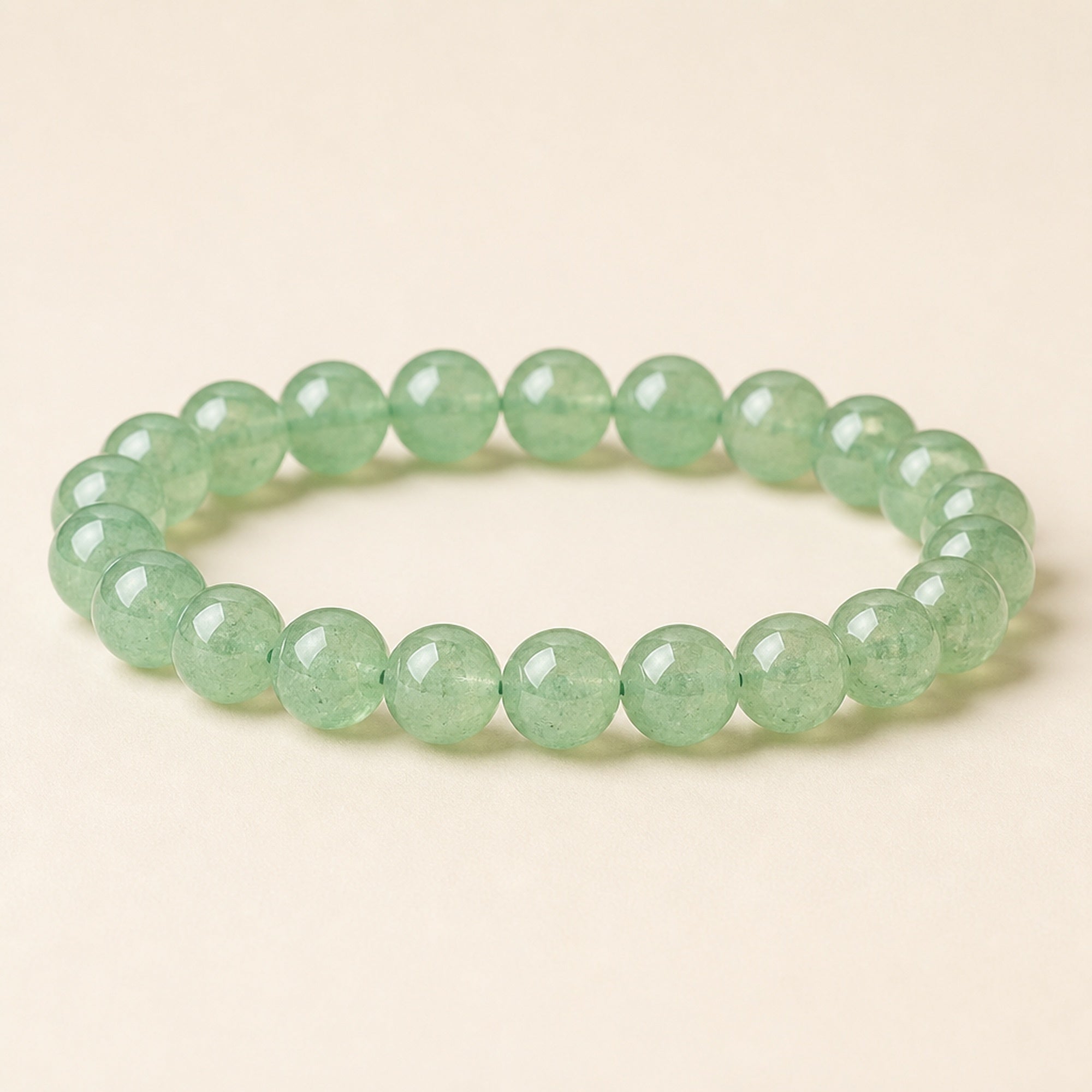
A related color-family option
Green Strawberry Quartz Bracelet – Gentle Renewal
This broader color-family option is not presented as Emerald. We only identify jewelry as Emerald when that exact material is verified.
Explore this related optionCleansing and Caring for Emerald: Safe Methods That Protect Fillers and Fractures
How do I cleanse and care for an emerald stone? Use gentle methods only. Wipe with a soft, slightly damp cloth and dry immediately. Avoid ultrasonic cleaners, steam cleaners, and harsh chemicals, because fillers and fractures can be affected. Store your emerald in its own soft pouch away from harder stones. For energetic cleansing traditions, moonlight, sound (a bell or singing bowl), or a brief smudge are commonly used and are safe for the stone—just skip salt water and prolonged soaking.
Emerald by Zodiac, Birthstone, and Gift Occasions
Emerald is the traditional May birthstone, making it a natural gift for May birthdays and spring anniversaries. In zodiac lore, it is often associated with Taurus and Cancer, though these associations are cultural and vary by tradition. For gifting, a small bezel-set pendant is a versatile choice that suits many styles and offers protection for a softer gem.
FAQ: Emerald Stone Healing Questions Answered
What are the healing properties of emerald stone?
Traditionally, emerald is associated with heart-centered themes such as compassion, honesty, renewal, and calm. These are cultural and symbolic associations used as mindfulness reminders, not medically proven effects.
Is emerald stone scientifically proven to heal?
No. There is no scientific evidence that emerald treats or cures any condition. Its documented properties are gemological—beryl with a Mohs hardness of 7.5 to 8—and its color is simply often perceived as restful.
How do I cleanse and care for an emerald stone?
Wipe it with a soft damp cloth, dry it promptly, and avoid ultrasonic or steam cleaners and harsh chemicals, which may affect fillers and fractures. Store it separately from harder gems.
Sources
Disclaimer: This article is for informational and cultural interest only. It is not medical advice. © 2026 Lumina Quartz.
Crystal traditions are presented here as symbolic, cultural, and personal ritual practices. They are not medical tools; consult a qualified professional for health concerns.