Kambaba Jasper Meaning: A Grounding Guide for Meditation and Crystal Rituals

Table of Contents
- Introduction to Kambaba Jasper
- Geological Truth: Rhyolite, Not Jasper
- Where Does Kambaba Jasper Come From?
- Kambaba Jasper Meaning and Metaphysical Properties
- What Is Kambaba Jasper Good For?
- How to Use Kambaba Jasper in Daily Life
- How to Cleanse and Care for Kambaba Jasper
- Kambaba Jasper vs. Crocodile Jasper: Are They the Same?
- How to Spot Misleading Claims and Choose With Confidence
- Where to Buy Authentic Kambaba Jasper
- Key Takeaways
- Frequently Asked Questions
There are stones that speak softly and stones that hold your gaze. Kambaba Jasper — cradled in clouds of forest green and ink-black — is the kind of stone that feels like it remembers the beginning of time. Its ornate, spiraling patterns appear almost painted, yet they arise from naturally occurring mineral flows, a quiet reminder that the Earth is the original artist. Though its market name suggests a well-known variety of quartz, geological reality tells a more complex story. In this guide, we explore the true identity of Kambaba Jasper, its origins, and how to invite its quiet presence into your life.
Introduction to Kambaba Jasper
Kambaba Jasper is one of the most visually distinctive stones in the modern crystal collector's repertoire. Its swirling orbs of deep green, forest moss, pale celadon, and charcoal black have made it a favorite among those drawn to organic patterns and earthy palettes. Often described as a “stone of preservation,” Kambaba Jasper is frequently used as a companion in meditation, worn as a talisman, or kept close in pockets and homes as a source of grounding comfort.
Yet beyond its appearance and market popularity, Kambaba Jasper carries a layered story that stretches through geology, culture, and personal ritual. Whether you are new to crystals or have been sitting with them for years, understanding Kambaba Jasper on a deeper level may enrich your relationship with this quiet, ancient-looking stone. It is not a loud stone. It does not demand attention. Instead, it invites you to slow down and listen — resembling a riverbed fossilized into a pattern of patience.
Geological Truth: Rhyolite, Not Jasper
Let us begin with a gentle softening of a long-held assumption. Despite its common name, Kambaba Jasper is not technically a jasper in the strict geological sense. Geologists classify Kambaba Jasper as a type of rhyolite — a fine-grained volcanic rock formed from felsic lava that cooled relatively quickly. The orbs and swirls that inspire so many collectors are not the result of sedimentary deposition or quartz chalcedony replacement (as with true jaspers); instead, they arise from the crystallization of various minerals, including quartz and feldspar, within the rhyolitic matrix.
The term “jasper” has become a catch-all in the gemstone trade, used to describe any opaque, colorful stone that takes a good polish. Kambaba Jasper falls under this umbrella for practical, commercial purposes, and its pattern does resemble the organic, earthy qualities we love in true jasper. However, purists may prefer the alternative name “Kambaba Stone” or “Kambaba Rhyolite.” Some enthusiasts refer to it as “green stromatolite jasper,” though the fossil interpretation of its orbicular forms is still debated. There may be sedimentary samples containing fossilized microbial structures, but other specimens are clearly igneous volcanic flow. This duality is part of the stone’s quiet mystery — imprecise to science, yet undeniably meaningful to those who work with its energy.
It is worth pausing on the trade-name question, because the same material has surfaced under more than one commercial label over the years. Collectors comparing “Kambaba Jasper” and “Nebula Stone” have occasionally noticed a striking resemblance, and mineralogical discussion on databases such as Mindat has noted that the two trade names can refer to geologically and mineralogically similar material. For buyers, the practical takeaway is simple: a name on a tag tells you how a stone is marketed, not necessarily what it is. When in doubt, ask about origin and mineral composition rather than relying on a single familiar word.
Where Does Kambaba Jasper Come From?
The most widely recognized sources of Kambaba Jasper are the island of Madagascar, South Africa, and parts of Indonesia. Madagascar, in particular, has become known for producing some of the most striking pieces, with vivid green patterns that seem to glow softly from within. South African deposits are also important, and because the stone is mined in several localities, slight variations of color, density, and pattern can be expected.
Kambaba Jasper often surfaces in the form of large boulders or seams of rock that weather out of volcanic formations. Artisans cut these rough blocks into cabochons, spheres, palm stones, pendants, and raw free-form pieces. The supply is not infinite, and some mining zones may experience periods of reduced output. If you have been drawn to Kambaba Jasper for a while, you may have noticed that pieces with darker, more saturated greens and highly defined orbs tend to be more sought after. This is not simply a matter of aesthetics — the richness of the stone often correlates with the concentration of the minerals that produce its characteristic hue, and many long-time collectors prefer those variations for their depth and complexity.
Kambaba Jasper Meaning and Metaphysical Properties
In the domain of crystal meaning, Kambaba Jasper is often associated with grounding, patience, and the release of negative thought patterns. Its connection to the earthy green and shadowy black swirls evokes the imagery of deep forests and fertile soil, reminding us of the cycles of growth, decay, and renewal. It is often considered a stone of the Root and Sacral chakras, subtly anchoring scattered energy while gently encouraging emotional flow.
Those who work with crystals for emotional balance say that Kambaba Jasper may support the calming of a restless mind and may assist in steadying emotions during times of upheaval. It is often described as a stone that “holds space” — the sort of companion you keep nearby when you need to regulate yourself before a difficult conversation, or when you simply want to feel more present within your body. This energetic signature is often associated with resilience: not the loud, forceful push of a strong stone, but the steady, unwavering endurance of a tree that has weathered a hundred seasons.
From a wellness perspective, Kambaba Jasper is often associated with the idea of preserving your vital energy — protecting your internal resources from being depleted by external stress. Some crystal healers partner it with deep breathing exercises or journaling practices to help release tension that has been stored in the body. As always, we offer these perspectives without medical promises; Kambaba Jasper is not a substitute for professional care, but it may be a meaningful companion on your personal wellness journey.
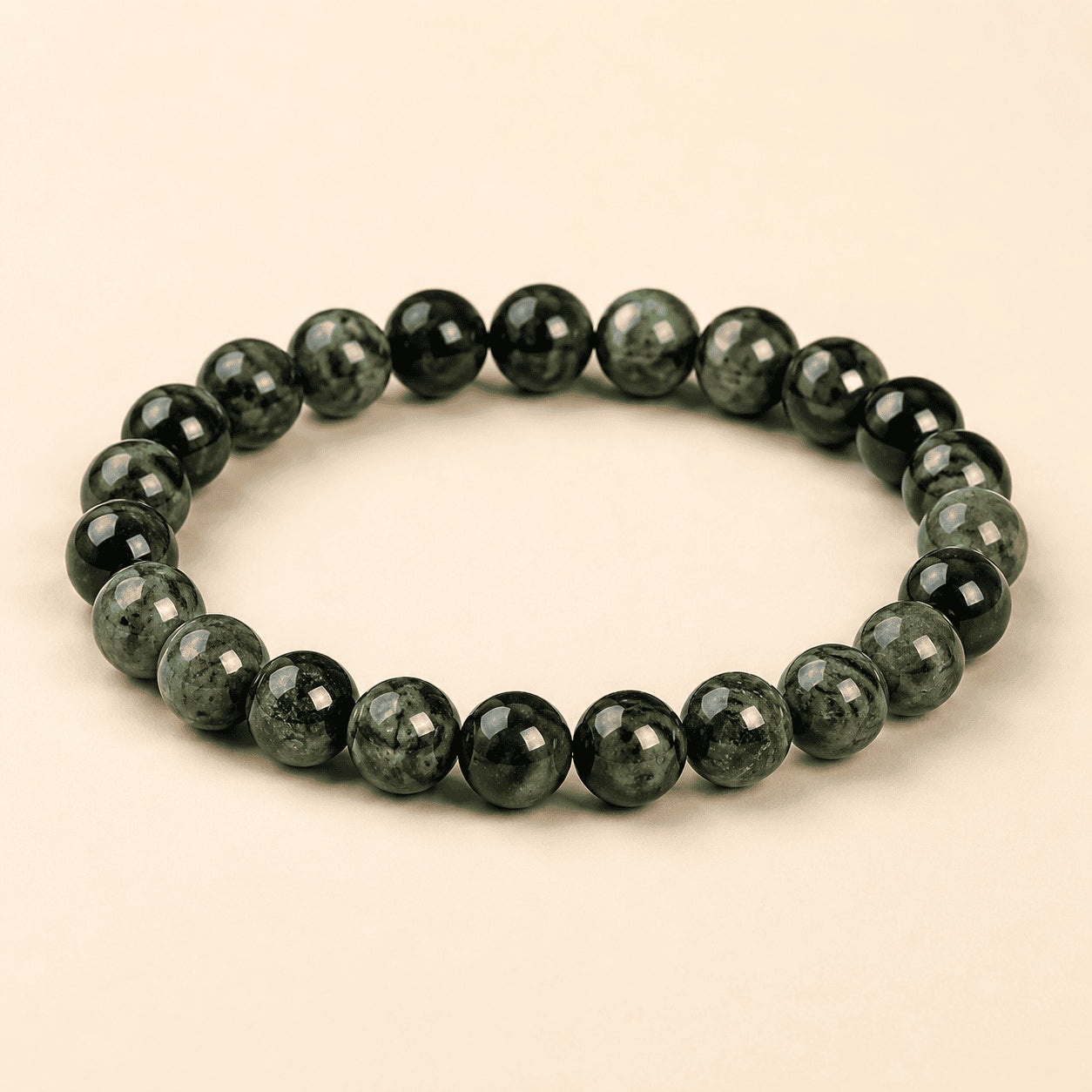
Kambaba Jasper Bracelet
A gentle ritual piece for bringing this intention into your daily routine.
Shop This Authentic Piece →What Is Kambaba Jasper Good For?
If you have ever wondered what Kambaba Jasper is actually good for in everyday practice, the honest answer is that it tends to excel at the quiet, unglamorous work: settling the body, slowing the mind, and helping you stay steady while other things in life move quickly. It is not typically chosen for bursts of motivation or high-energy manifestation. It is chosen for the moments in between.
Grounding During Overwhelm
Because it is so strongly tied to the Root chakra, Kambaba Jasper is often reached for when life feels scattered. Holding it during a few minutes of slow breathing is a simple way to anchor attention in the body rather than in the noise of the day.
Meditation and Stillness
Its orbicular, almost entrancing patterns make it a natural focal point for gaze-based meditation. Resting the eyes on a single swirl and letting the mind settle there is an accessible entry point for anyone who finds traditional silent meditation difficult.
Emotional Patience and Resilience
In crystal lore, this stone is associated with patience — particularly patience with yourself. Those working through grief, transition, or long seasons of slow progress sometimes keep it nearby as a reminder that endurance is its own kind of strength.
Protective, Preserving Energy
It is frequently described as protective in a soft sense: not blocking everything out, but helping you conserve your energy rather than spend it on things that drain you. Many people keep a piece on a desk or bedside table for exactly this reason.
Sleep and Evening Wind-Down
Because it is calming rather than stimulating, Kambaba Jasper is sometimes placed on a nightstand or held briefly before bed as part of a wind-down routine. As with any crystal practice, results are personal and not guaranteed.
How to Use Kambaba Jasper in Daily Life
There is no single correct way to work with this stone. What matters most is consistency and intention.
- Morning ritual: Hold your stone for a minute before checking your phone, setting a simple intention for steadiness.
- Pocket companion: Carry a tumbled piece through the day and touch it when you notice tension building.
- Desk anchor: Keep a palm stone beside your workspace as a visual cue to pause and breathe.
- Meditation focus: Rest it in your open palm or on the ground in front of you during seated practice.
- Journaling: Place it on your notebook while you write, especially when reflecting on patterns you want to release.
- Sleep support: Set it on a nightstand or under a pillow if you find its presence soothing.
How to Cleanse and Care for Kambaba Jasper
Kambaba Jasper is a durable stone, but it still appreciates gentle handling. To cleanse it:
- Smoke: Pass it through palo santo, cedar, or incense smoke.
- Sound: Use a singing bowl or chime near the stone.
- Moonlight: Leave it on a windowsill overnight under the moon.
- Earth: Bury it in a bowl of dry salt or soil for a few hours, then brush clean.
Because it is a volcanic rock rather than a porous sedimentary stone, brief contact with water is generally fine, but prolonged soaking is not recommended. Wipe it with a soft, slightly damp cloth to remove dust. Avoid harsh chemicals, ultrasonic cleaners, and long exposure to direct sun, which can dull the surface over time. Recharge your stone whenever it feels “heavy” to you — there is no fixed schedule, only your own sense of when it needs a reset.
Kambaba Jasper vs. Crocodile Jasper: Are They the Same?
This question comes up often, and the short answer is: not exactly, though the names are sometimes used interchangeably in casual trade.
- Kambaba Jasper is known for its rounded, orbicular eyes and swirling green-black patterns, with a softer, more painterly look.
- Crocodile Jasper (also called Crocodile Rock) tends to show angular, cracked, or reptilian textures, often with brighter green and sharper contrast.
- Both share a similar origin story as volcanic material, and both are marketed under the loose “jasper” umbrella.
- Some sellers use the terms loosely, so it pays to judge the stone by its appearance rather than the label alone.
If you love one, you may well love the other. But they are not interchangeable names for a single, identical material, and a careful buyer will notice the difference immediately once they see them side by side.
How to Spot Misleading Claims and Choose With Confidence
Because Kambaba Jasper sits at the intersection of geology, trade naming, and crystal lore, it attracts more than its share of loose claims. This quick guide can help you sort signal from noise.
- “It is a true jasper.” — Not geologically accurate. It is generally classified as rhyolite, a volcanic rock. The name is a trade convention.
- “It is a stromatolite fossil.” — Still debated. Some material may show fossil-like structures, but many specimens are clearly igneous volcanic flow.
- “Kambaba Jasper and Nebula Stone are completely different stones.” — Mineralogical discussion has noted these trade names can refer to geologically and mineralogically similar material.
- “This stone will cure or treat a condition.” — No stone replaces professional care. Treat energetic descriptions as personal practice, not medical advice.
- “One origin story is the only correct one.” — Material comes from several regions, including Madagascar, South Africa, and Indonesia. Single-origin claims deserve scrutiny.
When evaluating any claim — geological or energetic — ask whether it is being offered as a scientific fact, a trade convention, or a personal interpretation. Each has its place, but conflating them is where confusion begins.
Where to Buy Authentic Kambaba Jasper
Because the material is mined in several localities and sold under multiple names, the best protection is a seller who is transparent about what they are offering. Look for:
- Clear, well-lit photographs that show the actual stone you will receive, not a stock image.
- Honest descriptions that acknowledge the rhyolite classification or the trade-name context.
- Details on origin where known, and a willingness to answer questions about composition.
- A straightforward return policy, which gives you room to inspect the piece in person.
Price is not a reliable indicator of authenticity here. Kambaba Jasper is reasonably abundant, so unusually high prices are more often about pattern quality and size than rarity. A dark, well-defined, evenly patterned piece may command more simply because it is visually striking.
Key Takeaways
- Kambaba Jasper is a trade name for a green-and-black orbicular stone generally classified as rhyolite, not a true jasper.
- It is most commonly sourced from Madagascar, with additional material from South Africa and Indonesia.
- It is associated in crystal lore with grounding, patience, resilience, and preserving personal energy.
- It is especially well suited to meditation, evening wind-down, and steadying moments of overwhelm.
- Clean it gently with smoke, sound, moonlight, or dry salt, and avoid harsh chemicals and long sun exposure.
- Trade names like Kambaba Jasper and Nebula Stone can overlap, so buy from sellers who describe their material honestly.
Frequently Asked Questions
What is Kambaba Jasper?
Kambaba Jasper is a green-and-black orbicular stone sold widely in the crystal trade. Despite the name, it is generally classified by geologists as a type of rhyolite — a fine-grained volcanic rock — rather than a true jasper. Its distinctive swirling “eyes” come from mineral crystallization within the volcanic matrix.
Where does Kambaba Jasper come from?
The best-known sources are Madagascar, South Africa, and parts of Indonesia. Madagascar is particularly associated with vivid, well-defined patterns. Because it is mined in several regions, color and density can vary noticeably from piece to piece.
What are Kambaba Jasper healing properties?
In crystal lore it is associated with grounding, patience, resilience, and the preservation of personal energy. Many people use it during meditation or as a calming pocket stone. These are traditional energetic associations, not medical claims, and it is not a substitute for professional care.
What is Kambaba Jasper good for?
It is most often chosen for grounding during overwhelm, as a focal point in meditation, for emotional patience during slow or difficult seasons, and as a soft protective presence at a desk or bedside. It is a calming stone rather than a stimulating one.
How do I cleanse Kambaba Jasper?
Smoke, sound, moonlight, or a brief rest in dry salt or soil are all gentle options. Because it is a durable volcanic stone, a quick wipe with a damp cloth is fine, but avoid prolonged soaking, harsh chemicals, and ultrasonic cleaners.
Is Kambaba Jasper a stromatolite?
The fossil interpretation is debated. Some material may contain fossilized microbial structures, but many specimens are clearly igneous volcanic flow. Treat “stromatolite” claims as one interpretation rather than a settled fact.
Is Kambaba Jasper the same as Crocodile Jasper?
No. Kambaba Jasper shows rounded, orbicular eyes, while Crocodile Jasper typically has angular, cracked, reptilian textures. Both are marketed under the loose “jasper” umbrella, and some sellers use the names loosely.
Sources
Continue Exploring
- Red Jasper: A Gentle Guide to Meaning, Benefits, and Uses
- Black Tourmaline: Meaning, Properties, and Everyday Uses
- Kyanite Crystal Meaning: A Guide to Benefits, Uses, and Chakra Alignment
- Rose Quartz Crystal: A Gentle Guide to Meaning, Benefits, and Uses
- Fluorite Meaning: Meaning, Properties, and Everyday Uses
- Sunstone Meaning: Meaning, Properties, and Everyday Uses