Kunzite Crystal Meaning: How to Use It for Emotional Calm and Heart Healing
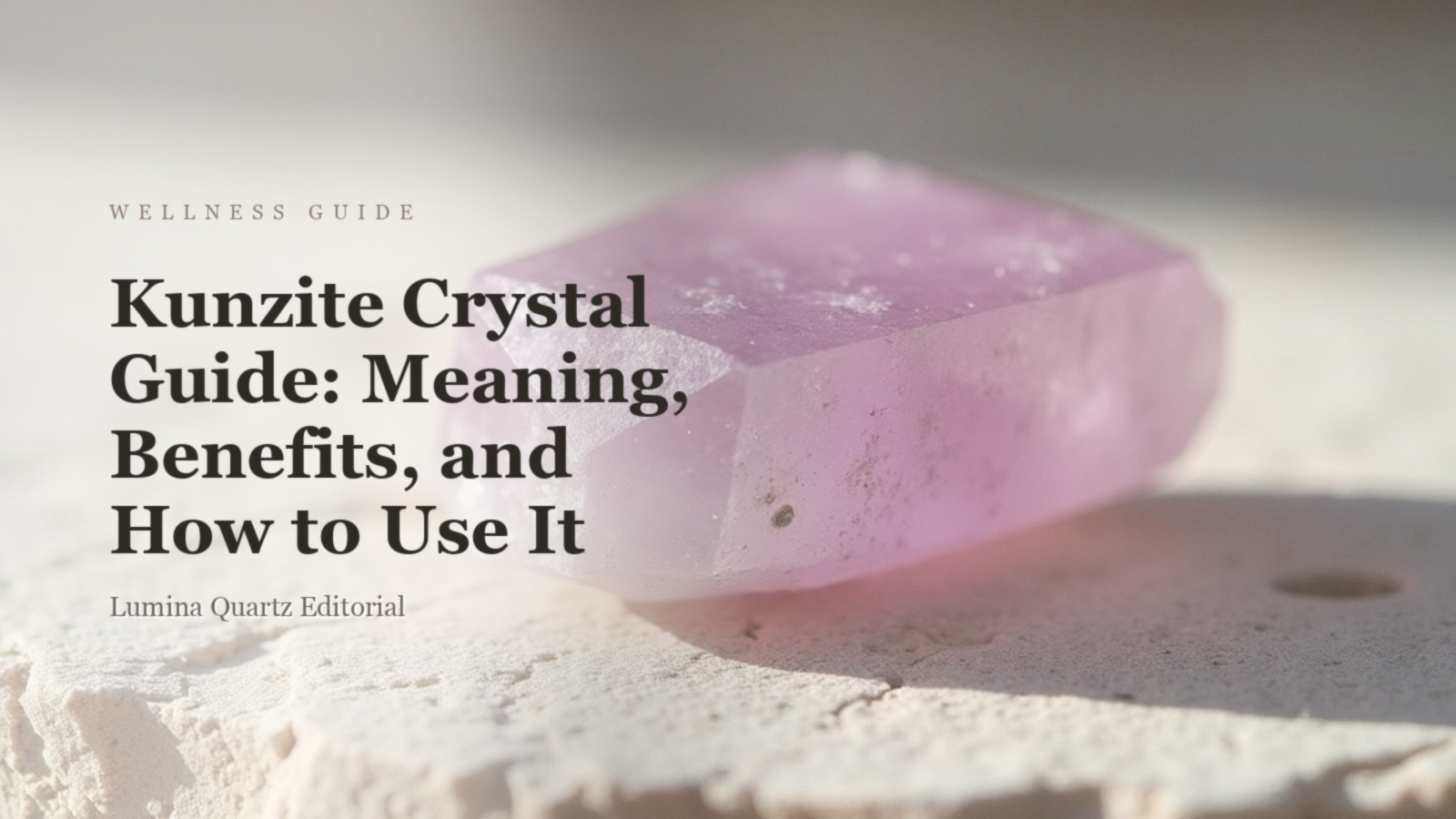
Table of Contents
- What is Kunzite?
- The History of Kunzite
- Kunzite Crystal Meaning and Symbolism
- Kunzite and the Heart Chakra
- Kunzite in Love and Relationships
- Kunzite Healing Properties
- How to Use Kunzite
- How to Care for Your Kunzite Crystal
- Choosing the Right Kunzite
- Conclusion
- Key Takeaways
- Frequently Asked Questions
- Sources
There are crystals that seem to announce themselves the moment they are unearthed—bright, bold, impossible to overlook. And then there are those that hold their light quietly, as if waiting for a gentle eye to notice them. Kunzite is decidedly the latter. With its soft blush of pink and violet, it does not demand attention; it simply invites it. And once you begin to work with kunzite, you may find that it invites something even more intimate: a deeper conversation with your own heart.
Whether you are new to the world of crystals or a longtime collector, kunzite has a way of slowing time down. Its color is a whisper, not a shout, and that whisper often carries exactly what we need to hear—that we can rest, that we can soften, that we can trust the process of becoming. In this guide, we explore its origins, its symbolism, and the gentle ways it is traditionally used to support emotional and spiritual wellbeing. As you read, please remember that no crystal replaces professional medical care. Kunzite is not a cure, but it can serve as a quiet companion on your journey—honest, calm, and deeply present.
What is Kunzite?
Kunzite is a pink to violet variety of spodumene, a lithium aluminum silicate mineral that forms in lithium-rich pegmatite deposits deep within the Earth's crust. Its signature blush comes from trace amounts of manganese, and due to its pleochroic nature, it can appear differently depending on the angle of the light. In some directions it seems almost translucent, while in others it blooms like an early morning sky. This subtle playfulness is one of the reasons so many are drawn to it.
The stone was formally identified in 1902 in the Pala District of San Diego County, California, though today it is also found in Brazil, Afghanistan, Madagascar, Myanmar, and Pakistan. Because it forms slowly, over long geological time scales, kunzite is a stone of patience by its very nature. Its crystalline structure is relatively soft—measuring 6.5 to 7 on the Mohs scale—and it has perfect cleavage in two directions, which means it can be more delicate than harder stones like quartz. This fragility is not a weakness; it is a quiet reminder that tenderness has its own quiet strength.
The History of Kunzite
Kunzite was first described by the American gemologist George Frederick Kunz, a man as fascinated by the stories behind stones as he was by their chemistry. When he encountered a vivid pink crystal in a Southern California mine in 1902, he recognized it as something uncommon. The stone was later named in his honor, making it one of the few gemstones to be christened after a single individual. That personal connection has given kunzite an almost biographical warmth—every time we hold a piece, we are holding a fragment of a story that began more than a century ago.
During the early decades of the twentieth century, kunzite rose in popularity among jewelry designers, particularly those drawn to the romantic spirit of the Art Deco era. Its soft color and silky luster made it a favorite for statement necklaces and cocktail rings. Later, as the modern crystal healing movement gained momentum, kunzite found a second life in meditation circles, reiki practices, and personal altars. Its history thus spans ballrooms and meditation mats, blending glamour with groundedness—a duality that makes it endlessly compelling.
Kunzite Crystal Meaning and Symbolism
When people ask about the kunzite crystal meaning, the answer usually circles back to one word: openness. At its core, kunzite is associated with unconditional love, emotional transparency, and the courage to be soft in a world that often rewards hardness. It is a stone that many turn to when navigating grief, anxiety, or the lonely quiet after a heartbreak. The pale, rosy hue is no accident; color is a crystal's first language, and kunzite speaks in gentle syllables. In crystal traditions, it is said to encourage authenticity, nudging us to set down the masks we wear for others and to rest in our own skin.
In the language of crystal symbolism, kunzite meaning also carries a theme of emotional release. Where some stones are associated with action and momentum, kunzite is associated with stillness—the kind that allows buried feelings to surface safely. This may be why kunzite is so frequently used in heart-centered practices. It carries no agenda, no urgency—only an invitation to come home to yourself. When you sit with kunzite, you might notice a subtle softening in the chest, as though something long held has finally been given permission to exhale.
Kunzite and the Heart Chakra
In crystal healing traditions, kunzite is primarily aligned with the heart chakra, the energetic center located at the center of the chest. This is the space where love, compassion, and vulnerability reside. When the heart chakra feels guarded or closed, we may struggle to connect with others—and even with ourselves. Working with kunzite may help to gently open this space, allowing feelings to move without resistance and without judgment. Many describe the stone's presence as cooling and calming, making it a soothing companion for anyone who carries heat in the form of frustration or emotional exhaustion.
Kunzite in Love and Relationships
Perhaps because it speaks so directly to the heart, kunzite is caringly linked to romantic love and interpersonal harmony. It is often used after a breakup, as a way to process the tender debris of a relationship, and it is also welcomed by couples who want to deepen their communication. Kunzite may support honest self-expression and active listening—not by forcing change, but by clearing the inner static so that love can speak for itself. For those who have built high walls after past hurts, kunzite may offer a sense of safety that makes lowering those walls feel possible, even natural.
Kunzite Healing Properties
As with any crystal, it is important to approach kunzite with both an open heart and a grounded mind. It is not a miracle cure, and its effects are often described as subtle shifts rather than sudden, dramatic transformations. Kunzite is not a substitute for medical treatment, professional therapy, or prescribed medication. The properties described below are traditionally associated with kunzite and may complement your existing physical, emotional, or spiritual routines.
Emotionally, kunzite is most often reached for during periods of transition—after a loss, at the end of a relationship, or whenever the heart feels raw and overexposed. In crystal lore, it is said to soften self-criticism, to create space for grief without overwhelm, and to remind us that healing is rarely linear. In meditation, kunzite is traditionally used to quiet mental chatter and to foster a sense of compassionate self-awareness. Many find that simply holding it during a few slow breaths is enough to shift the tone of a difficult day.
As with all healing stones, these effects are not guaranteed and should always be complemented by appropriate professional care.
What Kunzite Is Often Said to Support—and What It Cannot Do
Crystal traditions assign many gentle qualities to kunzite. The table below separates what is traditionally associated with the stone from what should never be expected of it, so you can work with it honestly.
| Traditionally Associated with Kunzite | Outside the Scope of Any Crystal |
|---|---|
| A calming ritual focus during meditation or slow breathing | Treating, curing, or preventing any medical or mental health condition |
| A visual reminder to pause, soften, and check in with your feelings | Replacing therapy, medication, or advice from a qualified professional |
| A heart-centered symbol used in grief, transition, and relationship reflection | Guaranteed emotional, neurological, or physical effects of any kind |
| A mindful anchor for journaling, intention-setting, or gratitude practice | Diagnosing or altering brain chemistry, mood disorders, or anxiety |
Treat kunzite as a supportive ritual object, not a treatment. If you are struggling with your emotional or physical health, please reach out to a qualified professional.
How to Use Kunzite
There is no single right way to work with kunzite. The stone tends to meet you where you are, so the most useful approach is often the simplest one. Wearing kunzite as jewelry keeps it close to the body throughout the day, which many people find helpful during emotionally demanding periods. A pendant resting near the heart or a bracelet on the wrist can serve as a quiet reminder to breathe, to soften, and to return to yourself.
For meditation, try holding a kunzite piece in your non-dominant hand while resting your dominant hand over your heart. Let your breath slow naturally, and if emotions surface, allow them to move without forcing them away. Placing kunzite in a bedroom or on a bedside table is another gentle option—many people enjoy it as part of a wind-down ritual before sleep. You can also keep a small tumbled piece on your desk or in a pocket, using it as a tactile cue to pause and check in with how you are feeling.
If you are drawn to kunzite's soft pink energy, keep an eye on our collection of crystals and gemstones for pieces that speak to you.
How to Care for Your Kunzite Crystal
Kunzite requires a little more gentleness than many other stones. According to the Gemological Institute of America, kunzite has perfect cleavage in two directions, so a hard blow may split it, and extreme pressure or sharp temperature changes can cause it to break. With that in mind, a few simple habits will keep your piece beautiful for years:
- Store kunzite separately from harder stones to avoid scratches and knocks.
- Avoid ultrasonic cleaners and steam cleaners; gentle hand cleaning is safest.
- Keep it away from prolonged direct sun, as its color can fade over time.
- Remove kunzite jewelry before exercise, gardening, or other activity where it might be struck.
- Avoid sudden temperature swings, such as moving it from a hot car to a cold room.
For energetic cleansing, many people prefer gentle methods such as moonlight, sound, or placing the stone on a piece of selenite—avoiding water and salt, which are not ideal for a stone with perfect cleavage.
Choosing the Right Kunzite
Kunzite ranges from pale lilac to a saturated pink-violet, and personal preference matters more than any rule. When choosing a piece, look for clarity, a color that pleases your eye, and a shape that feels comfortable to hold. Tumbled stones are wonderful for pockets and meditation, while raw specimens suit altars and display. If you are buying jewelry, check the setting for protective coverage—kunzite's cleavage makes it a stone that benefits from a little extra care in how it is worn. Above all, choose the piece you keep reaching for; that quiet pull is often the best guide.
Conclusion
Kunzite does not shout. It glows. Its soft pink light and long geological patience make it a fitting companion for the tender work of emotional openness—grief, transition, self-compassion, and the slow rebuilding of trust. Whether you wear it, hold it, or simply keep it nearby, kunzite invites you to soften without losing your strength. Treat it as a ritual ally, care for it gently, and let it remind you that tenderness is not fragility. It is a way of moving through the world with your heart intact.
Key Takeaways
- Kunzite is a pink-violet variety of spodumene, first identified in California in 1902 and named after gemologist George Frederick Kunz.
- In crystal traditions, kunzite symbolizes openness, unconditional love, and emotional release, and is aligned with the heart chakra.
- Its properties are traditionally associated qualities, not proven medical effects; kunzite is not a substitute for professional care.
- Kunzite is relatively soft (6.5–7 on the Mohs scale) with perfect cleavage, so it needs gentle handling and careful storage.
- Wear it, meditate with it, or keep it on your bedside table as a quiet ritual anchor.
Frequently Asked Questions
What does kunzite crystal mean?
In crystal symbolism, kunzite is associated with openness, unconditional love, and emotional honesty. Many people use it as a heart-centered ritual stone during grief, transition, or relationship reflection. These are traditional associations rather than medically proven effects.
Which chakra is kunzite connected to?
Kunzite is primarily associated with the heart chakra, the energetic center at the center of the chest. In crystal healing traditions, it is used to encourage a sense of openness and compassion.
Can kunzite go in water?
It is best to avoid soaking kunzite. Because it has perfect cleavage, water exposure and temperature changes are not ideal for the stone. Clean it gently by hand and dry it softly.
How do I cleanse kunzite?
Gentle methods such as moonlight, sound, or resting the stone on selenite are often recommended. Avoid salt and water, which can be harsh on a stone with perfect cleavage.
Is kunzite safe to wear every day?
Many people wear kunzite daily as a pendant or bracelet. Because it is relatively soft and can split under a hard blow, remove it before activities that might strike or scratch it, and store it separately from harder stones.
Does kunzite really calm emotions?
There is no scientific evidence that kunzite changes mood or brain chemistry. What many people describe is a calming ritual effect—holding the stone during slow breathing or meditation can be a soothing practice, but it does not replace professional care.
Sources
- Gemological Institute of America — Kunzite Care and Cleaning
- Mindat — Kunzite: Mineral information, data and localities