Larimar Crystal Guide: Meaning, Benefits, and How to Use It
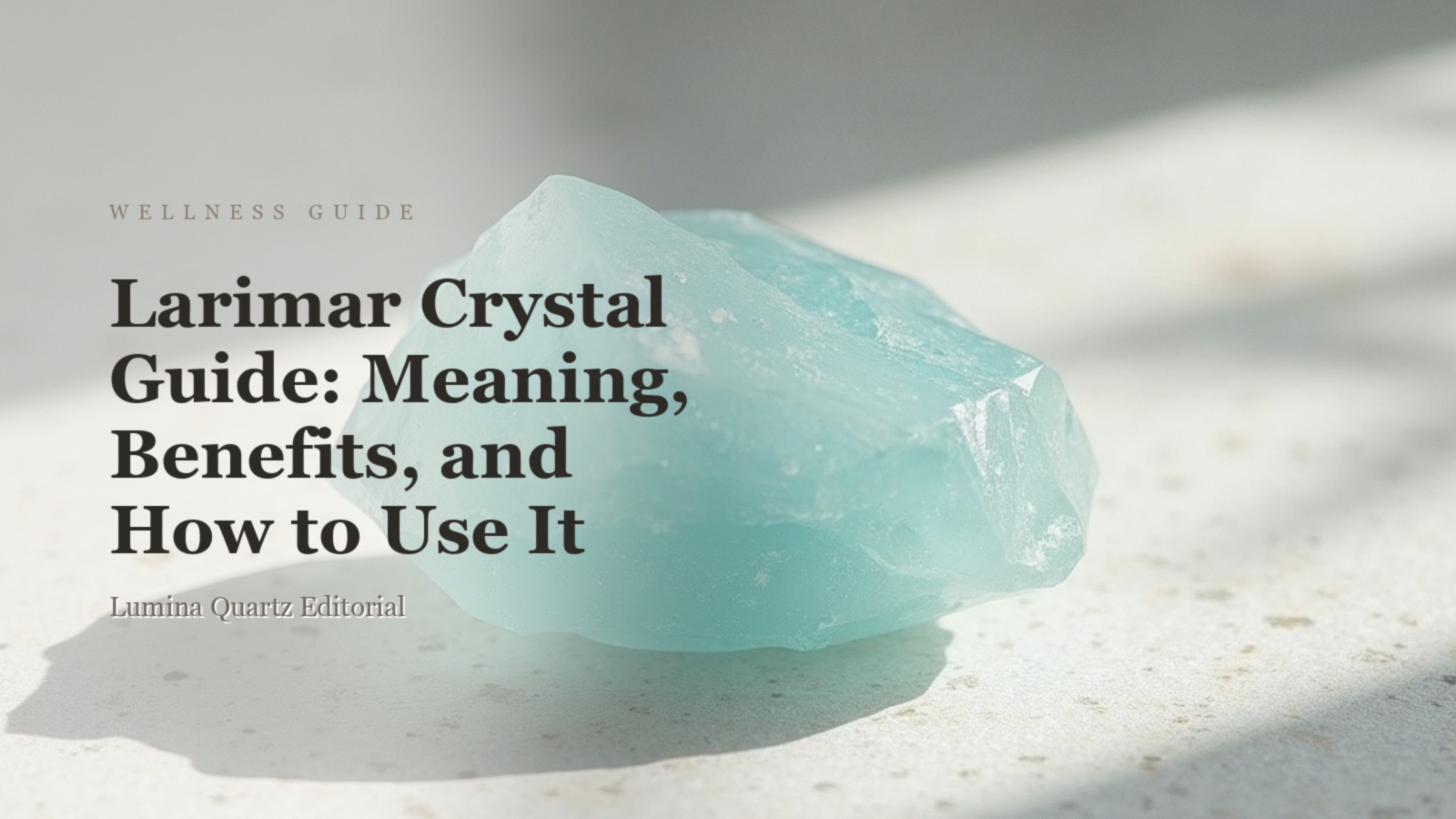
Table of Contents
- Larimar Crystal Guide: An Introduction
- Key Takeaways
- What Is Larimar Stone?
- The Origin and Rediscovery of Larimar in the Dominican Republic
- Larimar’s Unique Color Patterns and Mineral Composition
- Why Larimar Is One of the Rarest Gemstones
- Larimar Meaning and Symbolism
- Larimar as the “Stone of the Sea” — Atlantis Stone and Dolphin Stone
- Emotional and Spiritual Meaning: Peace, Clarity, and Communication
- Larimar Stone Benefits
- Physical Benefits of Larimar
- Metaphysical Benefits: Connecting With the Throat and Heart Chakras
- How to Use Larimar Crystal
- Wearing Larimar Jewelry: Pendants, Rings, and Bracelets
- Meditating With Larimar
- Placing Larimar in Your Home or Workspace
- How to Cleanse and Charge Larimar
- Complementing Larimar With Other Crystals
- How to Identify Genuine Larimar and Avoid Fakes
- Where to Buy Authentic Larimar Jewelry
- Frequently Asked Questions About Larimar
- Final Thoughts
Larimar Crystal Guide: An Introduction
There are stones that feel less like objects and more like memory. Larimar crystal is one of them. In its polished face, you can see the exact color of a Caribbean afternoon—pale aqua, deep midnight blue, and creamy foam stirred together as if the ocean itself decided to rest for a moment. People often note that the stone looks like water, yet it feels solid, cool, and quietly grounding in the palm.
This guide is an invitation to slow down and meet larimar on its own terms. We will explore its origins in the Dominican Republic, the meanings that have gathered around it, the benefits it is most often associated with, and simple ways you can invite its calm, clarifying presence into your daily life. You will not find exaggerated promises here, only honest, caring information. A crystal is a companion, not a cure.
Key Takeaways
- Larimar is a rare, blue form of pectolite found almost exclusively in one mountainous area of the Dominican Republic.
- Its sea-like appearance has earned it names such as the Stone of the Sea, the Atlantis Stone, and the Dolphin Stone.
- Larimar is often associated with emotional peace, clarity, and honest, kind communication.
- Holding or wearing larimar may support a slower, more mindful rhythm during meditation, breathwork, or difficult conversations.
- Because larimar comes from a single known source, authentic, undyed larimar is considered genuinely rare.
- Simple care—avoiding salt, heat, and long hours of direct sunlight—will keep your larimar beautiful for many seasons.
What Is Larimar Stone?
In plain mineralogical terms, larimar is a blue variety of pectolite, a sodium calcium silicate that forms in volcanic rock. Mineral databases and gem laboratories alike describe it as a trade name for a bluish massive pectolite, and it is one of the few gem materials in the world that can be traced back to a single known region. Yet the official description says little about why the stone moves people so deeply. When light passes through a larimar cabochon, it seems to carry a small piece of the sky inside it, and that luminous quality is why so many cultures and crystal lovers have welcomed it into their daily rituals.
The Origin and Rediscovery of Larimar in the Dominican Republic
Larimar’s story is intertwined with the island of Hispaniola. A Spanish priest named Father Miguel Domingo Fuertes Loren is said to have discovered the stone in 1916, but his request to mine it never gained enough traction, and the deposit was quietly forgotten. Then in 1974, a Peace Corps volunteer named Norman Rilling and a Dominican artisan named Miguel Méndez found blue stones washing ashore on the beaches of the Barahona province. Intrigued, they followed the trail inland and eventually reached the steep, lush slopes near the village of Los Chupaderos, where the source was finally uncovered.
Méndez named the stone “Larimar,” combining the name of his daughter, Larissa, with the Spanish word for sea, mar—a loving tribute that captures both the stone’s coastal birthplace and its oceanic color. Today, larimar is recognized as the national stone of the Dominican Republic, and the original mine remains one of the few places in the world where it can be found.
Larimar’s Unique Color Patterns and Mineral Composition
Larimar is a silicate mineral, but its signature blue glow comes from trace amounts of copper that substitute into its crystalline structure. The stone can range from nearly white to deep, almost navy blues, with gentle swirls, irregular cloud bands, and small radial patterns that remind people of sunlight filtering through waves. Because no two deposits form in the same way, every larimar piece is essentially a tiny, unrepeatable landscape.
In its raw form, larimar often looks pale and unremarkable. It is only after cutting and polishing that the blue emerges, which is why high-quality larimar is sometimes compared to a secret the earth has been keeping. On the Mohs scale, it sits at about 4.5 to 5, making it softer than quartz, but that softness also gives lapidary artists a chance to carve it into smooth hearts, freeform pendants, and beads with a gentle, watery luminosity.
Why Larimar Is One of the Rarest Gemstones
Several factors make larimar rare: its limited geography, the difficulty of mining the steep terrain where it is found, and the sheer unpredictability of the deposits. Although pectolite itself can appear in other places around the globe, the blue, copper-bearing variety that we call larimar has only been found in meaningful quantities in the Dominican Republic. Mining often depends on weather and seasonal access, and even then, much of the material is too pale or too fractured to become jewelry. When you hold a piece of genuine larimar, you are holding the result of a very particular meeting between volcanic heat, mineral-rich water, and time.
Larimar Meaning and Symbolism
Larimar’s meaning is deeply tied to its origin story. For many people, the stone represents the threshold between land and sea—a place of mystery, nourishment, and quiet transformation. It is not a loud stone. Its symbolism tends to be gentle: patience, fluidity, and the courage to speak from the heart.
Larimar as the “Stone of the Sea” — Atlantis Stone and Dolphin Stone
Among crystal lovers, larimar is often called the “Stone of the Sea,” and it is also affectionately known as the “Atlantis Stone.” Legend suggests that the lost island of Atlantis once existed somewhere in the region of the Caribbean, and that larimar carries the records of that ancient, water-washed civilization. While this myth cannot be proven, it adds a layer of poetry to the stone’s already dreamy presence. The “Dolphin Stone” nickname grew from the same ocean-loving spirit, and from the way larimar is said to encourage communication that feels playful, sincere, and free.
Emotional and Spiritual Meaning: Peace, Clarity, and Communication
In crystal healing traditions, larimar meaning centers on calm. It is often described as a stone for people who carry a storm of thoughts inside and long for a still horizon. Many practitioners associate it with honest self-expression—not bluntness, but the ability to say what is true with tenderness. It is sometimes placed with the throat and heart together, because the kindest words begin in the heart and pass through the throat. Larimar is also connected to the element of water, so it is often reached for during emotional transitions: a new season of life, a difficult conversation, or simply a day when the nervous system needs a softer pace.
Larimar Stone Benefits
When people search for larimar stone benefits, what they are usually looking for is a gentle overview of how this stone is used and what it tends to represent. Here is an honest, grounded way to think about it.
Larimar is most often valued for its calming presence. Many people find that simply holding it or wearing it encourages a slower breath and a more measured response during stressful moments. It is associated with clarity of thought, particularly when emotions feel tangled, and with communication that is both truthful and kind. Because of its oceanic color and folklore, it also carries a strong symbolic benefit: it serves as a reminder of patience, flow, and the steadiness of deep water beneath a restless surface.
It is worth saying plainly that these are energetic and symbolic benefits, not medical ones. Larimar is a companion for mindfulness and emotional reflection, not a treatment for any condition. If you are drawn to its calm, that pull is meaningful on its own.
Larimar at a Glance: What It Is and What People Report
Because larimar is a factual, mineralogical topic as well as a spiritual one, this short reference table separates what can be verified from what is traditionally believed. Keeping the two side by side helps you enjoy the stone honestly.
- Mineral identity (verified): Larimar is a trade name for a bluish, massive pectolite, with the chemical formula NaCa2Si3O8(OH).
- Primary source (verified): The blue variety has only been found in the Dominican Republic, described originally from the Filipinas Larimar Mine, Los Checheses, Sierra de Baoruco, Barahona Province.
- Hardness (verified): Roughly 4.5–5 on the Mohs scale, so it needs gentle handling and protection from scratches.
- Common symbolic associations (traditional): Peace, clarity, honest communication, and connection to the sea.
- Commonly reported experiences (self-reported): A slowing of breath, a sense of grounding, and a feeling of emotional spaciousness during meditation or reflection.
- What it is not: A substitute for medical or psychological care. Nothing here should be read as a health claim.
Physical Benefits of Larimar
In crystal wellness circles, larimar is sometimes said to pair well with practices that involve the body: slow breathing, stretching, or simply pausing at the end of a long day. It is a cool stone in the hand, and many people find that coolness itself is soothing. These are subjective, comfort-based experiences. Larimar does not diagnose, treat, or cure anything, and it is best understood as a small ritual object that can help you settle into a calmer frame of mind.
Metaphysical Benefits: Connecting With the Throat and Heart Chakras
In chakra-based practice, larimar is typically associated with the throat chakra and the heart chakra. The throat chakra is linked to expression and truth; the heart chakra to compassion and connection. Placing larimar at the throat during meditation, or simply holding it near the heart, is a common way to explore the idea of speaking kindly and listening well. If you enjoy working with chakras, larimar can sit comfortably alongside stones you may already use, such as rose quartz for the heart.
How to Use Larimar Crystal
There is no single correct way to work with larimar. The most meaningful approach is usually the simplest one: choose a moment when you can be unhurried, and let the stone become a small anchor for your attention.
Wearing Larimar Jewelry: Pendants, Rings, and Bracelets
Larimar jewelry is one of the most approachable ways to keep the stone close. A pendant rests near the heart and throat, which is why it is a favorite placement for those working on calm communication. Larimar rings and bracelets allow the stone to travel with you through the day, and many people find that glancing down at that pale blue is itself a gentle reminder to breathe. If you are wondering about larimar bracelet benefits specifically, the most commonly reported experience is simple continuity—the stone stays with you as a quiet cue for mindfulness during meetings, commutes, or moments of tension. Because pectolite is relatively soft, choose protective settings and remove rings before lifting or gardening.
Meditating With Larimar
For meditation, hold larimar loosely in one hand or rest it on the chest or at the base of the throat. Let your breath lengthen naturally, and imagine water moving slowly beneath a calm surface. Some people silently repeat a phrase that matters to them, or simply notice the cool weight of the stone. Even a few quiet minutes can shift the tone of a busy afternoon.
Placing Larimar in Your Home or Workspace
Larimar can also live on a desk, bedside table, or small altar. A polished sphere, heart, or freeform near a workspace can serve as a visual pause button—a reminder to unclench the jaw and slow down. Pair it with soft natural light, since strong sun exposure is not kind to the stone over time.
How to Cleanse and Charge Larimar
Larimar prefers gentleness in care as much as in spirit. Wipe it with a soft, slightly damp cloth and dry it thoroughly. Avoid ultrasonic cleaners, steam, harsh chemicals, and prolonged soaking. For energetic cleansing, many people use sound—a singing bowl, chime, or gentle bell—or rest the stone on dry selenite overnight. To recharge, place it in indirect moonlight or soft morning light rather than hours of direct sun, which can fade the blue over time. Salt and saltwater are best avoided because they can dull the surface.
Complementing Larimar With Other Crystals
Larimar plays well with others. Rose quartz deepens the heart-centered, self-compassion side of its energy. Amethyst or fluorite can support a settled, contemplative mood. Black tourmaline grounds the body while larimar calms the mind. If you already keep a small collection, larimar often becomes the quiet stone that softens the whole arrangement rather than dominating it.
How to Identify Genuine Larimar and Avoid Fakes
Because larimar is rare and beloved, imitations exist. Gem laboratories have published notes on imitation larimar, often made from dyed materials or blue glass, which makes a little knowledge genuinely useful. A few practical checks can help:
- Color realism: Genuine larimar almost always contains white, grey, or reddish-brown mineral patches and soft color transitions. Uniform, neon, or perfectly even blue is a warning sign.
- Pattern: Look for natural clouding, swirls, and irregular veins rather than printed or concentrated color along cracks.
- Known origin: Authentic larimar is sourced from the Dominican Republic. A reputable seller should be able to tell you where the material came from.
- Treatment disclosure: Ask whether the stone has been dyed or stabilized. Honest sellers will say so.
- Provenance: Buy from established jewelry makers or gem dealers with clear sourcing practices.
If you love the look of deep blue larimar, understand that the most saturated, vivid material is the rarest and the most imitated. A quieter, pale-to-medium blue with honest natural patterns is often a sign that you are holding the real thing.
Where to Buy Authentic Larimar Jewelry
When you are ready to bring larimar home, look for sellers who are specific about origin, treatment, and grade. At Lumina Quartz, we choose pieces with natural color variation and gentle patterns, because that is what larimar looks like when it has not been altered. Take your time, ask questions, and trust the piece that feels calm in your hand.
Frequently Asked Questions About Larimar
What is larimar stone?
Larimar is a rare, blue variety of the mineral pectolite. It is a sodium calcium silicate that forms in volcanic rock, and the blue color comes from trace amounts of copper. Gem references note that the blue variety has only been found in the Dominican Republic, which is a large part of why it is considered so special.
What are the healing benefits of larimar?
In crystal tradition, larimar is associated with calm, clarity, and kind communication. Many people find that holding or wearing it helps them slow their breathing and respond more thoughtfully. These are energetic and symbolic benefits supporting mindfulness—larimar is not a medical treatment and should not replace professional care.
How can you tell if larimar is real?
Genuine larimar usually shows natural white, grey, or reddish-brown mineral patches and soft, irregular color transitions. Be cautious of uniform or neon-blue stones, and ask sellers about origin and treatment. Because authentic larimar comes from the Dominican Republic, provenance matters. Gem laboratories have documented imitation larimar, so buying from established, transparent sources is the safest approach.
Final Thoughts
Larimar asks very little of us. It does not demand attention the way brighter, louder stones sometimes do. It simply sits there, holding its piece of Caribbean afternoon, and invites us to breathe a little more slowly. Whether you wear it as a pendant, keep a small heart on your desk, or hold it during a difficult conversation, larimar works best as a gentle companion—a reminder that calm is always available, just beneath the surface. If you would like to explore more stones that share this softer energy, our guides to rose quartz, kyanite, and fluorite are a lovely next step.
Interested in verified Larimar jewelry?
We are reviewing materials, sizing, supplier images, and shipping details before adding Larimar jewelry. Subscribe for launch updates.
Ask About Availability