Morganite Metaphysical Properties: Meaning, Crystal Guide, and Meditation Rituals
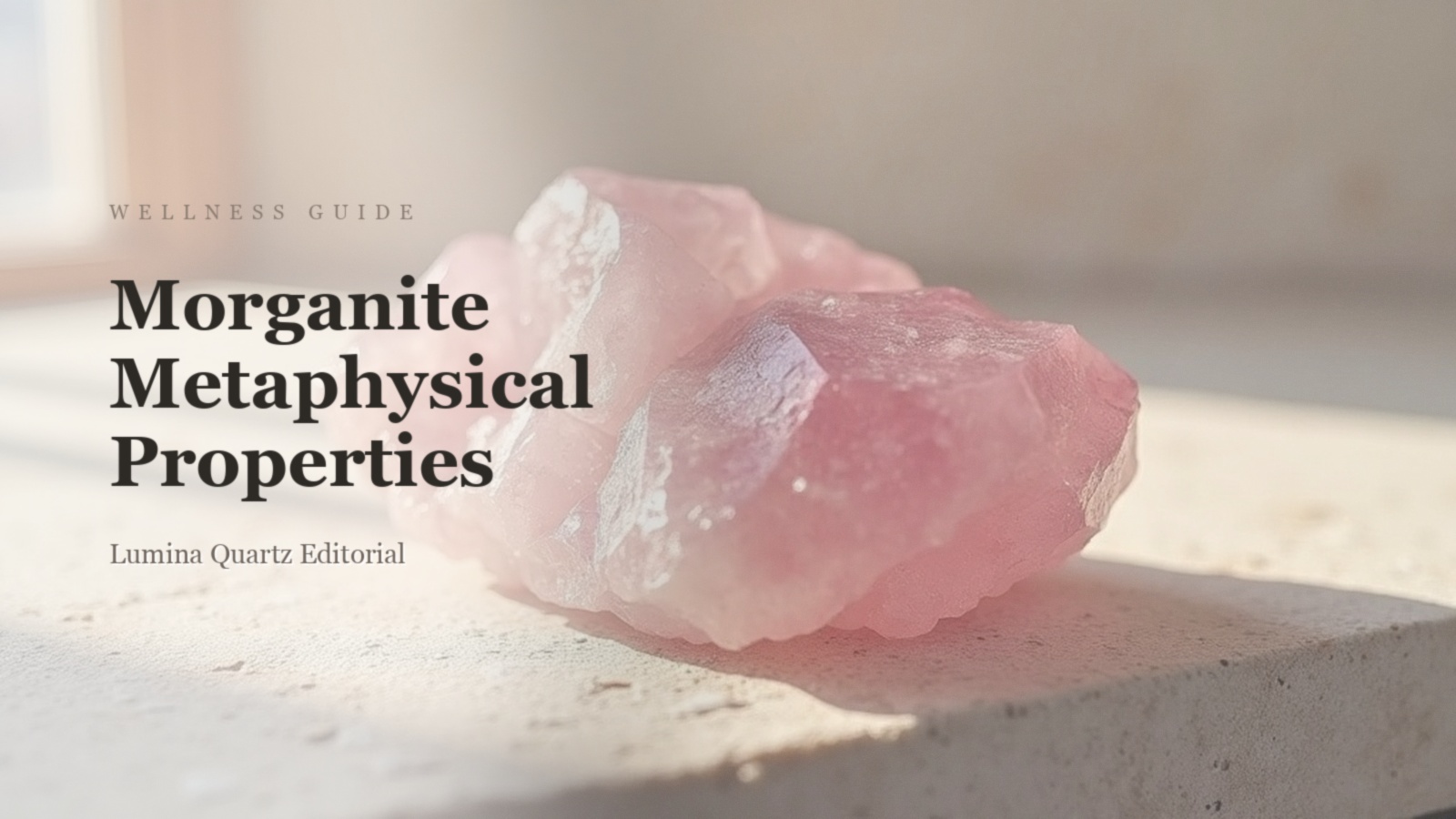
Table of Contents
- Key Takeaways
- Introduction to Morganite and Its Metaphysical Significance
- What is Morganite? A Brief Overview
- Physical Properties of Morganite
- Morganite Properties at a Glance
- The History and Lore of Morganite
- Morganite: Documented Facts and Living Tradition
- Morganite Metaphysical Properties
- Morganite and the Heart Chakra
- Emotional Healing with Morganite
- Morganite for Love and Relationships
- Morganite for Spiritual Growth and Connection
- How to Use Morganite in Your Daily Life
- Wearing Morganite Jewelry
- Meditating with Morganite
- Placing Morganite in Your Environment
- How to Cleanse and Charge Morganite
- Morganite vs. Rose Quartz: A Comparison
- Frequently Asked Questions about Morganite
- Conclusion: Is Morganite Right for You?
- Sources
- Related Reading
There is a quiet kind of magic in the world that does not shout. It arrives softly, like light through a pale pink window at dawn, and asks only that we pause long enough to feel it. Morganite is one of those gentle presences. For centuries, the blush-colored stone has been honored not only for its quiet beauty, but for what it has come to represent: love made visible, tenderness held in the palm of the hand. In the world of crystals, morganite is often described as a stone of the heart. While the curious mind may ask for evidence, the poetic heart simply knows what it feels. This guide invites you to explore the morganite metaphysical properties with an open spirit, a soft gaze, and the understanding that every crystal's true value lives in the meaning we choose to give it.
Key Takeaways
- Morganite is often associated with the heart chakra and may support emotional healing, compassion, and self-love.
- Its gentle, calming energy is frequently described as comforting, and morganite may help ease feelings of stress and anxiety.
- Morganite is a pink-to-peach variety of beryl, ranking 7.5 to 8 on the Mohs hardness scale, which makes it suitable for everyday jewelry.
- Morganite can be incorporated into daily life through jewelry, meditation, and mindful placement in your environment.
- Cleansing and charging morganite regularly may help maintain its clarity and energetic resonance.
- Though similar at first glance, morganite and rose quartz offer different nuances of heart-centered energy.
Introduction to Morganite and Its Metaphysical Significance
Morganite is a stone that whispers rather than speaks. It has a particular way of reminding us that strength can be soft, that boundaries can be loving, and that our hearts are not burdens to be protected from the world — they are gifts to be offered with wisdom. In crystal healing traditions, morganite is often associated with the heart and its many languages: love, grief, forgiveness, trust.
What makes morganite so special is not that it performs dramatic, immediate transformations, but that it may support slow, honest, and lasting ones. It may help us meet ourselves exactly where we are, without pretending. For those navigating emotional transitions, relationship changes, or simply a season of uncertainty, morganite may offer a sense of grounding and comfort. It does not rush us. It accompanies us.
What is Morganite? A Brief Overview
Morganite belongs to the beryl family, the same mineral family that gives us emerald and aquamarine. Its delicate pink to peach tones are typically caused by traces of manganese within the crystal structure, though each stone contains its own unique dance of color, light, and inclusion. Some stones lean soft pink, others radiate warm salmon or apricot hues. No two morganites are ever quite alike, which feels fitting for a stone so closely linked to the intimate, unrepeatable nature of the human heart.
The stone was first described in California, and when a new deposit of rose beryl was discovered in Madagascar in 1910, the gem world took notice. It was named in honor of J.P. Morgan, the American banker and philanthropist who possessed one of the most exquisite gem collections of his era. Today, morganite is found in countries such as Brazil, Madagascar, Afghanistan, Mozambique, and Myanmar, and it continues to be beloved both as a fine gemstone and as a crystal companion for conscious living.
Physical Properties of Morganite
On a physical level, morganite is a durable stone, ranking between 7.5 and 8 on the Mohs hardness scale. This makes it suitable for everyday wear in rings, necklaces, and bracelets, a quality that has contributed to its popularity in modern fine jewelry. The stone is transparent to translucent, and its signature color ranges from the palest blush to a richer rose or peach.
Most morganite on the market today is heat-treated to enhance its pink color, a common and accepted practice in the gem trade. Its natural color can also be quite lovely, often carrying a softer, more muted salmony tone. Because morganite forms in pegmatite deposits alongside other minerals, it is often found with small inclusions or natural character marks — quiet reminders that perfect, unblemished stones are not the only kind worth giving our hearts to.
Morganite Properties at a Glance
If you are comparing stones or simply curious about what morganite is, this short overview gathers its best-known physical and traditional properties in one place.
- Mineral family: Beryl — the same family as emerald and aquamarine.
- Color: Pale blush pink through rose, salmon, peach, and apricot.
- Source of color: Trace amounts of manganese within the crystal structure.
- Hardness: 7.5 to 8 on the Mohs scale, making it a practical choice for daily wear.
- Clarity: Transparent to translucent, often with natural inclusions.
- Typical localities: Madagascar, Brazil, Afghanistan, Mozambique, Myanmar, and California.
- Common treatment: Gentle heating to deepen the pink hue, an accepted trade practice.
- Noted optical behavior: The gemologist George F. Kunz recorded that morganite shows an intense red fluorescence under X-rays, with no phosphorescence once the X-ray source was turned off.
- Traditional energetic associations: The heart chakra, compassion, emotional softening, and self-love.
The History and Lore of Morganite
Though morganite was only formally identified in the early twentieth century, the beryl family has deeply ancient roots. Beryl stones have been treasured for millennia, often associated with the sea because of their watery clarity, and valued as talismans of protection, courage, and love. Morganite, as the pink member of this lineage, carries these ancient associations forward into a modern context.
The stone was named by the celebrated gemologist George Frederick Kunz, who proposed the name at a meeting of the New York Academy of Sciences on 5 December 1910, honoring his friend and patron J.P. Morgan for his support of the arts and sciences. In the years since, morganite has come to symbolize a softer form of love — love that includes self-love, compassion, and the kind of gentle courage that allows us to be vulnerable. Its lore is still being written, and each person who wears or meditates with morganite adds a new page.
Morganite: Documented Facts and Living Tradition
Morganite is discussed in two different languages at once — the language of gemology and the language of crystal tradition. Both can be true at the same time, because they answer different questions. Here is a simple way to tell them apart as you read.
- Documented: Morganite is the pink-to-peach variety of beryl, named in 1910 by George F. Kunz after J.P. Morgan. It was first described in California, and Madagascar became famous for its deep pink material.
- Documented: It measures 7.5 to 8 on the Mohs hardness scale, which is why it is considered suitable for everyday jewelry.
- Documented: Kunz himself observed that morganite fluoresces an intense red under X-rays but does not continue glowing once the X-ray source is switched off.
- Documented: Fine morganite is found in Brazil, Madagascar, Afghanistan, Mozambique, Myanmar, and California.
- Tradition, not gemology: The heart chakra association, the themes of compassion and emotional softening, and the practice of meditating with the stone over the chest belong to crystal and energy traditions rather than to gemological science.
- A gentle boundary: Crystal traditions are best held as a complement to, not a substitute for, professional medical or mental health care. Morganite is a beautiful companion; it is not a treatment.
Reading this way keeps the poetry intact without overpromising. You are free to hold the facts in one hand and the meaning in the other.
Morganite Metaphysical Properties
The morganite metaphysical properties are rooted in a single, central theme: openness of the heart. This is not the loud, relentless energy of force or will. It is the energy of presence. Morganite is often associated with the vibrations of compassion, empathy, and emotional truth. It may support us in releasing the armor we have built around our hearts, not by demanding that we drop it all at once, but by helping us see that we are safe enough to set down a piece at a time.
Because of its gentle frequency, morganite is frequently recommended for those who feel emotionally vulnerable, overwhelmed by the heaviness of the world, or simply tired of carrying old stories that no longer serve them. Its energy invites us to exhale.
Morganite and the Heart Chakra
In the chakra system, morganite is most often associated with the heart chakra, or anahata, which sits at the center of the chest. This energetic center is believed to govern our ability to give and receive love, to form meaningful connections, and to experience compassion for ourselves and others. When the heart chakra feels closed or guarded, we may experience difficulty trusting, forgiving, or feeling worthy of love.
Morganite is considered a companion for the heart chakra in the gentlest sense. It may support the gradual opening of this energetic space, helping us soften the edges of our defenses. Meditating with morganite placed over the heart is a practice many find soothing, as the stone's cool, luminous presence can feel like a hand resting quietly on the chest, reminding us that we are allowed to feel.
Emotional Healing with Morganite
Morganite is often described as a stone for the tender seasons of life. It may help create a little more room around difficult feelings, so that grief, disappointment, or old resentment can be felt without swallowing us whole. Many people find that simply holding morganite during a hard conversation with themselves makes the honesty a little kinder.
Its energy is typically described as steadying rather than cathartic. It does not promise that sadness will vanish; it offers company while the sadness moves through. For anyone who has been told to "just move on," morganite offers a gentler invitation: feel it fully, and let it loosen on its own.
Morganite for Love and Relationships
Because it is so closely tied to the heart, morganite is often kept nearby during relationship milestones — a new partnership, a reconciliation, an engagement, or the quiet renegotiation of an old bond. In crystal tradition, it is associated with honesty in love: the kind of honesty that says what is true without cruelty, and listens without keeping score.
It is also a stone of boundaries. Softness without boundaries becomes self-abandonment, and morganite is often described as helping us say a loving no as easily as a loving yes. Placed on a bedside table or worn as a ring, it can serve as a small daily reminder that you are allowed to be both kind and clear.
Morganite for Spiritual Growth and Connection
On a spiritual level, morganite is often linked with the practice of compassion — not as a feeling that arrives on its own, but as something we practice, the way we practice scales or stretching. Working with the stone may invite a slower, more forgiving relationship with yourself, which tends to ripple outward into how you meet others.
Some people find morganite supportive during prayer, journaling, or quiet contemplation, particularly when the intention is gentleness rather than achievement. It is a stone that tends to ask, "What would love do here?" rather than "How can I fix this?"
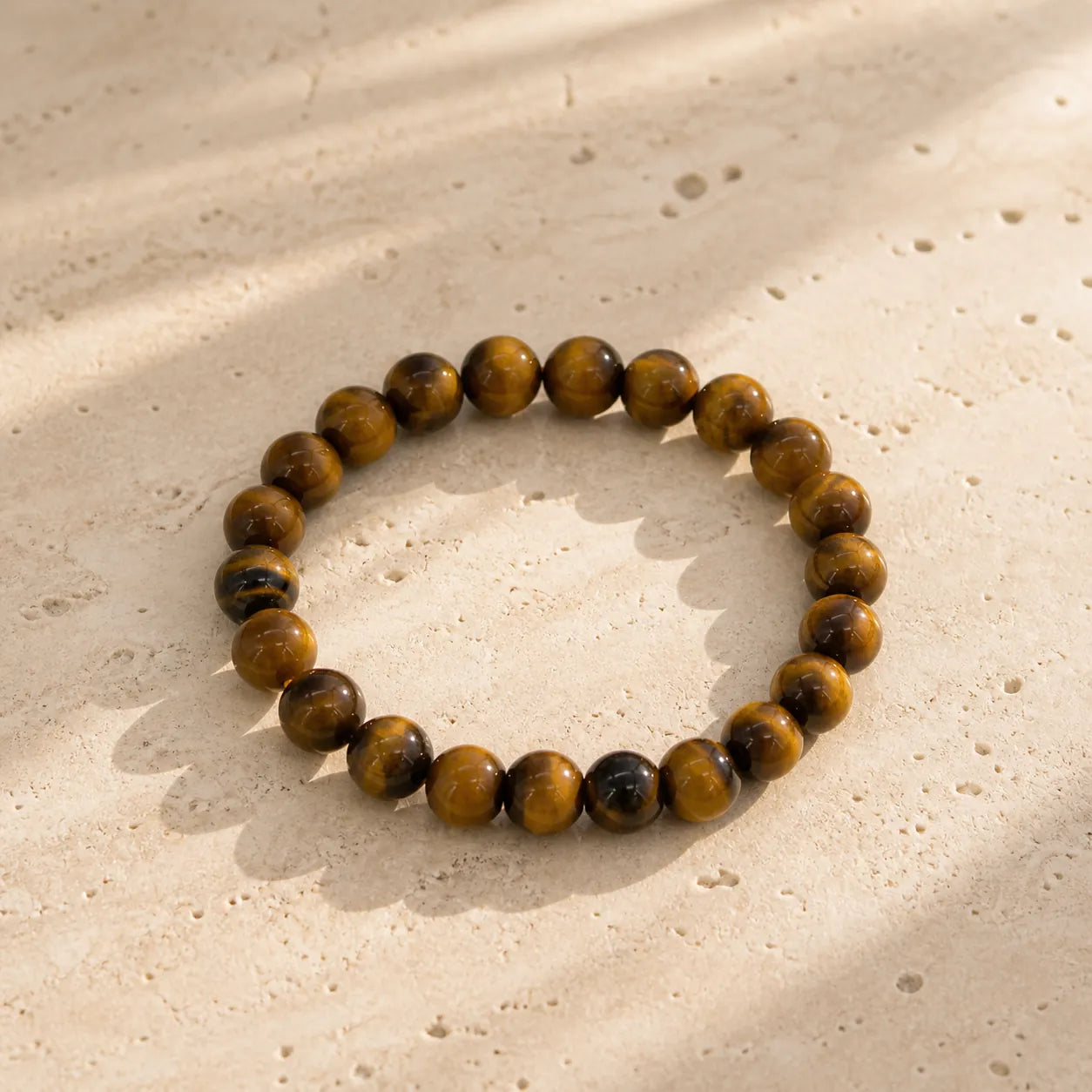
A related intention option
Tiger Eye Bracelet – Decisive Focus
This is a related mindful option, not a Morganite product. We only identify jewelry as Morganite when that exact material is verified.
Explore this related optionHow to Use Morganite in Your Daily Life
Morganite does not require elaborate ritual to be meaningful. Often the simplest contact — a stone in a pocket, a pendant at the throat, a palm resting on the chest — is enough to bring its gentle theme back into focus.
Wearing Morganite Jewelry
Thanks to its 7.5 to 8 hardness, morganite is well suited to everyday jewelry. Rings, pendants, and bracelets all keep the stone close to the body, and many people find that a piece worn near the heart or on the hand becomes a small anchor for the intention they set. A pendant that rests near the chest pairs naturally with heart-centered work, while a ring or bracelet keeps the reminder visible during ordinary tasks.
If you feel drawn to keeping morganite with you through the day, our morganite collection offers simple, everyday-friendly pieces meant to be worn rather than stored away. Care is straightforward: store it away from harder stones, clean it with warm water and a soft cloth, and avoid harsh chemicals or ultrasonic cleaners.
Meditating with Morganite
Morganite is a lovely companion for a short, unhurried practice. Ten minutes is plenty. You might try this simple heart meditation:
- Find a comfortable seat and take a few slow breaths, letting the exhale be longer than the inhale.
- Hold morganite in your palm, or lie down and rest it gently over the center of your chest.
- Bring your attention to the physical sensation of the stone — its coolness, its weight, the small point of contact.
- Silently repeat a phrase that feels true to you, such as "I am allowed to soften" or "I can be kind and still be clear."
- When your mind wanders, return to the stone rather than scolding yourself. The returning is the practice.
- Finish by holding the stone to your heart for one breath, then setting it down with thanks.
Placing Morganite in Your Environment
A morganite tumbled stone or small cluster can quietly shape a room. Placing one on a bedside table may support a softer transition into sleep; keeping one near a desk or in a living space can act as a visual cue to pause before reacting. Some people place morganite in the room where they journal, meditate, or simply sit with a cup of tea.
Trust your own instinct about placement. The spot you notice most often is usually the right one.
How to Cleanse and Charge Morganite
Cleansing is a way of resetting a stone's energetic tone and, practically speaking, a good excuse to handle and care for it. Morganite is relatively hardy, but it still appreciates gentleness.
- Moonlight: Leave your stone on a windowsill overnight during a full or waxing moon. This is one of the gentlest methods and suits morganite's soft nature.
- Sound: A singing bowl, chime, or tuning fork held near the stone can refresh it without any physical contact.
- Smoke or herbs: Passing morganite through the smoke of dried sage, rosemary, or palo santo is a traditional option.
- Water: A brief rinse under cool running water is fine for most morganite, followed by a gentle pat dry. Skip salt water, which can dull the surface over time.
- Adjacent stones: Resting morganite beside clear quartz or selenite is a simple, hands-off way to keep its energy clear.
- Intention: Hold the stone and set a clear intention — "may I meet today with an open heart" — to close the practice.
Avoid prolonged, intense direct sunlight, which some jewelers suggest can lighten the color of fine pink gemstones over time, and keep morganite away from household cleaners and ultrasonic devices.
Morganite vs. Rose Quartz: A Comparison
These two stones are often confused, and understandably so — both are pink, both speak the language of the heart, and both are often worn as jewelry. Their differences are subtle but real, and they tend to suit different moments.
- Hardness: Morganite measures 7.5 to 8 on the Mohs scale, while rose quartz is around 7. Morganite is the more scratch-resistant choice for a ring worn daily.
- Appearance: Morganite is typically clear and faceted, with a peachy pink glow. Rose quartz is usually translucent to cloudy, with a cooler, softer pink.
- Energetic tone: Rose quartz is often described as the classic stone of unconditional love — warm, broad, and nurturing. Morganite is frequently described as the stone of love with wisdom: gentler, more boundary-aware, and a little more grown-up.
- Best for: Rose quartz tends to be the choice for self-love, comfort, and emotional warmth. Morganite is often chosen for relationship work, healthy boundaries, and softening defenses we have carried a long time.
- Practical note: Both can be worn together, and many people find they balance each other beautifully.
If you would like to explore rose quartz in more depth, our guide to rose quartz crystal meaning, benefits, and uses covers its qualities in detail.
Frequently Asked Questions about Morganite
What are the metaphysical properties of morganite?
In crystal tradition, morganite is most often associated with the heart chakra, compassion, emotional softening, self-love, and honest connection. It is generally described as a gentle, steadying stone rather than an energizing one, and it is frequently recommended for people moving through emotional transitions or learning to set kinder boundaries.
Is morganite the same as rose quartz?
No. Morganite is a pink variety of beryl and is harder (7.5 to 8 on the Mohs scale), while rose quartz is a quartz and measures around 7. Both are heart-centered stones, but rose quartz is usually described as warmer and more universal, and morganite as softer and more boundary-aware.
Which chakra is morganite associated with?
Morganite is most commonly associated with the heart chakra, anahata, located at the center of the chest. Meditating with the stone placed over the heart is a common and soothing practice.
Can I wear morganite every day?
Yes. At 7.5 to 8 on the Mohs hardness scale, morganite is durable enough for daily wear in rings, pendants, and bracelets. To keep it looking its best, store it separately from harder stones, clean it with warm water and a soft cloth, and avoid harsh chemicals and ultrasonic cleaners.
How often should I cleanse my morganite?
There is no strict rule. Many people cleanse a stone when they feel its energy has become heavy, after an emotionally demanding period, or simply once a month. Moonlight, sound, and smoke are all gentle options. Trust what feels right rather than following a fixed schedule.
Conclusion: Is Morganite Right for You?
Morganite does not ask you to become someone else. It asks you to become a little more honest with the person you already are. If you have been holding your heart carefully — protecting it, managing it, quietly apologizing for it — morganite may feel like a permission slip to loosen your grip.
It is a stone for slow mornings and difficult conversations, for learning that a loving no is still love, and for the long, unglamorous work of becoming gentler with yourself. Whether you wear it, meditate with it, or simply keep it on a bedside table, its gift is not certainty. It is companionship. And sometimes, that is the most healing thing of all.
Sources
- GIA — Morganite History and Lore
- Smithsonian National Museum of Natural History — Beryl (var. morganite)
- GIA GemKids — Morganite
- Mindat — Morganite: Mineral information, data and localities