Pink Opal Emotional Healing: Meaning, Benefits & How to Use This Crystal
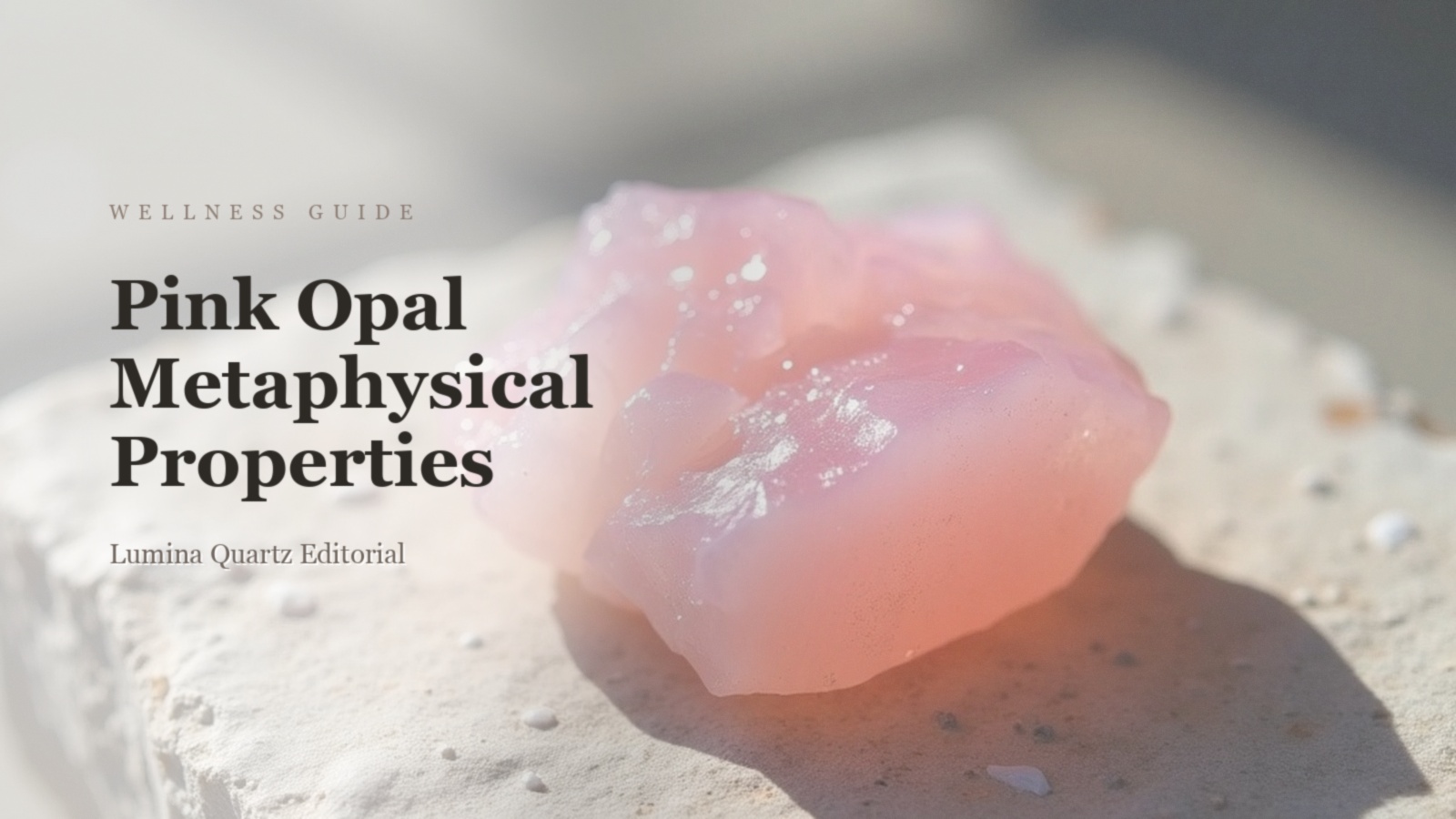
Table of Contents
- Introduction to Pink Opal Metaphysical Properties
- Emotional Healing with Pink Opal
- Releasing Old Patterns
- Supporting Heartbreak and Loss
- Pink Opal and Chakra Balancing
- Heart Chakra
- Crown and Galactic Chakras
- How to Use Pink Opal in Daily Practice
- Caring for Your Pink Opal Crystal
- Why Choose Lumina Quartz for Pink Opal
- Key Takeaways
- Frequently Asked Questions
There are stones that shimmer loudly, and there are stones that simply cradle. Pink opal belongs to the second kind. Its color brings to mind a sunrise kept inside a glass jar, or the inside of a seashell catching light. It feels less like a gem and more like a held breath becoming a sigh. Many who work with crystals reach for pink opal not to demand dramatic shifts, but to make small, honest returns — to the body, to the breath, to a heart that has been doing its best all along.
Introduction to Pink Opal Metaphysical Properties
Pink opal forms quietly, deep in the earth, as a silica gel that densifies over millions of years into a soft, porcelain-like stone. It is found primarily in Peru, with notable deposits also emerging in Australia and Mexico. Unlike amethyst or clear quartz, pink opal does not grow in geometric crystals. It settles into rounded masses, smooth and undramatic — and perhaps that is exactly why it feels so safe to hold.
When we speak of the pink opal meaning, we are speaking less about intensity and more about tenderness. In crystal folklore, pink opal is often associated with emotional renewal, self-compassion, and the kind of love that does not need to prove itself. It is not a stone that shouts. It is a stone that hums, low and constant, like a mother humming near a sleeping child.
Historically, pink opal has been called the Stone of Hope in some South American traditions. It is often associated with the slow reweaving of joy after grief, and with softening the mental loops that keep old wounds playing on repeat. While no stone can replace compassionate professional care, many holistic practitioners include pink opal in rituals designed for emotional ease, nervous-system settling, and gentle self-inquiry.
Perhaps the most poetic thing about pink opal is that it asks for patience. Its energy rarely announces itself. Instead, you may notice that you sleep a little more deeply, that your shoulders drop away from your ears, that you choose softer words when speaking to yourself. Those small shifts are the signature of pink opal.
Emotional Healing with Pink Opal
Emotional healing is rarely a straight line. It curves, loops back, and revisits rooms we thought we had locked. Pink opal does not promise to erase that terrain, but it may support a gentler journey through it. Many crystal practitioners describe pink opal as a soothing balm for the emotional body — a stone that helps you feel your feelings without being swallowed by them.
The stone is deeply calming, and calm is often the first casualty of emotional distress. When you are anxious, grieving, or overwhelmed, your nervous system can stay on high alert. Pink opal is often associated with the subtle invitation to rest, to soften, to let the body remember that not every moment is an emergency.
Releasing Old Patterns
There is a difference between remembering the past and being imprisoned by it. Pink opal, in its quiet way, may support the release of old emotional patterns — the defensive reactions, the fears of abandonment, the stories we tell ourselves about not being enough. These patterns are often stored not only in the mind but in the body, in the clench of the jaw, the guarded posture, the shallow breath.
Working with pink opal may help you notice when an old pattern is rising before it takes the wheel. Journaling with the stone nearby, or simply sitting with it in your palm, can create a pocket of awareness. From that awareness, choice becomes possible. You may feel less compelled to react in the same way, and more able to respond as your present self — not your wounded past.
Because pink opal is a gentle stone, it may support change without force. It is often associated with gradual transformation, the kind that happens like weather eroding a stone — not in a dramatic cracking, but in a patient smoothing. If you are tired of harsh self-criticism as a motivator, pink opal offers a different path: change through kindness.
Supporting Heartbreak and Loss
Grief is one of the most solitary experiences we carry. Even in a room full of love, the grieving heart can feel profoundly alone. Pink opal's tender energy is often associated with heartbreak and loss, not because it takes the pain away, but because it may help you hold space for it. The stone seems to say: you do not have to rush through this.
People who work with pink opal after a breakup, a death, or a betrayal often report that it helps them cry more freely, or sometimes rest more deeply, when the weight of sadness feels unbearable. It may support the releasing of held emotions — those unspoken words, unfinished conversations, secret wishes — and allow them to surface in safe, manageable waves.
Pink opal may also remind you that love does not end with a loss. It changes form, but its threads continue. Holding pink opal during meditation, or sleeping with it under your pillow, may support the slow return of hope — not a forced positivity, but a genuine trust that your heart can expand again, in its own time.
Pink Opal and Chakra Balancing
In the subtle energy system of the body, pink opal is most commonly connected to the heart and the higher chakras, though its soothing influence can ripple through many energy centers. Crystal healers often describe the stone as a bridge between the personal heart and the greater, more universal consciousness — a gentle staircase from the human and the divine.
Because every body is different, your experience of pink opal may differ from someone else's. That is the honest beauty of working with stones: they meet you where you are, not where a book says you should be.
Heart Chakra
The heart chakra, known in Sanskrit as Anahata, is the energy center associated with love, compassion, and our ability to give and receive affection. When this center is closed, we may feel guarded, cynical, or unable to trust. When it is open, we can love without clinging and receive love without suspicion.
Pink opal is often associated with the heart chakra because of its soft, rosy hue. Placing the stone over your chest during meditation, or wearing it as a pendant near the heart, may support the gentle opening of this energy center. Many people notice a warmth spreading across the chest, or a release of tightness they had not realized they were holding.
Pink opal's heart-chakra resonance is not about romantic love alone. It includes self-love, sibling love, friendship, and the radical act of loving yourself while you are still a work in progress. If you struggle with being kind to your own tender places, pink opal may support you in offering yourself the same grace you would offer a beloved friend.
Crown and Galactic Chakras
Some energy practitioners also connect pink opal to the crown chakra. The crown is the body's connection to higher awareness, intuition, and the sense that you are part of something vast. Pink opal's ability to quiet mental noise may support a clearer channel to that spacious place — not through grasping, but through stillness.
There is also a newer, more expansive concept in crystal work: the galactic chakra, sometimes described as a point above the crown that links personal consciousness to something larger than the self. Practitioners who work with this idea often place pink opal above the head during meditation, letting its soft frequency encourage a sense of belonging — to the earth, to the cosmos, to the quiet pulse that connects all living things.
Pink Opal Stone: Origin, Color and Identification
Pink opal is a real mineral, and it is worth knowing how it forms before you buy. The table below summarizes what is well established and what is best treated as folk tradition.
| What is well documented | What is tradition, not fact |
|---|---|
| Pink opal is a hydrous silica mineral, documented in mineral databases such as Mindat. It forms in rounded, non-crystalline masses rather than geometric crystals. | Statements that pink opal "clears" or "heals" emotional wounds are folk and energy-practice traditions, not clinical findings. |
| Major sources include Peru, with deposits also reported in Australia and Mexico. | The title "Stone of Hope" is traditional lore, not a scientific designation. |
| Color treatment exists in the opal market. GIA has documented dye testing on pink and blue opal samples, and treated stones may not hold color under heat or solvents. | Claims that a specific stone will fix a specific relationship, or guarantee an outcome, are not supported and should be treated as symbolic. |
When shopping, look for an even, soft pink without sharp streaks. As GIA's report on dyed opal notes, color-stability testing is the usual way labs confirm whether a stone's hue is natural or introduced. If a seller cannot tell you whether a pink opal is natural or treated, treat that as useful information rather than a red flag you must ignore.
How to Use Pink Opal in Daily Practice
There is no single correct way to work with pink opal. The stone is forgiving, and the best ritual is the one you will actually return to. A few gentle starting points:
- Morning pause: Hold pink opal in your non-dominant hand for three slow breaths before you check your phone. Notice what your body is already carrying.
- Heart placement: Lie down and rest the stone on your chest for five to ten minutes. Let your exhale be longer than your inhale.
- Pillow companion: Tuck a tumbled stone under your pillow during seasons of grief or transition. Some people sleep more easily; others simply feel accompanied.
- Journaling anchor: Keep pink opal beside your notebook. When an old pattern surfaces, write it down and set the stone on the page as a small marker of self-compassion.
- Pocket stone: Carry a smooth piece in your pocket on days you know will ask a lot of you, and touch it when you need a reminder to soften.
Whatever practice you choose, keep it simple. Pink opal works best as a quiet companion, not a task to complete.
Caring for Your Pink Opal Crystal
Pink opal is relatively soft compared to quartz or obsidian, so it prefers a gentle touch. Clean it with a soft, dry cloth or a barely damp one, and avoid harsh chemicals, ultrasonic cleaners, and long soaks. Because some pink opal in the market is color-treated, as the GIA report describes, keep treated pieces away from acetone, alcohol, and prolonged sun exposure, which can fade or shift the color.
For energetic clearing, many practitioners prefer moonlight, sound, or a brief rest on a bed of clean salt rather than water. Opal is sensitive to sudden temperature changes, so store it away from direct heat and heavy stones that could scratch its surface.
Why Choose Lumina Quartz for Pink Opal
At Lumina Quartz, we choose pink opal for its calm rather than its flash. Each piece is selected for even color, smooth finish, and a weight that feels good in the hand, then described honestly so you know what you are receiving. If pink opal has been calling to you, it is waiting quietly in our collection, ready to be held.
Key Takeaways
- Pink opal is a soft, non-crystalline form of hydrous silica, found mainly in Peru, with deposits in Australia and Mexico.
- The pink opal gemstone meaning centers on emotional tenderness, self-compassion, and hope after grief.
- It is most often associated with the heart chakra, and sometimes the crown and galactic chakras.
- Its energy is gradual. Expect small shifts — softer self-talk, deeper rest — rather than dramatic transformation.
- Natural and color-treated pink opal both exist, so buy from sellers who can tell you which you are getting.
- Crystal work is a personal practice and not a substitute for professional care.
Frequently Asked Questions
What are pink opal metaphysical properties?
In crystal tradition, pink opal is associated with emotional renewal, self-compassion, hope, and gentle release of old patterns. It is considered a calming stone rather than a stimulating one, and is often described as supporting the heart during periods of grief, transition, or quiet growth.
How does pink opal help with emotional healing?
Pink opal is traditionally used as a soothing companion during emotional difficulty. Practitioners describe it as helping you feel your feelings without being overwhelmed by them, which can make hard moments feel more manageable. These are energy-practice traditions, and pink opal is not a substitute for professional mental health support.
What chakras is pink opal associated with?
Pink opal is most commonly linked to the heart chakra, where it is used to support love, compassion, and self-acceptance. Some energy practitioners also associate it with the crown chakra and the more expansive galactic chakra, placing the stone above the head during meditation to encourage a sense of connection.
Is all pink opal natural?
No. The opal market includes both natural and color-treated stones. GIA has documented dye testing on pink and blue opal samples, and treated stones can lose color under heat or solvents. Ask your seller whether a piece is natural or treated so you know what you are caring for.
How do I choose a pink opal stone?
Look for even, soft pink color without harsh streaks, a smooth and undramaged surface, and a size that feels comfortable in your hand. If you plan to use it near water or heat, favor a natural stone, since treated pieces are more vulnerable to color change.
Interested in verified Opal jewelry?
We are reviewing materials, sizing, supplier images, and shipping details before adding Opal jewelry. Subscribe for launch updates.
Ask About AvailabilityRelated Reading
- Rose Quartz Crystal: A Gentle Guide to Meaning, Benefits, and Uses
- Kyanite Crystal Meaning: A Guide to Benefits, Uses, and Chakra Alignment
- Red Jasper: A Gentle Guide to Meaning, Benefits, and Uses
- Black Tourmaline Meaning: Meaning, Properties, and Everyday Uses
- Sunstone Meaning: Meaning, Properties, and Everyday Uses
- Fluorite Meaning: Meaning, Properties, and Everyday Uses