Prehnite Stone: Spiritual Meaning, Symbolism, and Daily Use
Table of Contents
- The Verdict Box
- Prehnite at a Glance: What the Stone Actually Is
- The Spiritual Meaning of Prehnite: Unconditional Love and the Healer's Stone
- Heart and Solar Plexus: Why the Paired Chakras Matter
- Symbolism of Prehnite: Prophecy, Dreaming, and the Honest History
- Separating Modern Crystal Tradition from Invented Ancient Lineage
- Prehnite's Healing Properties in Practice: Calm, Clarity, and Emotional Release
- Decision Checklist: Is Prehnite the Right Stone for You?
- Daily Use: Jewelry, Meditation, Dreamwork, and Feng Shui
- Caring for Prehnite: Hardness, Water Safety, and Cleansing
- Buying Prehnite: Color, Quality, and How to Spot Lookalikes
- FAQ: Quick Answers on Prehnite Meaning and Use
- What is the spiritual meaning of prehnite?
- What chakra is prehnite good for and how do you use it?
- How do you wear or cleanse prehnite in daily life?
- Sources
Prehnite is a pale green to yellow-green mineral (calcium aluminum silicate hydroxide) with a Mohs hardness of 6 to 6½, and in modern crystal tradition it is most often associated with unconditional love, calm clarity, and heart-centered emotional release rather than with any scientifically verified healing effect. If you are asking "what does prehnite mean," the short answer is this: it is a collector-favored mineral whose spiritual reputation is a recent, evolving cultural layer, and it is best used as a gentle personal reminder stone — not a medical or psychological treatment.
The Verdict Box
- Direct Verdict: Prehnite's meaning in modern crystal practice centers on unconditional love, gentle calm, and honest emotional clarity. Its properties are mineralogical and its symbolism is cultural — neither is a proven therapeutic claim.
- Mohs Hardness: 6–6½ (soft enough to scratch; care needed with daily jewelry wear).
- Specific Gravity: 2.80–2.95.
- Chemical Formula: Ca₂Al₂Si₃O₁₀(OH)₂ — a calcium aluminum silicate hydroxide.
- Crystal System: Orthorhombic; commonly found in botryoidal (grape-like) or stalactitic masses.
- Typical Color: Colorless to gray, yellow, yellow-green, or white; very rarely pale blue.
- Best For: Heart-focused meditation, dream journaling, feng shui "gentle room" placement, and display collecting.
- Not Ideal For: Rough-and-tumble daily rings, prolonged ultrasonic cleaning, or anything requiring durability.
Prehnite at a Glance: What the Stone Actually Is
Before interpreting any stone's spiritual meaning, it helps to know what it physically is. According to Mindat, prehnite is a valid IMA mineral species with the formula Ca₂Al₂Si₃O₁₀(OH)₂, a vitreous-to-pearly luster, a Mohs hardness of 6 to 6½, and a specific gravity of 2.80–2.95. It crystallizes in the orthorhombic system, though collectors most often see it as rounded, grape-like botryoidal masses rather than distinct crystals.
The mineral was named in 1788 by Abraham Gottlieb Werner in honor of the Dutch colonel Hendrik von Prehn, who is credited with discovering it in 1774 at the Cape of Good Hope in South Africa. It is primarily prized as a collector's mineral — the U.S. Geological Survey describes it alongside apophyllite as a collectors' favorite, and the Smithsonian's Q?rius collection holds specimens from localities such as Sanders Quarry in the U.S. Mid-Atlantic region. This grounding context matters: prehnite's spiritual meaning is layered onto a real, well-documented stone — and knowing the physical facts helps you separate mineral science from tradition.
The Spiritual Meaning of Prehnite: Unconditional Love and the Healer's Stone
In contemporary crystal practice, prehnite is often called the "healer's stone" and is most strongly associated with unconditional love — a love that does not need to be earned or performed. This reputation is modern cultural symbolism, not a scientifically verified property. Used as a meditation focal point or a quiet personal reminder, many people find it helpful for softening self-judgment and opening toward gentler self-talk; that is a subjective, reflective practice, not a clinical one.
What makes prehnite distinctive among green "heart" stones is its combination of yielding softness and clarity. It is frequently described as a stone that "calms the heart without numbing it" — associated with emotional honesty that arrives gradually rather than all at once. If you want to work with prehnite, treat it as a ritual anchor: hold it during a short breathing practice, keep it where you journal, or place it near your bed. The stone supports the habit; the habit does the work.
Heart and Solar Plexus: Why the Paired Chakras Matter
Prehnite is commonly linked to the heart chakra (anahata) and the solar plexus chakra (manipura) together. The pairing is somewhat unusual and is worth understanding: the heart is associated with love, connection, and compassion, while the solar plexus is linked to personal will, confidence, and boundaries. In crystal tradition, prehnite's reputation as a stone of "loving courage" comes from the idea that warmth without boundaries can become self-erasure — and boundaries without warmth can become coldness.
In practice, this means prehnite is often chosen by people working on saying no kindly, setting limits without guilt, or voicing feelings that have been swallowed. If you use chakra framing, try a simple ritual: hold prehnite at the heart during a slow inhale, then move it to the solar plexus on the exhale, repeating three to five times while naming one boundary you want to honor. It is a grounding, deliberate practice — and, like all crystal work, a symbolic support rather than a medical intervention.
Symbolism of Prehnite: Prophecy, Dreaming, and the Honest History
Prehnite carries two main streams of symbolism in modern practice: prophecy and dreaming. It is often associated with quiet knowing — the sense of a truth you already suspect but have not yet admitted — and with vivid or instructive dreams when placed near a bedside or used before sleep. These are cultural and personal-symbolic associations, not demonstrable effects, and they vary widely among practitioners.
The mineral's collection history adds a quiet, grounded layer: it is a stone discovered by naturalists and treasured by collectors long before it entered crystal-shop vocabulary. Some writers describe its botryoidal (grape-like) form as symbolic of gathered wisdom — many small, rounded insights forming a single mass. That reading is modern and interpretive, but it matches how the stone actually looks, which makes it a more honest starting point than invented mythology.
Separating Modern Crystal Tradition from Invented Ancient Lineage
You will often see prehnite described as "known to ancient peoples" or tied to ancient prophecy traditions. Be cautious. The mineral was formally named only in 1788, and the mystical claims most often circulating are modern additions. Mindat notes that "a considerable mystique and folklore have surrounded Prehn and prehnite," which suggests the stone's reputation has been embellished over time rather than preserved from antiquity.
This does not make the symbolism worthless — modern tradition is a legitimate lived practice for many people. It simply means the honest account is: prehnite's prophecy-and-dreaming reputation is a contemporary layer, and you can hold it as meaningful personal symbolism without claiming it is ancient fact. That honesty is part of the Lumina Grade AAA Integrity Standard: we describe stones as what they are, and we describe tradition as tradition.
Prehnite's Healing Properties in Practice: Calm, Clarity, and Emotional Release
In crystal tradition, prehnite is often associated with calm, clarity, and gentle emotional release. The word "healing" here should be understood as supportive and symbolic: a quiet focal object that may support reflection, journaling, and深呼吸-based relaxation — not a treatment for any condition, and not a substitute for professional care.
Where prehnite is often chosen over other green stones is in its gentleness. Many people describe it as a "low-intensity" stone — good for days when you want to slow down rather than push through. Practical, non-medical uses include:
- Grounding pause: Hold it during a 3–5 minute breath practice before a difficult conversation.
- Journaling anchor: Keep it on the page while writing about feelings you have been avoiding; the stone marks the ritual of honesty.
- Evening wind-down: Place it on a bedside table as a cue to stop scrolling and reflect.
- Workspace reminder: Keep a small piece near your desk as a symbol of kind boundaries.
None of these require belief in magic — they require attention. That is the most grounded way to use prehnite.
Decision Checklist: Is Prehnite the Right Stone for You?
This checklist is built specifically for prehnite's strengths and limits — not generic crystal advice.
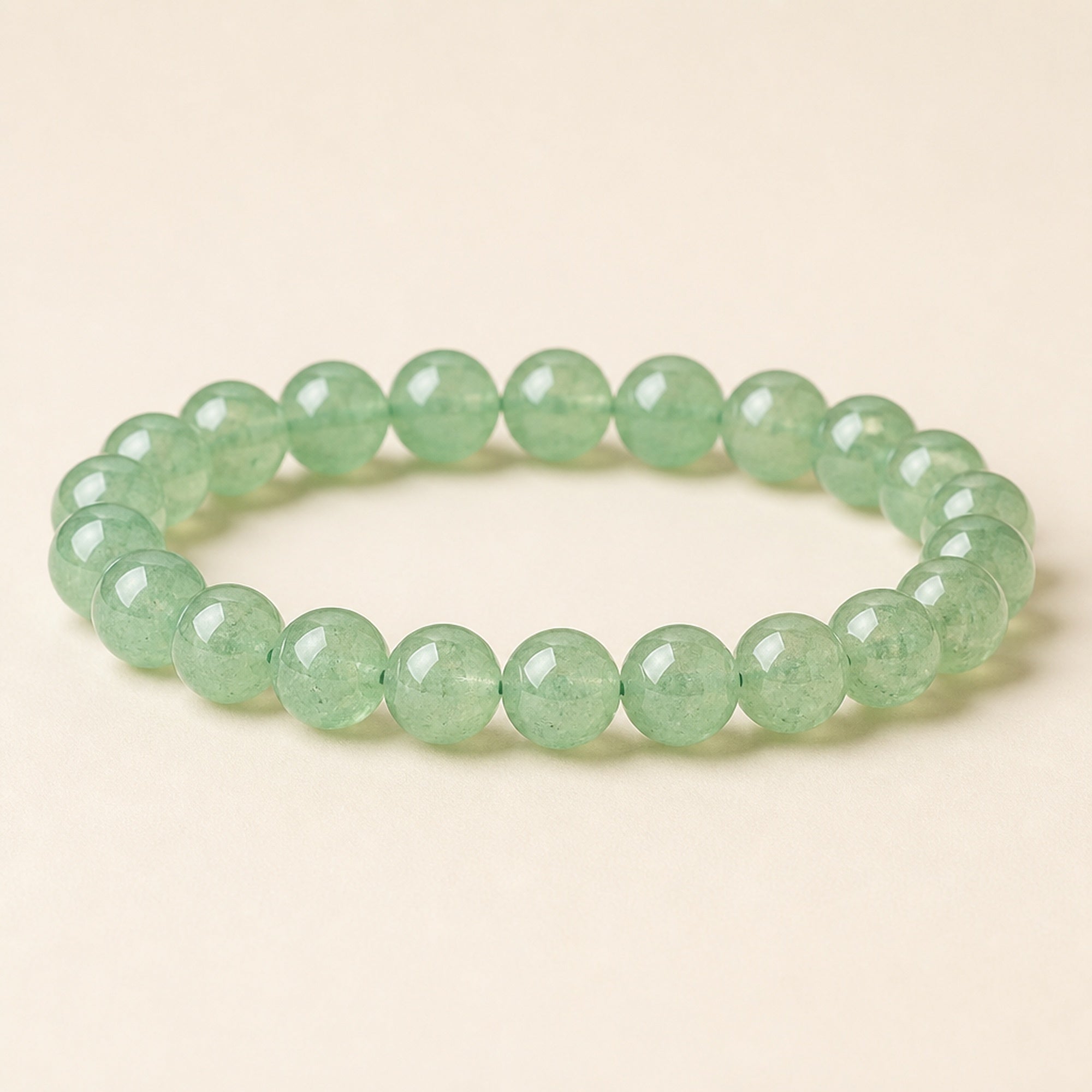
A related color-family option
Green Strawberry Quartz Bracelet – Gentle Renewal
This broader color-family option is not presented as Prehnite. We only identify jewelry as Prehnite when that exact material is verified.
Explore this related option- Choose prehnite if: you want a soft, heart-centered focal stone for journaling, meditation, or gentle boundary work, and you prefer a "quiet" energy over an intense one.
- Choose prehnite if: you value documented mineral history — a named species from 1788 with clear physical properties — and you want symbolism that can be held honestly as modern tradition.
- Pause if: your main need is durability. Mohs 6–6½ means it scratches more easily than quartz (7) or jadeite (6.5–7); a prehnite ring worn daily will show wear.
- Pause if: you are looking for something to "fix" anxiety, intrusive thoughts, or health concerns. Prehnite may support reflective calm as a ritual object, but it does not treat any condition; speak with a qualified professional.
- Choose another green stone if: you want a tough everyday stone. Jade (jadeite and nephrite) is a separate material with its own identification rules — see the GIA's guide to jade and its simulants — and prehnite is softer and usually lighter in color.
- Buy with clear standards: ask for natural, untreated material. Lumina Grade AAA Integrity Standard means natural rough, no chemical resin filling, and no irradiation or dye treatment — a standard worth naming when you shop, because prehnite's pale color makes treated lookalikes easy to pass off.
Daily Use: Jewelry, Meditation, Dreamwork, and Feng Shui
Prehnite is versatile but delicate enough that placement matters. Here are practical daily uses that fit its actual properties:
- Jewelry: Pendants and earrings are safer than rings and bracelets, which take more impact. A prehnite pendant sits over the heart — a natural fit for its association — while keeping the stone away from scraping surfaces.
- Meditation: Use it as a focal object at the heart or in the palm. A short practice — three slow breaths, one honest sentence you want to say — is enough to give the ritual structure.
- Dreamwork: Place it on the bedside table or under the pillow as a cue to write down dreams on waking. The journal is the instrument; prehnite is the reminder.
- Feng Shui: Prehnite's soft yellow-green reads as gentle growth, so it is often placed in the relationship or "family" corners, or on a bedside table for a calmer sleep environment. Treat this as spatial ritual and aesthetic grounding, not as a guarantee of outcomes.
- Desk and study: Keep a small botryoidal piece near where you plan — it is a tactile, low-glare object that can serve as a "pause before reacting" cue.
Caring for Prehnite: Hardness, Water Safety, and Cleansing
Prehnite's Mohs hardness of 6 to 6½ makes care essential. It can be scratched by quartz, steel tools, and even window glass, and it should never be used with ultrasonic cleaners or steam. Store it separately in a soft pouch.
On water: prehnite contains water (hydroxyl groups) in its structure and is generally considered safe for brief rinses, but prolonged soaking, salt water, and sun exposure are best avoided to protect the surface finish and color. For cleansing, dry methods are safest — a soft cloth, a brief sound or smoke cleansing if that fits your practice, or resting it on a clean shelf. If you do use water, pat dry immediately and avoid abrasive cloths.
For placement, keep prehnite out of dishwashers, purses where it rubs against other stones, and direct sunlight for long periods. A dedicated small tray or pouch solves most problems.
Buying Prehnite: Color, Quality, and How to Spot Lookalikes
Prehnite is most valued for saturated yellow-green color, translucency, and clean botryoidal form. But its pale color and softness make lookalikes common, so a few checks matter:
- Fracture and luster: Prehnite typically shows a vitreous-to-pearly luster with uneven fracture; plastic and glass imitations often look uniformly glossy and feel lighter or warmer.
- Structure: Genuine pieces frequently show rounded, grape-like (botryoidal) surfaces or radiating internal structure. Uniform, bubble-free blocks are a red flag.
- Color behavior: Dye and resin treatments can deepen pale prehnite. Look for color pooling in cracks and an unusually oily feel.
- Comparison with jade: Jade is actually two materials (jadeite and nephrite) and has its own simulants; the GIA's "Jade Enigma" report outlines key jade identification properties and contrasts them with common green simulants — useful background if you are comparing green stones side by side. Prehnite is generally softer and lighter, with a more yellow, translucent cast than fine jade.
- Standards to ask for: Natural rough, no resin filling, no irradiation or dye. That is the core of the Lumina Grade AAA Integrity Standard, and it is the clearest way to avoid treated or mislabeled pieces.
When in doubt, ask for provenance and photos in natural light. A reputable seller will provide both.
FAQ: Quick Answers on Prehnite Meaning and Use
What is the spiritual meaning of prehnite?
In modern crystal tradition, prehnite is associated with unconditional love, gentle calm, and honest emotional clarity — sometimes called the "healer's stone." These are cultural and symbolic meanings, not scientifically verified properties.
What chakra is prehnite good for and how do you use it?
It is most often linked to the heart and solar plexus chakras together. A simple use is to hold it at the heart on the inhale and at the solar plexus on the exhale while naming one boundary you want to honor.
How do you wear or cleanse prehnite in daily life?
Wear it as a pendant or earring rather than a daily ring, since it is softer than quartz. Cleanse with a soft cloth or brief dry method, avoid prolonged soaking and salt water, and store it separately to prevent scratches.
Sources
- Mindat — Prehnite mineral data page
- U.S. Geological Survey — Sample of Apophyllite and Prehnite
- Smithsonian Q?rius — Phyllosilicate Mineral Prehnite
- GIA — The Jade Enigma (jade and green simulant identification)
Disclaimer: This article discusses mineral science and cultural symbolism, not medical advice. Crystal practices are personal and symbolic and do not replace professional care. © 2026 Lumina Quartz.