Purple Crystals Guide: Meanings, Best Stones & How to Use for Sleep & Meditation
Table of Contents
- Introduction to Purple Crystals
- Meanings and Benefits of Popular Purple Crystals
- Amethyst – The Stone of Tranquility
- Lepidolite – The Calming Stone
- Purple Fluorite – The Stone of Order
- Charoite – The Stone of Transformation
- How Purple Crystals Differ by Shade and Formation
- Best Purple Crystals for Sleep and Meditation
- How to Use Purple Crystals for Sleep and Meditation
- Caring for Your Purple Crystals
- Key Takeaways
- Frequently Asked Questions
- What are the meanings of purple crystals?
- Which purple crystals are best for sleep and meditation?
- How do I use purple crystals for sleep?
- Conclusion
Introduction to Purple Crystals
There is a quiet wisdom in the colour violet. It sits at the edge of the visible spectrum, blending the calm of blue with the energy of red. For centuries, civilisations have turned to purple crystals — not simply for their regal hue, but for the grounding, intuitive presence they may bring to a space. Whether you are seeking deeper sleep, a more focused meditation practice, or simply a companion for quiet reflection, a thoughtful purple crystals guide can help you choose the stones that resonate with your intention.
Purple has long been associated with the crown chakra, the energy centre linked to higher consciousness and spiritual connection. While no crystal can replace medical care or guarantee specific outcomes, many people find that incorporating a luminous piece of amethyst or lepidolite into their evening ritual creates a sense of sanctuary. This gentle quality — poetic yet honest — is what makes purple crystals so beloved in modern wellness practices.
In this guide, we will explore the meanings and benefits of popular purple stones, identify which ones are best for sleep and meditation, and offer simple, heartfelt ways to use them. Think of this as an invitation to slow down and let the stone’s quiet rhythm meet your own.
Meanings and Benefits of Popular Purple Crystals
Each purple crystal carries its own signature, like a fingerprint of the earth. Below we explore four of the most cherished stones, their historical associations, and the subtle ways they may support your inner life. Remember, the true magic lies in your relationship with the stone — the meaning unfolds through your own experience.
Amethyst – The Stone of Tranquility
Perhaps the most famous of all purple crystals, amethyst is a variety of quartz that ranges from pale lavender to deep violet. Its name comes from the Greek word amethystos, meaning “not intoxicated,” and it has long been carried as a talisman for clarity and sobriety. In a modern context, amethyst is often associated with emotional balance and mental calm. Placing an amethyst cluster on your bedside table may help quiet a busy mind before sleep. Its energy is gentle, like a soft hand on your shoulder, reminding you to breathe.
Many crystal enthusiasts appreciate amethyst for its ability to transform restless energy into stillness. If you find yourself lying awake at night replaying conversations or worrying about tomorrow, holding a smooth amethyst palm stone while you practise deep breaths can become a comforting ritual. While it is not a treatment for insomnia, it may help create a supportive atmosphere for rest to find you.
Lepidolite – The Calming Stone
Lepidolite is a lilac to lavender mica mineral that naturally contains trace amounts of lithium — the same element that appears in certain prescription medications. That is worth saying plainly: holding a stone is not the same as taking a medicine, and the amount present in lepidolite is not a therapeutic dose. What draws people to lepidolite is its texture and its symbolism. When you hold a piece, you may notice its flaky, almost feathery surface — it feels fragile yet resilient. This stone is often associated with ease from stress and emotional overwhelm.
For those who feel wound up in the quiet hours before bed, lepidolite can be a gentle anchor. Meditators sometimes place a lepidolite slab on their lap or chest during practice, sensing a gradual release of tension. It does not force calmness but rather invites it, like a lullaby sung by the earth. If you are building a purple crystals guide for emotional wellbeing, lepidolite deserves a special place.
Purple Fluorite – The Stone of Order
Purple fluorite, often found in cubic formations, is admired for its geometric beauty and its association with mental clarity. When the mind feels cluttered — especially during meditation — purple fluorite may support a return to focus. It is sometimes called the “genius stone” because of its long folk connection to concentration and decision-making.
Using purple fluorite during a study session or a morning meditation can help you sort through thoughts like a librarian organising a shelf. Its energy is orderly without being rigid. For those who find their meditation interrupted by a wandering mind, holding a piece of fluorite can be like a gentle nudge back to the breath. It does not promise genius, but it offers structure — and sometimes structure is what we need to feel free.
Charoite – The Stone of Transformation
Charoite is a rare purple stone found only in Siberia. Its swirling patterns of violet, lavender, and white resemble a cosmic nebula. This stone is often associated with deep emotional transformation and the release of old fears. People who are going through significant life changes — a breakup, a career shift, or a spiritual awakening — may be drawn to charoite’s empowering energy.
Because charoite is relatively soft and its patterns are so distinctive, it is usually polished into cabochons and palm stones rather than left raw. In meditation, it pairs beautifully with a slow, grounding breath practice: inhale for four counts, hold for four, exhale for six. The stone keeps your hands busy so your mind can settle.
How Purple Crystals Differ by Shade and Formation
Not all purple crystals are amethyst, and not all purple stones are natural. A few distinctions are worth knowing before you buy.
- Amethyst is quartz coloured by iron and natural irradiation. It can be pale lilac, deep grape, or banded with white quartz and smoky tones. Heat-treated amethyst turns golden (citrine), so some citrine on the market began life as purple quartz.
- Lepidolite is a mica, not quartz. It looks layered, glittering, and slightly flaky — lilac with pink, grey, or sparkling inclusions. If a “lepidolite” bracelet looks perfectly uniform, it may be a glass or dyed imitation.
- Purple fluorite is banded and often translucent, with visible cubic or octahedral crystal faces. Its purple is usually paired with green, blue, or clear zones, and it glows under UV light.
- Charoite is opaque and fibrous, with swirling violet and white patterns that look almost painted. It is found in one region of the world, which is part of why it feels so collectible.
- Dyed stones are common in the purple range — dyed agate, dyed quartz, and dyed howlite appear frequently. A quick check: natural colour usually varies across the stone, while dye pools in cracks and looks strongest in fractures.
Colour alone does not determine what a stone “does.” What matters far more is how you use it: the ritual, the attention, the pause.
A Practical Choosing Guide — and an Honest Boundary
If you are choosing a single purple crystal, start with the moment you want it to help. This short decision guide pairs an intention with the stone most often chosen for it, plus a note on what that choice realistically offers.
- Falling asleep more easily: amethyst or lepidolite. Choose amethyst if you want a clean, classic bedside stone; choose lepidolite if you prefer something soft-looking and textural. What it offers: a cue to begin your wind-down routine at the same time each night.
- Meditation that keeps drifting: purple fluorite. Its structured, geometric look suits a practice built on counting breaths. What it offers: a visual and tactile anchor for attention.
- Working through a life change: charoite. Keep it somewhere you will see it daily — a desk, a windowsill, a journal cover. What it offers: a reminder of the intention you set.
- A piece you will actually carry: a smooth amethyst tumble or bracelet. Pocket-sized stones work best because they are used most often.
- Gifting: choose by intention, not by price. A small palm stone chosen for someone’s sleep ritual means more than a large decorative cluster.
Boundaries worth holding onto
Purple crystals are objects for ritual, reflection, and beauty. They are not supplements, medicines, or therapies, and they should never delay or replace care from a qualified professional. That distinction matters, because even in the world of botanical wellness — where ingredients are actually ingested and studied — certainty can be hard to come by. The U.S. National Center for Complementary and Integrative Health, for example, notes that there is not enough high-quality evidence to reach definite conclusions about the health effects of milk thistle, a purple-flowered plant long used in traditional practice. If a well-studied plant ingredient cannot promise clear outcomes, a decorative stone certainly should not be marketed that way either.
What crystals can do is hold meaning. They give you a physical cue for a habit, a reason to pause, and a small daily reminder of what you decided to care about.
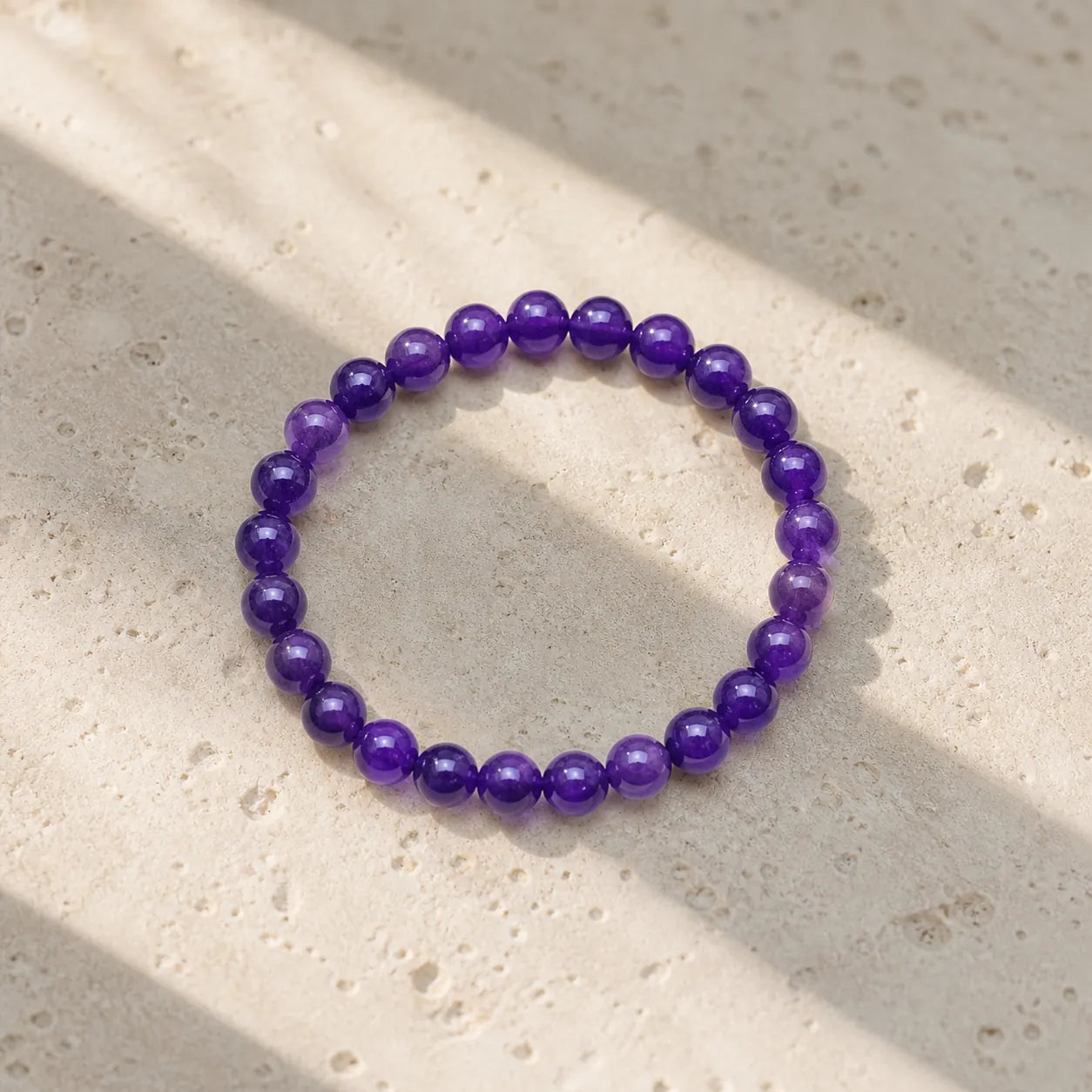
Natural Amethyst Bracelet 8mm Beads
A gentle ritual piece for bringing this intention into your daily routine.
Shop This Authentic Piece →Best Purple Crystals for Sleep and Meditation
If your goal is rest and stillness, a small, focused selection works better than a crowded shelf. Here is how the four stones compare for these two purposes.
- For sleep, first choice — amethyst. Its calm, familiar presence makes it easy to place on a nightstand or under a pillow without fuss. A tumbled stone or small cluster is ideal.
- For sleep, second choice — lepidolite. Best if you want something softer and more tactile to hold during a breathing practice before bed.
- For meditation, first choice — amethyst or purple fluorite. Amethyst suits devotional or heart-centred practice; fluorite suits concentration and breath-counting.
- For meditation through change — charoite. Reach for it when your practice is less about calm and more about courage.
A simple pairing many people enjoy: amethyst by the bed for sleep, and a small purple fluorite on a meditation cushion or desk for daytime focus.
How to Use Purple Crystals for Sleep and Meditation
Practical rituals matter more than elaborate setups. These are gentle, repeatable ways to bring a purple stone into your day.
- Bedside placement. Set your stone where your eyes land last at night. Let it mark the start of your wind-down: dim the lights, put the phone away, and take five slow breaths.
- Palm-stone breathing. Hold a smooth stone in your non-dominant hand. Inhale for four counts, exhale for six. When your mind wanders, notice the stone’s temperature and texture, then return to the breath.
- A three-stone meditation layout. Place amethyst at the centre for calm, fluorite to one side for clarity, and charoite to the other for release. Spend a few minutes at each.
- Journaling companion. Keep a stone on your notebook as a small anchor while you write a few lines before bed.
- Wearable reminders. A bracelet or pendant keeps the intention with you through the day, especially useful during a period of change.
- Pair with scent and sound. A drop of lavender, a low ambient track, or simply an open window can reinforce the same cue. The crystal is one part of a larger ritual, not the whole of it.
Caring for Your Purple Crystals
Purple stones are generally easy to live with, but a few are softer than they look.
- Keep amethyst out of prolonged direct sunlight. Its colour can fade over months on a bright windowsill.
- Skip water for lepidolite, fluorite, and charoite. Lepidolite is a layered mica that can flake, fluorite is soft and water-sensitive, and charoite prefers to stay dry. A dry soft cloth is enough.
- Avoid salt baths for soft stones. Salt can scratch fluorite and dull charoite’s polish.
- Cleanse gently. Moonlight, sound (a singing bowl or chime), or resting the stone on a selenite plate are all gentle options that suit these materials.
- Store separately. Fluorite in particular scratches easily, so give it its own pouch rather than tossing it in a bowl of harder stones.
Key Takeaways
- Purple crystals are traditionally linked with the crown chakra, intuition, and inner quiet — a symbolic association rather than a medical one.
- Amethyst is the most versatile choice for sleep and meditation; lepidolite is the softest and most tactile; purple fluorite supports focus; charoite suits periods of change.
- Look for natural variation in colour and texture when buying, and be cautious of stones with dye pooled in cracks.
- Ritual and repetition do the real work — the stone is a cue, not a cure.
- Care is simple: keep soft purple stones dry, out of harsh sunlight, and stored apart from harder pieces.
Frequently Asked Questions
What are the meanings of purple crystals?
Across crystal traditions, purple stones are associated with the crown chakra, intuition, spiritual insight, and mental calm. Amethyst is linked with tranquillity and balance, lepidolite with emotional soothing, purple fluorite with clarity and order, and charoite with transformation and release. These meanings are cultural and symbolic rather than scientific — what a stone means to you will come from how you use it.
Which purple crystals are best for sleep and meditation?
Amethyst and lepidolite are the most common choices for sleep, largely because they are comfortable to keep beside a bed or hold in the hand. For meditation, amethyst suits slow, calming practice while purple fluorite suits focus and breath-counting. Charoite is often chosen when meditation is part of working through a life change.
How do I use purple crystals for sleep?
Place a tumbled stone or small cluster on your bedside table and let it mark the beginning of your wind-down routine. Hold a smooth palm stone while you take slow breaths before sleep, or keep it under your pillow if that feels comfortable. The stone is a cue for consistency — the routine is what supports rest. If sleep difficulties persist, speak with a healthcare professional.
Conclusion
Purple crystals ask nothing of you except attention. In return, they offer a small, beautiful anchor for the two practices most of us need more of: rest and stillness. Whether you choose a classic amethyst for the bedside, a soft lepidolite to hold during an evening breath practice, a structured piece of purple fluorite for your desk, or a swirling charoite for a season of change, the value lies in the ritual you build around it — not in a promise it cannot keep.
Start with one stone. Place it where you will see it. Use it as a cue to slow down, and let that be enough.
Related Reading
- Fluorite Meaning: Meaning, Properties, and Everyday Uses
- Kyanite Crystal Meaning: A Guide to Benefits, Uses, and Chakra Alignment
- Rose Quartz Crystal: A Gentle Guide to Meaning, Benefits, and Uses
- Angelite Crystal Meaning, Benefits & Spiritual Guide
- Red Jasper: A Gentle Guide to Meaning, Benefits, and Uses