Rhodonite Stone: Spiritual Meaning, Symbolism, and Daily Use

Table of Contents
- What Is Rhodonite? Manganese-Rich Stone Basics (Color, Hardness, Origins)
- 10-Second Executive Summary / The Verdict Box
- Rhodonite Stone Meaning and Symbolism (Heart-Centered Love, Compassion, Emotional Balance)
- Spiritual Meaning and Healing Properties (Emotional Healing, Forgiveness, Confidence, Grounding)
- Rhodonite and the Chakras: Heart Chakra Use and Energy Work
- Daily Use: Jewelry, Meditation, Home and Workspace Placement
- How to Cleanse, Charge, and Care for Rhodonite
- Authenticity and Buying Guide: Rhodonite vs. Rhodochrosite, Pyroxmangite, and Bustamite
- Rhodonite Lookalike Decision Table
- FAQ: Quick Answers on Rhodonite Meaning, Benefits, and Use
- What does rhodonite stone mean spiritually?
- What chakra is rhodonite associated with and how do you use it?
- How can you tell real rhodonite from lookalikes like rhodochrosite or pyroxmangite?
- Sources
What Is Rhodonite? Manganese-Rich Stone Basics (Color, Hardness, Origins)
Rhodonite is a manganese silicate mineral (MnSiO₃) that typically appears in opaque to translucent pink, rose-red, or brownish-red masses, often with distinctive black manganese oxide veining—and its spiritual meaning centers on heart-centered compassion, emotional healing, and grounding through forgiveness, though these are interpretive and cultural associations rather than scientific claims.
The Smithsonian's National Museum of Natural History notes that rhodonite's pink color comes from manganese (Smithsonian NMNH). For the buyer and the practitioner alike, the technical basics are worth knowing before any symbolic layer is added.
- Chemistry: Manganese silicate, MnSiO₃.
- Mohs hardness: Approximately 5.5–6.5 (frequently cited range for massive material; single crystals can trend toward the higher end). This is softer than quartz (7) and requires care in daily wear.
- Color and pattern: Pink to rose-red groundmass, black dendritic/vein-like manganese oxide inclusions, sometimes with brown or gray zones.
- Origin: Notable localities include Russia (historically the Ural Mountains), Australia, Brazil, Sweden, Peru, and the United States. Mindat lists global localities and locality data for reference (Mindat).
- Polymorph note: Pyroxmangite is a high-pressure, low-temperature polymorph of MnSiO₃—chemically the same as rhodonite but structurally different (Mindat). This matters for identification and for any claim of "authentic rhodonite."
10-Second Executive Summary / The Verdict Box
- Direct Verdict: Rhodonite is a manganese silicate gemstone most often associated with the heart chakra, compassion, forgiveness, and emotional grounding—symbolic and cultural meanings, not medical effects.
- Mohs Hardness: ~5.5–6.5 (massive material); softer than quartz, so rings and bracelets need protection.
- Key Physical Marker: Pink/rose groundmass with black manganese oxide veining; pink color is manganese-derived.
- Best Use Cases: Heart-centered meditation, journaling and affirmation work, home/workspace placement, and jewelry worn with care (pendants and earrings before rings).
- Buying Signal: Look for natural manganese veining and ask about treatment; apply the Lumina Grade AAA Integrity Standard (natural rough, no chemical stabilization/resin filling, no irradiation or dye).
Rhodonite Stone Meaning and Symbolism (Heart-Centered Love, Compassion, Emotional Balance)
In crystal and folk traditions, rhodonite's meaning is built around the heart: it is often associated with compassionate love, forgiveness, and the gradual settling of emotional turbulence. The name itself traces to the Greek rhodon ("rose"), a reference to its color rather than any proven effect. This is where honest language matters. Rhodonite may support reflective practices and is often used as a personal reminder to respond with gentleness, but it does not chemically "balance emotions" or regulate the nervous system—those claims belong to marketing, not mineralogy.
What the stone does offer symbolically is a useful contrast: soft rose tones interrupted by black veins. Practitioners frequently read this as a metaphor for tenderness coexisting with difficulty—compassion that has been tested. If you work with rhodonite, treat that metaphor as your anchor. It is a prompt for how you want to show up, not a promise about how you will feel.
Spiritual Meaning and Healing Properties (Emotional Healing, Forgiveness, Confidence, Grounding)
Across modern crystal practice, rhodonite is most often associated with a handful of recurring themes. These are cultural and personal-use associations, and they are best held as invitations rather than outcomes.
- Emotional healing: Often framed as a stone for processing old hurt at a sustainable pace—useful as a journaling or meditation focus, not as a substitute for care from qualified professionals.
- Forgiveness: Frequently paired with practices of self-forgiveness and releasing resentment; the black veins are symbolically read as the residue that stays after healing, not as failure.
- Confidence: Sometimes called a "self-worth" stone; in practice, people use it as a touchstone before difficult conversations or public speaking.
- Grounding: Its dense, opaque character and manganese content lead many practitioners to place it in the "earthy, stabilizing" category—again, a felt association rather than a measurable effect.
A grounded way to use these meanings: choose one theme per season. If forgiveness is your theme, pair rhodonite with a written practice (a letter you don't send, a weekly reflection). If confidence is your theme, keep it in your pocket for specific moments rather than wearing it passively. Meaning grows from repetition and intention, not from the stone alone.
Rhodonite and the Chakras: Heart Chakra Use and Energy Work
Rhodonite is most commonly associated with the heart chakra (Anahata), and secondarily with the root chakra when used for grounding. In energy-work traditions, heart-chakra stones are used to support openness, compassion, and relational balance—again, as symbolic and meditative support.
A simple, repeatable heart-chakra practice:
- Sit comfortably and hold rhodonite in your non-dominant hand, or place it at the center of your chest.
- Breathe slowly for 3–5 minutes, directing attention to the sternum area without forcing any sensation.
- Name one person (including yourself) you wish to treat with more patience this week.
- Close by noting one concrete action that would express that patience.
If you are combining stones, keep the pairing intentional. Rhodonite with clear quartz is a common choice for clarity; rhodonite with hematite is often chosen for grounding. Avoid overloading a single grid or pouch—three stones is usually enough to keep the focus legible.
Daily Use: Jewelry, Meditation, Home and Workspace Placement
Because rhodonite sits around 5.5–6.5 on the Mohs scale, daily use should be planned around its softness. Rings and bracelets take the most abuse; pendants, earrings, and pocket stones are lower-risk.
- Jewelry: Choose pendants or earrings for everyday wear. If you want a bracelet, look for a protected setting or a beaded design with a soft cord, and remove it before gardening, gym work, or cleaning.
- Meditation: Hold a tumbled stone or a palm-sized slab. The black veining gives the eye a natural focal point, which helps with steady attention.
- Workspace: Place a small piece near your monitor or in a desk drawer as a "pause" cue—something you touch before replying to a tense email.
- Home: Entryway dishes, bedside tables, and reading nooks are common placements. Keep pieces out of direct, prolonged sunlight if the color is important to you, and away from humid bathrooms if the piece has metal fittings.
How to Cleanse, Charge, and Care for Rhodonite
Cleansing and charging are traditional practices, not physical necessities—rhodonite does not "hold energy" in any measurable sense. What matters physically is moisture, heat, and abrasion.
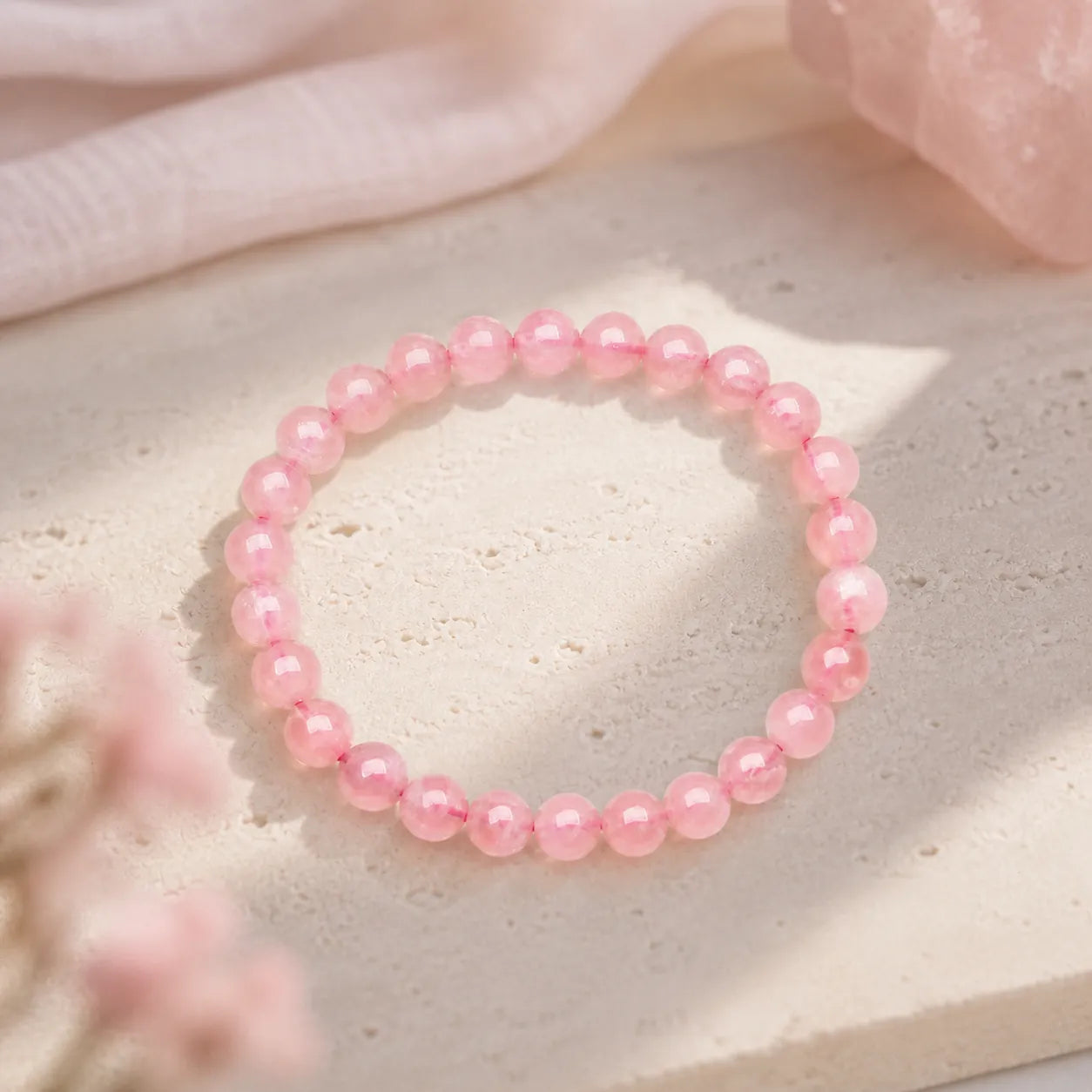
A related intention option
Rose Quartz Love Bracelet
This is a related emotional healing, love option, not a Rhodonite product. We only identify jewelry as Rhodonite when that exact material is verified.
Explore this related option- Cleanse gently: Wipe with a soft, slightly damp cloth and dry immediately. Avoid soaking, ultrasonic cleaners, and steam—manganese-bearing material and any metal settings are better kept dry.
- Charge by moonlight or intention: A common practice is to rest the stone on a windowsill overnight or simply hold it and set an intention. Avoid long sun exposure, which may fade color over time.
- Store separately: Keep rhodonite in a soft pouch away from harder stones like quartz or sapphire to prevent scratching.
- Skip salt beds and harsh chemicals: Salt and acidic cleaners can dull the polish and damage settings.
Authenticity and Buying Guide: Rhodonite vs. Rhodochrosite, Pyroxmangite, and Bustamite
Rhodonite is frequently confused with lookalikes, and the difference is not only aesthetic—it affects price, durability, and what the seller can honestly claim. The Lumina Grade AAA Integrity Standard, used here as our buying benchmark, means natural rough material with no chemical stabilization or resin filling and no irradiation or dye. Apply it as a checklist: ask for the material's origin, ask whether it has been treated, and inspect the pattern under good light.
Rhodonite Lookalike Decision Table
| Candidate | Key Visual/Physical Cue | Chemical/Structural Note | Buying Caution |
|---|---|---|---|
| Rhodonite | Pink/rose groundmass with black manganese oxide veining; opaque, dense | MnSiO₃; Mohs ~5.5–6.5 | Confirm natural veining, no resin filling; dyed material often shows uniform pink with unnatural contrast |
| Rhodochrosite | Often banded or botryoidal, pink to rose with white/cream swirls; frequently more translucent | MnCO₃ (manganese carbonate); softer (Mohs ~3.5–4) | Softer and more expensive; do not assume rhodonite's durability |
| Pyroxmangite | Visually near-identical to rhodonite in many specimens | Same composition, different polymorph (high-pressure, low-temperature) (Mindat) | Routine visual identification is unreliable; request lab-backed material descriptions |
| Bustamite | Pinkish to brownish, often with a more fibrous or granular habit; generally less veined | Manganese calcium silicate; distinct mineral species | Sold in mixed lots; ask for species-level identification, not "pink stone" |
For reference-quality material, collections such as the Smithsonian's mineral holdings show the range of color and crystal habit in natural rhodonite (Smithsonian). A specimen-grade crystal looks very different from a polished bead strand, and neither is "more authentic"—but both should be honestly described. GIA's work on rhodonite–pyroxmangite occurrences underscores why species-level claims deserve scrutiny (GIA).
FAQ: Quick Answers on Rhodonite Meaning, Benefits, and Use
What does rhodonite stone mean spiritually?
In crystal traditions, rhodonite is associated with heart-centered compassion, forgiveness, and emotional grounding—symbolic meanings, not verified effects. It is most often used as a personal reminder for gentleness and self-worth.
What chakra is rhodonite associated with and how do you use it?
Rhodonite is most commonly linked to the heart chakra (and secondarily the root chakra for grounding). A simple practice is to hold it at the chest, breathe slowly for a few minutes, and set one concrete intention for patience or forgiveness.
How can you tell real rhodonite from lookalikes like rhodochrosite or pyroxmangite?
Look for pink groundmass with natural black manganese veining, and remember that rhodochrosite is softer and often banded with white, while pyroxmangite can look nearly identical and requires mineralogical identification. Ask sellers for treatment details and apply a strict standard such as the Lumina Grade AAA Integrity Standard.
Disclaimer: Rhodonite's meanings and uses described here are cultural and personal-practice associations. This article is for informational purposes and is not medical, psychological, or therapeutic advice. If you are experiencing emotional distress, consult a qualified professional.
Sources
- Mindat — Rhodonite: Mineral information, data and localities
- Smithsonian National Museum of Natural History — Rhodonite
- Smithsonian Institution — Rhodonite object record
- GIA — Rhodonite–Pyroxmangite from Tanatz Alp
- Mindat Mineralogy Database — Rhodonite Mineral Data
© 2026 Lumina Quartz