Sodalite Bracelet Meaning: What to Know Before You Choose
Table of Contents
- Introduction: The Meaning and Appeal of Sodalite Bracelets
- What Is Sodalite? A Brief Overview
- The History and Origins of Sodalite
- Sodalite's Color and Appearance
- Sodalite Bracelet Meaning: Symbolism and Everyday Use
- A Stone of Truth and Logic
- Enhancing Intuition and Mental Clarity
- Emotional Balance and Communication
- Sodalite vs. Lapis Lazuli: How to Tell Them Apart
- Is a Sodalite Bracelet Right for You? A Decision Checklist
- Healing Benefits of Sodalite Bracelets
- Emotional and Spiritual Healing
- Physical Healing Properties
- How to Choose the Perfect Sodalite Bracelet
- Quality Factors: Color, Clarity, and Cut
- Bracelet Styles and Bead Sizes
- How to Cleanse and Care for Your Sodalite Bracelet
- Cleansing Methods
- Charging and Programming Your Crystal
- Frequently Asked Questions About Sodalite Bracelets
- Conclusion: Is a Sodalite Bracelet Right for You?
There are certain stones that seem to carry a quiet kind of knowing within them — an old, steady wisdom that invites you to slow down and listen. Sodalite is one of those stones. With its deep blue fields and delicate veins of white, it resembles a night sky frozen in stone, or perhaps the moment before dawn when the world feels suspended between sleep and clarity. For centuries, sodalite has appeared in jewelry and sacred objects, and today it continues to draw people in with its understated, contemplative beauty.
If you have been searching for a meaningful piece of wearable crystal energy, you may have found yourself reading about the sodalite bracelet meaning and wondering whether this stone might hold something for you. A steadier mind. A softer heart. A deeper sense of truth. This guide explores what sodalite is, what it has come to symbolize, how to choose a bracelet that resonates with you, and how to care for it once it becomes part of your everyday life.
Introduction: The Meaning and Appeal of Sodalite Bracelets
Sodalite bracelets have a way of finding the people who need them. Perhaps you were drawn to the color first — that rich, royal blue that seems to absorb light rather than reflect it. Or maybe you noticed the name, sodalite, which sounds like something ancient and grounded, and you felt curious. Whatever brought you here, the appeal of these bracelets often reaches beyond mere aesthetics. They speak to something inside us that longs for order, peace, and honest self-expression.
In the world of crystals, sodalite is often associated with clarity, logic, and emotional truth. It is not a flashy stone. It does not demand attention the way a diamond might, nor does it glow with the warm urgency of amber. Instead, sodalite asks you to lean in closer, to sit with it, to notice the subtle patterns and quiet depth it holds. For many, wearing a sodalite bracelet becomes a daily reminder of their own inner knowing — a small, tangible anchor in a world that often feels loud and chaotic.
What Is Sodalite? A Brief Overview
To truly appreciate the sodalite bracelet meaning, it helps to understand the stone itself. Sodalite is a member of the feldspathoid group of minerals, composed primarily of sodium and aluminum silicate with chloride. Its name comes from its sodium content, which is unusually high for a mineral — mineralogists note that, unlike related minerals such as haüyne and lazurite, calcium and potassium are seldom present in its crystal structure.
Sodalite was first formally described in the early 19th century, after specimens were found in Greenland, but its use predates that discovery by centuries. Notable deposits are found in Canada, Namibia, Brazil, Russia, and Afghanistan, and gem-quality material — including some unusually transparent pieces — continues to be produced today.
The History and Origins of Sodalite
Long before it was formally named, sodalite was prized by indigenous peoples of South America. In the Andes, it adorned ceremonial masks and jewelry, often mistaken for lapis lazuli because of its striking blue color. The Incas, in particular, held the stone in high regard for its color and spiritual resonance, using it in rituals and decorative art.
Science formally identified sodalite in 1811, and since then it has been discovered in numerous locations, including Canada's Quebec and Ontario regions, which produce some of the world's finest specimens. Today, sodalite is not considered a rare gemstone, which makes it accessible to those who are drawn to its beauty without the high price tag of more precious blue stones.
Sodalite's Color and Appearance
Most people recognize sodalite by its signature blue hue — a deep, serene blue that can range from pale powder blue to a nearly navy intensity. White calcite veins often weave through the stone, creating webbing or cloud-like patterns. This natural matrix gives each bead a unique, one-of-a-kind appearance. You may also notice small flecks of pyrite, which add a subtle glimmer, though these are less common than in lapis lazuli.
The stone is typically opaque, though some pieces may be slightly translucent on thin edges. A rare variety called hackmanite can be far more transparent, and gemologists have documented sulfur-rich fluid inclusions inside these clearer crystals — tiny geological time capsules that hint at how the stone formed. Because sodalite has a hardness of only 5.5 to 6 on the Mohs scale, it is considered a relatively soft stone, best suited for bracelets and pendants that do not undergo extreme wear.
Sodalite Bracelet Meaning: Symbolism and Everyday Use
The sodalite bracelet meaning has evolved over time, weaving together threads of ancient cultural beliefs, modern crystal healing philosophies, and the personal significance that each wearer brings to it. At its core, sodalite is widely regarded as a stone of the logical and intuitive mind — a bridge between rational thought and inner knowing.
In crystal healing traditions, sodalite is associated with the throat and third-eye chakras. The throat chakra governs expression, while the third eye governs intuition. This makes sodalite an interesting stone, because it encourages not only speaking your truth but also knowing your truth in the first place. It invites you to check in with yourself before you speak, to feel the weight of your words, and to express honestly where it matters most.
A Stone of Truth and Logic
One of the most enduring symbolic associations with sodalite is its connection to truth. The stone is often referred to as the "poet's stone" because it is believed to enhance self-expression, creativity, and clear reasoning. If you are facing a difficult decision, a sodalite bracelet may serve as a reminder to step back from emotional overwhelm and see the situation with fresh eyes. It offers a kind of rational clarity, as if the universe is gently reminding you that you are capable of thinking things through.
Many people also use sodalite in work or study settings. Students, writers, and professionals often find that keeping sodalite nearby helps them stay focused and articulate. These experiences are personal and vary from person to person, but the consistent thread is that sodalite is associated with intellectual clarity and a calm, organized mind.
Enhancing Intuition and Mental Clarity
Beyond logic, sodalite is deeply connected to intuition. Its blue color — the color of the throat and third-eye chakras — is thought to open pathways of higher understanding. Some crystal practitioners describe sodalite as a stone that quiets mental noise so that quieter insights can surface. It is less about adding something new and more about clearing away what obscures what you already sense.
Wearing sodalite during meditation or journaling can be a simple way to invite that stillness. Many people find it easier to name what they are feeling when they have a physical focal point for their attention, and a smooth, cool bead resting against the wrist can serve exactly that purpose.
Emotional Balance and Communication
Sodalite is also associated with emotional steadiness, particularly in moments when emotions run high. Rather than suppressing feeling, it is traditionally thought to help you hold emotion and reason side by side — to feel deeply without being swept away. For anyone who tends to speak before thinking, or who struggles to speak at all, sodalite is often chosen as a companion for honest, measured communication.
In that sense, the meaning of a sodalite bracelet is not fixed. It becomes whatever you return to again and again: patience, honesty, calm, or simply a reminder to breathe before you respond.
Sodalite vs. Lapis Lazuli: How to Tell Them Apart
Because both stones are deep blue, sodalite and lapis lazuli are frequently confused — a mistake that goes back centuries. The simplest distinction is in the matrix. Sodalite usually shows white or pale gray calcite veining, while lapis lazuli typically includes golden flecks of pyrite and may carry a slightly violet tone. Lapis is often a deeper, more saturated ultramarine; sodalite tends to read as a softer, more uniform royal blue with white webbing.
Both stones sit in a similar hardness range and both are opaque in most jewelry-grade material, so a careful look at the pattern — white veins versus gold flecks — is usually the quickest way to tell which one you are holding.
Is a Sodalite Bracelet Right for You? A Decision Checklist
Before you buy, a few simple checks can help you choose a bracelet you will actually enjoy wearing. This short guide walks through what to look for and when another stone might suit you better.
- You want a calm, focused stone. Sodalite suits people drawn to quiet clarity rather than high-energy or highly protective stones.
- You like visible, natural character. White calcite veining and slight color variation are normal and part of the stone's appeal. A perfectly uniform, glassy blue with no pattern is worth a second look.
- You will wear it gently. At 5.5–6 on the Mohs scale, sodalite scratches more easily than quartz or agate. If you work with your hands or wear a bracelet through heavy activity, a harder stone may hold up better.
- You want a stone you can wear daily. Sodalite is comfortable against the skin and light enough for all-day wear, provided you remove it for cleaning, gardening, or the gym.
- You are choosing between sodalite and lapis. If gold pyrite flecks and a deeper blue are the look you want, choose lapis. If you prefer white veining and a softer, more affordable blue, choose sodalite.
- You are buying online. Ask for photos in natural light, confirm the bead size in millimeters, and check whether the listing specifies natural, untreated sodalite rather than a dyed lookalike such as dyed howlite or jasper.
If most of these points feel like a fit, a sodalite bracelet is likely to become a piece you reach for often rather than one that sits in a drawer.
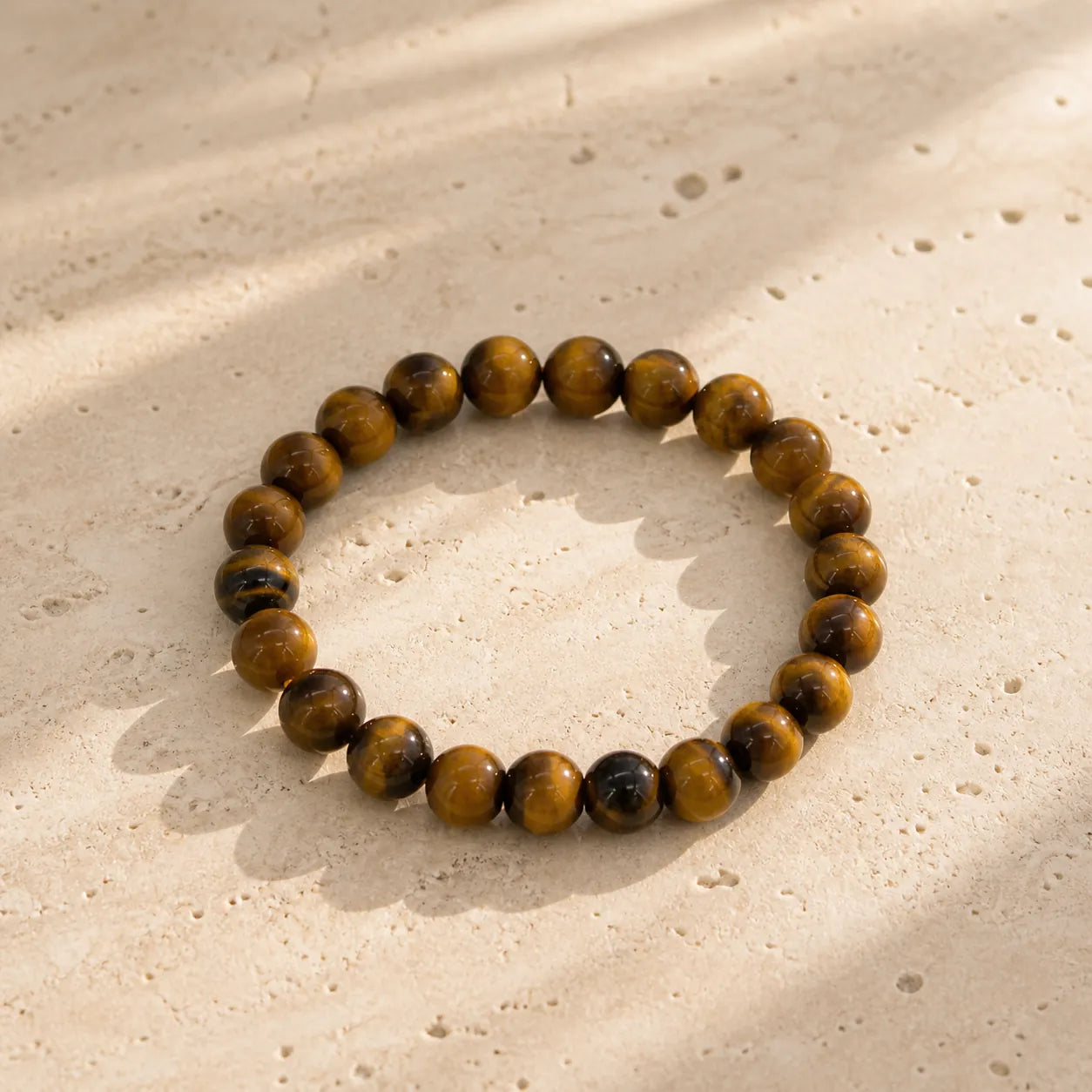
A related intention option
Tiger Eye Bracelet – Decisive Focus
This is a related focus option, not a Sodalite product. We only identify jewelry as Sodalite when that exact material is verified.
Explore this related optionHealing Benefits of Sodalite Bracelets
In crystal healing traditions, sodalite is valued for both emotional and physical support. These associations come from centuries of folk practice and modern energy work rather than from clinical research, and they are best enjoyed as part of a personal ritual practice. A bracelet is not a substitute for professional care, but it can be a meaningful companion alongside it.
Emotional and Spiritual Healing
Sodalite is traditionally linked with mental calm and emotional equilibrium. Crystal healers often suggest it for times when the mind feels cluttered or when self-doubt makes it hard to speak up. It is also associated with spiritual insight — the sense of connecting to a deeper, quieter part of yourself during meditation, breathwork, or reflective journaling.
Physical Healing Properties
In traditional crystal lore, sodalite is associated with the throat and with general physical balance — some practitioners place it near the throat during rest, while others wear it as a reminder to slow down and breathe. These are traditional beliefs rather than medical treatments. If you are dealing with a health concern, please speak with a qualified healthcare provider, and enjoy your bracelet as a source of comfort and intention rather than a remedy.
How to Choose the Perfect Sodalite Bracelet
Choosing a bracelet is a small ritual in itself. Take your time, hold a few options, and notice which one you keep returning to.
Quality Factors: Color, Clarity, and Cut
Look for a rich, even blue with crisp white veining and a smooth, well-polished surface. Beads should feel cool and dense, with no cracks, pits, or rough patches around the drill holes. Some variation between beads is natural and beautiful; what you want to avoid is a flat, painted-looking surface, which can indicate dyeing. Transparency is uncommon in sodalite and generally reserved for the rarer hackmanite variety, so opacity is not a flaw.
Bracelet Styles and Bead Sizes
Bead size changes both the look and the feel. Six-millimeter beads create a delicate, stackable bracelet; eight-millimeter beads are the most popular everyday size; ten-millimeter and larger beads make a bolder statement and show more of the stone's pattern. Stretch cord is convenient for daily wear, while a knotted strand with a clasp feels more formal. If you are layering, sodalite pairs beautifully with clear quartz, moonstone, or a simple gold band. You can explore soft, well-matched sodalite bracelets in the Lumina Quartz collection if you would like a place to start.
How to Cleanse and Care for Your Sodalite Bracelet
Regular cleansing is a way of resetting your relationship with a stone. Choose one method and return to it consistently — the routine matters more than the technique.
Cleansing Methods
- Smoke cleansing: Pass the bracelet through the smoke of palo santo, cedar, or dried herbs for a minute or two.
- Sound cleansing: Rest it near a singing bowl or chime and let the tone move through the beads.
- Moonlight: Leave your bracelet on a windowsill overnight during a full or new moon.
- Dry salt or rice: Bury the bracelet in a bowl of dry sea salt or brown rice for a few hours, then brush it clean.
Avoid prolonged soaking in water, which can loosen stretch cord over time, and skip ultrasonic cleaners, which are too aggressive for a stone of this hardness.
Charging and Programming Your Crystal
To charge your bracelet, place it in moonlight or beside a clear quartz point overnight. Programming is simply the practice of setting an intention — hold the bracelet, take a few slow breaths, and name what you would like it to remind you of. "Speak clearly." "Stay steady." "Tell the truth gently." Keep the intention short enough that you can recall it whenever you feel the beads against your wrist.
Frequently Asked Questions About Sodalite Bracelets
What does a sodalite bracelet mean?
A sodalite bracelet is traditionally associated with truth, logic, and clear communication. Because the stone is linked to the throat and third-eye chakras in crystal healing traditions, it is often worn as a reminder to think clearly and speak honestly.
Is sodalite the same as lapis lazuli?
No. They are different minerals, though they look similar. Sodalite usually shows white calcite veining, while lapis lazuli typically contains golden pyrite flecks and often appears a deeper, more violet blue.
Which wrist should I wear a sodalite bracelet on?
There is no fixed rule. Many people wear it on the left wrist when they want to receive the stone's calming energy, and on the right when they want to express or project it. Choose whichever feels comfortable and meaningful to you.
Can I wear a sodalite bracelet every day?
Yes. Sodalite is comfortable for daily wear, though at 5.5–6 on the Mohs scale it scratches more easily than harder stones. Remove it for cleaning, sports, and heavy manual work, and it should stay beautiful for years.
How do I know if sodalite is dyed?
A natural, untreated sodalite bracelet shows subtle color variation between beads with white veining that follows the stone's grain. Uniform, saturated color with no pattern — or color that has settled into cracks and drill holes — can indicate dyeing.
Conclusion: Is a Sodalite Bracelet Right for You?
A sodalite bracelet is not a magic charm, and it does not need to be. Its value lies in what it quietly invites: a breath before you speak, a moment of clarity before you decide, a reminder of the truth you already know. If you are drawn to deep blue, to honest self-expression, and to a stone that rewards patience rather than drama, sodalite is likely to feel at home on your wrist.
Choose one that catches your eye, cleanse it when it feels heavy, and let it carry whatever intention matters most to you right now. The sodalite bracelet meaning is ultimately yours to define — the stone simply keeps the reminder close.
Related Reading
- Crystal Rituals for Beginners: A Simple Guide to Daily Practice
- Daily Crystal Ritual: How to Set Intention, Wear, and Cleanse Your Stone
- Calming Crystals: Crystal Ritual Guide
- Crystals For Physical Healing: Best Stones and Simple Daily Rituals
- Energy Crystals For Water: Best Stones and Simple Daily Rituals
- Obsidian Bracelet: Your Guide to Grounding & Protection