Spiritual Of Selenite: Spiritual Meaning, Symbolism, and Daily Use

Table of Contents
- 10-Second Executive Summary / The Verdict Box
- What Is Selenite? The Moon-Named Stone of Light
- The Spiritual Meaning of Selenite: Clarity, Calm, and Cleansing
- Selenite Symbolism Through History, from Selene to Modern Crystal Practice
- Selenite and the Crown Chakra: Connecting to Higher Guidance
- Daily Use: 7 Simple Selenite Rituals for Home, Meditation, and Sleep
- Cleansing Your Space and Other Crystals
- Meditation, Angelic Connection, and Dream Work
- How to Care for Selenite: Keep It Dry and Handle with Care
- Selenite vs. Satin Spar and Other Lookalikes
- Quick Choosing and Care Checklist: Decision Guide
- Choosing Your Selenite: Wands, Towers, Plates, and Lamps
- Frequently Asked Questions
- What does selenite symbolize spiritually?
- Is selenite a cleansing crystal, and does it need to be cleansed?
- Can selenite get wet, and how should I care for it?
- Sources
Selenite is a transparent or translucent variety of gypsum, and its spiritual meaning centers on clarity, calm, and energetic cleansing. In crystal practice it is most often associated with the crown chakra, with quieting mental noise before meditation, and with clearing the energy of a room or of other stones. One practical point matters more than any ritual: selenite is soft and water-soluble, so it is cared for dry, not washed.
10-Second Executive Summary / The Verdict Box
- Direct Verdict: Selenite is best understood as a stone of clarity and clearing — a visual and symbolic anchor for calm, honest reflection, and space-setting rather than a medical or emotional treatment.
- What it is: A transparent variety of gypsum; "selenite" is largely synonymous with gypsum and historically described the clear form, as distinct from satin spar gypsum (Mindat).
- Mohs Hardness: 2 — soft enough to scratch with a fingernail; keep it away from harder stones and sharp edges.
- Water behavior: Selenite is water-soluble gypsum, so never soak or rinse it; clean with a dry or barely damp cloth.
- Chakra association: Crown chakra, often associated with higher guidance and quiet reflection.
- Best for: Meditation focal pieces, bedside calm rituals, dry crystal cleansing, and clearing a room's atmosphere before rest or practice.
- Integrity note: Look for natural, untreated material under the Lumina Grade AAA Integrity Standard — natural rough or polished gypsum, zero chemical resin filling, no irradiation or dye.
What Is Selenite? The Moon-Named Stone of Light
Selenite is a clear, often fibrous or pearly form of gypsum, named after Selene, the Greek goddess of the moon. Mineralogically, the term is mostly synonymous with gypsum but historically referred to the transparent variety, while the silky, opaque form is called satin spar gypsum (Mindat). That distinction matters when you shop: the glowing white "selenite" towers and lamps sold today are usually satin spar, and they carry the same soft, water-soluble gypsum chemistry. Its pale translucence is what gives it the moonlit quality that most spiritual traditions respond to.
The Spiritual Meaning of Selenite: Clarity, Calm, and Cleansing
In modern crystal practice, the spiritual meaning of selenite is usually described in three overlapping themes. First, clarity: its light-passing surface is often associated with clearing mental fog and seeing a situation plainly. Second, calm: it may support a slower, quieter state, especially when held or placed nearby during meditation. Third, cleansing: selenite is widely used to "clear" the energy of spaces and other crystals.
It is worth being honest here. These are cultural and symbolic associations, not measured effects. Selenite may support a sense of calm through ritual, attention, and setting, and it is often associated with peace and mental quiet — but it is not a treatment for anxiety, intrusive thoughts, or any nervous-system condition, and it should never replace care from a qualified professional. What you can rely on is geological fact: gypsum's soft, luminous structure, and the way light behaves in it.
Selenite Symbolism Through History, from Selene to Modern Crystal Practice
The moon association is embedded in the name. Selene was the Greek personification of the moon, and the stone's silvery translucence kept that link alive through centuries of lore. Historically, the word "selenite" was applied to the clear gypsum variety, which was valued for its unclouded transparency and sometimes cut into thin plates. In contemporary practice, the symbolism has shifted toward light and clearing: selenite wands are brushed over a space or an aura, selenite plates hold other stones, and selenite lamps act as gentle night-lights that double as decorative anchors.
Where the historical record gives us mineralogy, modern symbolism gives us metaphor. The moon's cycle offers a natural image for release and renewal, and selenite's soft glow makes that metaphor easy to hold in the hand. Keep the two layers separate in your own practice — geology for what it is, symbolism for what it helps you remember.
Selenite and the Crown Chakra: Connecting to Higher Guidance
Selenite is most commonly linked to the crown chakra, the uppermost energy center often associated with connection, insight, and higher guidance. Because its color and translucence read as "light," practitioners frequently place it above the head during meditation, on a bedside table, or at the top of a crystal grid. The crown association is also why selenite is often chosen for quiet reflection and for creating a sense of openness before prayer or journaling.
If you want to work with this association, keep the practice simple: lie down or sit comfortably, hold a small selenite piece or place it a short distance above your head, and spend five minutes noticing your breath. The value is in the pause and the intention, not in a claimed physiological effect. If a piece feels distracting or uncomfortable, set it aside — grounding rituals should feel steady, not strained.
Daily Use: 7 Simple Selenite Rituals for Home, Meditation, and Sleep
Selenite is easy to bring into ordinary days because it works well as a visual cue. Try one or two of these rather than all seven, and rotate as your routine changes:
- Entryway clearing: Place a small selenite tower or plate near the door; pause for one breath when you arrive home.
- Morning light ritual: Hold a piece in daylight for a moment and name one thing you want to approach clearly that day.
- Desk reset: Keep a flat selenite plate on your desk as a boundary object; clear the surface at the end of work.
- Meditation focal point: Set a selenite wand or sphere at eye level during a five-minute sit.
- Bedside calm: Place a small piece on the nightstand and pair it with a three-breath wind-down.
- Crystal care plate: Rest other gentle stones on a selenite plate overnight, keeping water away.
- Evening room sweep: At dusk, brush a selenite wand slowly through the air near a window or threshold as a closing ritual.
Cleansing Your Space and Other Crystals
The most common use of selenite is as a cleansing tool. It is widely believed that selenite does not need to be cleansed itself, and that it can clear the energy of other stones and rooms. Place smaller crystals on a selenite plate or beside a tower overnight, or sweep a wand through a room's corners with a clear intention. Remember that this is a symbolic practice — the point is the deliberate reset, not a measurable field effect. And never use water to "wash" a selenite tool; use a soft dry cloth instead.
Meditation, Angelic Connection, and Dream Work
Because of the moon-and-light symbolism, selenite is often associated with angelic connection and dream work. A simple practice: before sleep, place a small selenite piece on the nightstand, write one question in a notebook, and set it aside. In the morning, read the question before checking your phone. Some practitioners keep selenite near a meditation cushion to mark the start and end of a sit. These uses are personal reminders and ritual anchors; they are not claims about sleep quality or spiritual contact, and they should stay gentle and optional.
How to Care for Selenite: Keep It Dry and Handle with Care
Selenite care comes down to two rules: keep it dry, and handle it gently. As gypsum, it is noticeably soft (Mohs hardness 2) and water-soluble, so soaking, rinsing, or storing it in a humid spot can damage the surface. Dust with a dry or barely damp cloth, keep it away from other harder stones in a drawer, and store it where it will not be knocked against metal or quartz. A selenite lamp or tower should sit on a stable, dry surface, away from sinks and humidifiers. If a piece does get wet, blot it dry promptly rather than rubbing it.
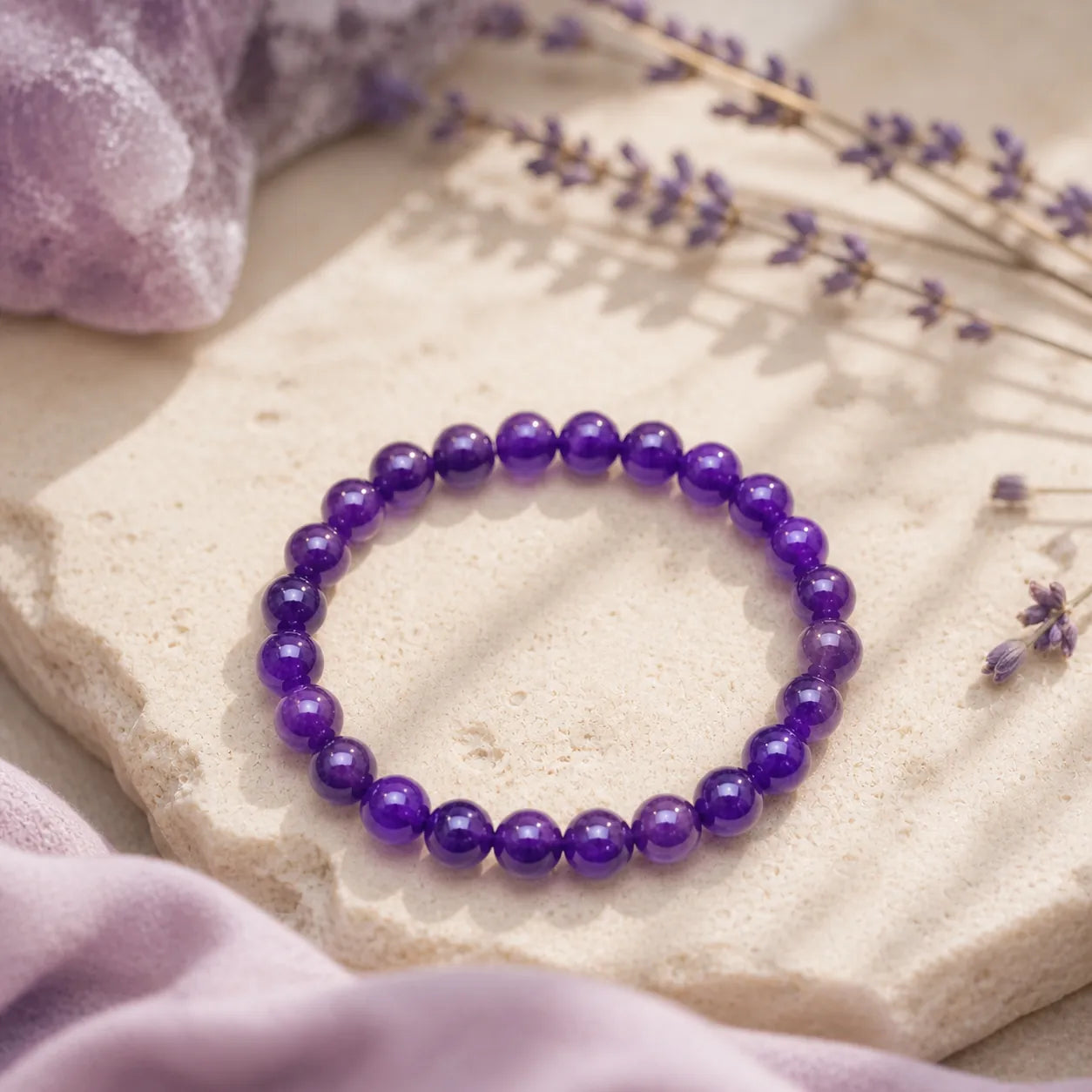
A related intention option
Amethyst Calm Bracelet
This is a related calm, meditation option, not a Selenite product. We only identify jewelry as Selenite when that exact material is verified.
Explore this related optionSelenite vs. Satin Spar and Other Lookalikes
Many "selenite" pieces sold today are technically satin spar gypsum — fibrous, silky, and opaque white, rather than clear. Both are gypsum and both share the same softness and water solubility, so care instructions do not change. Clear selenite tends to look like ice or glass with visible internal planes, while satin spar has a chatoyant sheen. Other lookalikes include clear quartz, which is far harder (Mohs 7) and does not scratch with a fingernail, and calcite, which is harder than gypsum and reacts differently to acid. A fingernail scratch test and a visual check for internal cleavage planes are quick, low-risk ways to tell selenite apart from quartz.
Quick Choosing and Care Checklist: Decision Guide
Use this checklist to pick and maintain a selenite piece without guesswork:
- Check the name on the label: If it says "selenite," confirm whether it is clear selenite or satin spar gypsum — both are gypsum per Mindat.
- Done a fingernail test? If the stone scratches easily, treat it as gypsum and keep it dry; if not, it may be quartz or calcite.
- Ask about treatment: Natural, untreated pieces should meet the Lumina Grade AAA Integrity Standard — natural rough or polished gypsum, no resin filling, no irradiation, no dye. Dyed selenite can lose color unevenly and may stain a dry cloth.
- Choose form by use: Wand for room sweeping and meditation focal points; tower for a shelf or entryway; plate for crystal care; lamp for a bedside glow.
- Storage: Dry drawer, away from hard stones, no plastic wrap in humid rooms.
- Cleaning: Dry or barely damp cloth only — no soaking, no ultrasonic cleaners, no salt water.
- Boundary note: Use selenite as a ritual and reflection tool; do not rely on it for medical or emotional treatment.
Choosing Your Selenite: Wands, Towers, Plates, and Lamps
The right piece depends on the ritual you want to keep. A wand suits room sweeping, meditation, and pointing intention; it is the most portable form. A tower or point is a stable focal object for an entryway, altar, or shelf, and its height makes it read as a marker in a space. A plate or charging slab is for holding other gentle stones overnight, keeping them dry and separated. A lamp, usually satin spar, is a decorative glowing piece for a bedside or living room, and it should sit on a stable, dry surface away from water.
Whatever the form, ask three questions before buying: Is the material natural gypsum with no resin or dye? Is the finish dry and stable rather than wet or sticky? Does it fit the place you will actually use it? A small, well-chosen piece you handle daily usually does more for a practice than a large display piece you never touch. Under the Lumina Grade AAA Integrity Standard, prefer pieces that are what they say they are — clear selenite or satin spar gypsum, honestly labeled and untreated — and let the stone's soft light do the rest.
Frequently Asked Questions
What does selenite symbolize spiritually?
Selenite is most often associated with clarity, calm, and cleansing, and its name links it to Selene, the Greek moon goddess. Practitioners use it as a symbol of light and mental quiet rather than as a claimed medical or emotional treatment.
Is selenite a cleansing crystal, and does it need to be cleansed?
Yes — selenite is widely used to "clear" spaces and other crystals, and many practitioners believe it does not need cleansing itself. Treat that as a symbolic ritual and always keep the stone dry, since gypsum is water-soluble.
Can selenite get wet, and how should I care for it?
No — selenite is soft gypsum (Mohs 2) and water-soluble, so keep it dry and clean it with a dry or barely damp cloth. Store it away from water, humidifiers, and harder stones that could scratch it.
Sources
- Mindat — Selenite: Mineral information, data and localities
- U.S. Geological Survey Open-File Report 03–018
© 2026 Lumina Quartz. This article shares cultural and symbolic associations and does not provide medical advice. Crystal practices are personal and should not replace professional care.