The Complete Everyday Guide to Agate Birthstone: Meaning and Uses

Table of Contents
- 10-Second Executive Summary / The Verdict Box
- Is Agate a Birthstone? Modern vs. Historical Status
- Agate as a Traditional May and June Birthstone
- Agate and Gemini: The Zodiac Connection
- What Agate Is: Banded Chalcedony and Its Place in the Quartz Family
- Agate Meaning and Everyday Benefits
- Emotional Balance, Communication, and Grounding
- Matching Agate Varieties to Intentions (Blue Lace, Moss, Fire, Botswana)
- Agate Variety Decision Table
- Agate Hardness, Durability, and Care for Daily Wear
- Cleaning and Storage Tips
- How to Choose Everyday Agate Jewelry
- Frequently Asked Questions
- Is agate an official birthstone or only a historical and zodiac one?
- What month and zodiac sign is agate associated with?
- What does agate mean and what healing properties is it believed to have?
- How hard and durable is agate for everyday rings and bracelets, and how should I care for it?
- Which agate varieties and jewelry styles suit everyday wear?
- Sources
Agate is not one of the twelve official modern birthstones, but it is widely recognized as a traditional birthstone for May and June and as the zodiac gem for Gemini (May 21–June 21). If you were born in late spring or early summer, or under Gemini, agate is a legitimate and historically grounded choice even though it does not appear on the standard modern list.
10-Second Executive Summary / The Verdict Box
- Direct Verdict: Agate is a traditional May/June birthstone and the Gemini zodiac stone, not an official modern birthstone. It is a durable, everyday-wearable choice for rings and bracelets.
- Mineral Identity: Banded chalcedony, a variety of microcrystalline quartz (SiO₂).
- Mohs Hardness: 6.5–7 — suitable for daily wear with normal care.
- Best For: Gemini and May/June birthdays; everyday rings, bracelets, and pendants; anyone drawn to grounding, banded, natural stones.
- Care Snapshot: Warm water, mild soap, soft cloth. Avoid harsh chemicals, ultrasonic cleaners, and long sun exposure for dyed or heat-treated pieces.
- Lumina Grade AAA Integrity Standard: Natural, untreated agate with no chemical stabilization, no irradiation, and no dyeing.
Is Agate a Birthstone? Modern vs. Historical Status
Agate sits in an interesting middle ground. It is not on the modern standardized birthstone list, yet it has a long history as a traditional stone for May and June and is firmly tied to Gemini in zodiac-based birthstone systems. Understanding this distinction helps you choose agate with confidence rather than confusion.
Agate as a Traditional May and June Birthstone
Traditional and alternative birthstone lists often assign agate to late spring and early summer. The International Gem Society notes that birthstones can be chosen by month, season, zodiac sign, or even day of the week, which is why agate appears in traditional and zodiac-based charts rather than the modern twelve-stone list. If your birthday falls in May or June and you feel drawn to agate, you are working within a recognized historical tradition, not inventing one.
Agate and Gemini: The Zodiac Connection
In zodiac-based birthstone systems, agate is the stone associated with Gemini, covering roughly May 21 to June 21. This is one of the clearest reasons agate is often called a “Gemini stone.” If you were born under Gemini, agate may serve as a meaningful personal talisman, though the connection is symbolic and cultural rather than scientific.
What Agate Is: Banded Chalcedony and Its Place in the Quartz Family
Agate is a banded form of chalcedony, which is itself a microcrystalline variety of quartz. Instead of growing large visible crystals, chalcedony forms in tiny, interlocking fibrous structures, and agate develops distinct bands or layers as it forms in cavities within host rock. This banding is what gives agate its characteristic striped, layered, or patterned appearance.
Because agate is quartz-based, it shares the general chemical composition of SiO₂ and sits at 6.5–7 on the Mohs hardness scale. That places it slightly softer than pure quartz crystal but harder than most glass and many decorative stones, making it a practical choice for everyday jewelry. A piece that meets the Lumina Grade AAA Integrity Standard is natural, untreated agate — no chemical stabilization, no irradiation, and no dyeing — so the banding you see is the banding nature made.
Agate Meaning and Everyday Benefits
Agate’s meaning is largely cultural and symbolic. Across history it has been associated with steadiness, grounding, and balanced communication, and different varieties are often linked to slightly different intentions. These associations are traditional and personal rather than medical; agate jewelry may support a sense of calm or focus for the wearer, but it is not a treatment for any condition.
Emotional Balance, Communication, and Grounding
Agate is often associated with emotional steadiness and clear expression. Blue lace agate, in particular, is frequently linked to gentle communication and calm speech, while darker banded agates are associated with grounding and stability. Many people use agate as a personal reminder — a tangible cue to pause, breathe, or speak deliberately. These are symbolic and mindful uses, not physiological effects.
Matching Agate Varieties to Intentions (Blue Lace, Moss, Fire, Botswana)
Different agate varieties carry different visual characters and traditional associations. Matching a variety to your intention is a practical way to choose a stone you will actually wear every day.
Agate Variety Decision Table
| Variety | Visual Character | Traditional Association | Best Everyday Use |
|---|---|---|---|
| Blue Lace Agate | Pale blue and white lacy banding; soft, light appearance | Gentle communication and calm expression | Pendants, delicate rings, everyday office wear |
| Moss Agate | Green inclusions resembling moss or foliage in clear chalcedony | Connection to nature and steady growth | Casual rings, beaded bracelets, outdoor-friendly pieces |
| Fire Agate | Iridescent, warm flashes of color; layered brown and gold | Vitality and motivation | Statement pendants and rings; keep away from harsh abrasion |
| Botswana Agate | Fine grey, pink, and white banding; understated and neutral | Grounding and quiet focus | Daily rings and bracelets; versatile neutral palette |
Use this table as a starting point: choose the variety whose look you genuinely enjoy, then let the traditional association reinforce your intention. For treat-free natural pieces, look for stones verified under the Lumina Grade AAA Integrity Standard.
Agate Hardness, Durability, and Care for Daily Wear
At 6.5–7 on the Mohs scale, agate is hard enough for everyday rings and bracelets, but it is not indestructible. It can scratch with prolonged contact with harder materials and can chip if struck sharply. It is also sensitive to heat and to strong chemicals, especially if it has been dyed or treated. Natural, untreated agate is generally the most stable choice for daily wear.
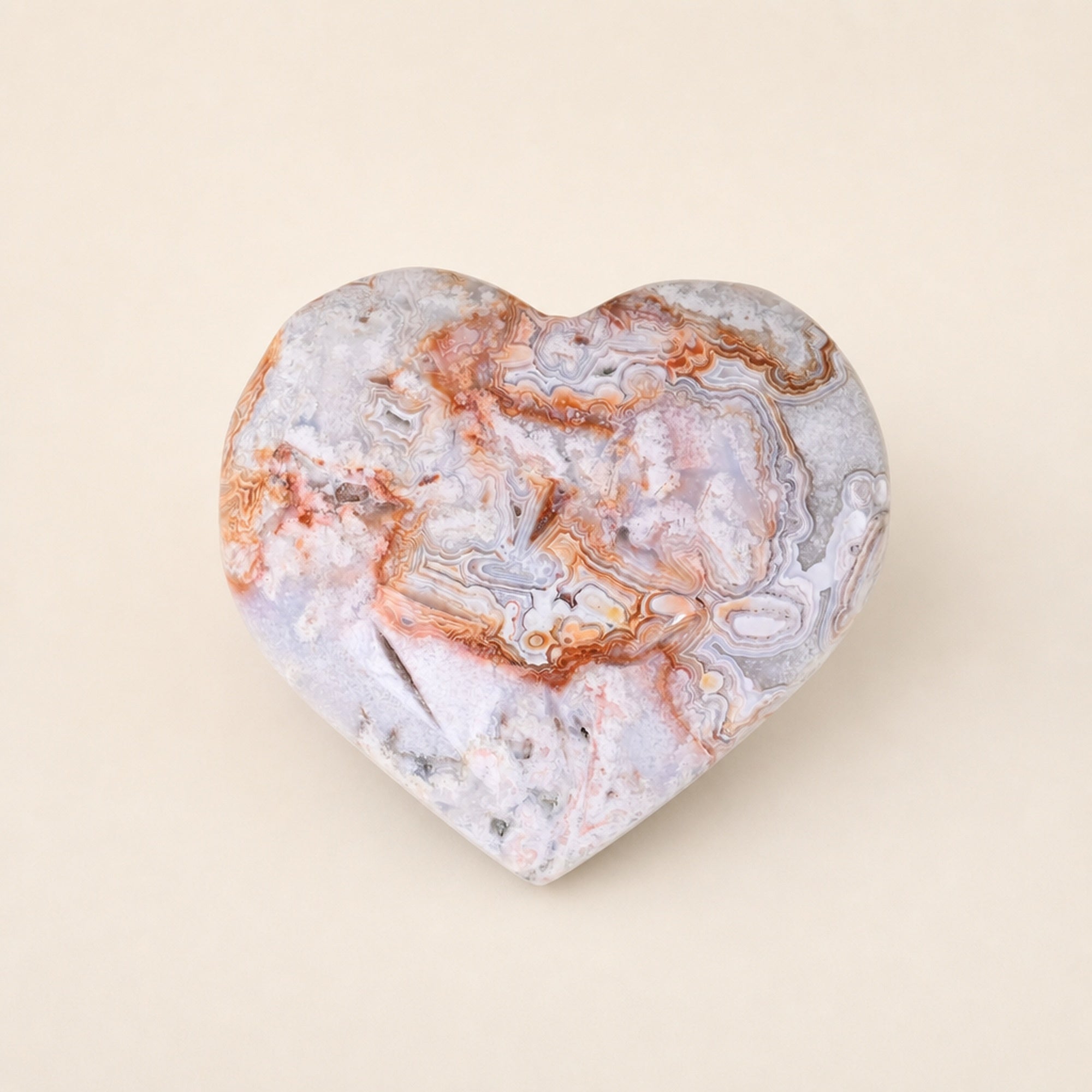
A related stone-family option
Crazy Lace Agate Heart Stone – Joyful Movement
This is a related variety in the same stone family, not a Agate product. We only identify jewelry as Agate when that exact material is verified.
Explore this related optionCleaning and Storage Tips
- Clean with warm water and a drop of mild soap; use a soft cloth or brush.
- Avoid ultrasonic cleaners, steam cleaners, bleach, and harsh household chemicals.
- Store separately from harder stones such as sapphire or diamond to prevent scratching.
- Remove agate rings before heavy lifting, gardening, or contact sports.
- Keep dyed or heat-treated pieces out of prolonged direct sun, which may fade color.
How to Choose Everyday Agate Jewelry
Choosing everyday agate jewelry comes down to matching the stone to your routine. For rings and bracelets that will see daily wear, prioritize solid settings, smooth cabochons, and natural untreated stones. For pendants and earrings, you have more freedom to choose delicate or intricately patterned pieces because they face less abrasion.
Check the stone’s surface for cracks, pits, or cloudy patches before buying, and ask whether the color is natural or dyed. A natural agate under the Lumina Grade AAA Integrity Standard is untreated, so its banding and color are stable and honest. Let the variety guide you — Botswana and moss agate are quietly practical, blue lace is soft and light, and fire agate is the most visually dramatic — then wear it often, care for it simply, and let it be the quiet, grounding companion agate has long been associated with.
Frequently Asked Questions
Is agate an official birthstone or only a historical and zodiac one?
Agate is not on the modern official birthstone list; it is a traditional May/June birthstone and the zodiac stone for Gemini. It remains a legitimate choice within historical and zodiac-based traditions.
What month and zodiac sign is agate associated with?
Agate is traditionally linked to May and June and to Gemini (May 21–June 21). Its exact placement varies by tradition, so both are commonly cited.
What does agate mean and what healing properties is it believed to have?
Agate is traditionally associated with grounding, emotional steadiness, and calm communication. These are cultural and symbolic associations, not medical effects; agate jewelry may serve as a personal reminder but is not a treatment for any condition.
How hard and durable is agate for everyday rings and bracelets, and how should I care for it?
Agate ranks 6.5–7 on the Mohs scale, making it suitable for daily wear with normal care. Clean it with warm water and mild soap, avoid harsh chemicals and ultrasonic cleaners, and store it separately from harder stones.
Which agate varieties and jewelry styles suit everyday wear?
Botswana and moss agate are the most practical for daily rings and bracelets, while blue lace agate suits delicate pendants and fire agate works best as a statement piece. Choose smooth cabochons and solid settings for pieces worn daily.
Sources
© 2026 Lumina Quartz. This article is for informational and cultural purposes only and does not constitute medical advice. Crystal associations described here are traditional and symbolic, not scientifically proven health claims.