The Complete Everyday Guide to Carnelian Stone: Meaning and Uses
Table of Contents
- 10-Second Executive Summary / The Verdict Box
- What Is Carnelian Stone? Composition, Color, and Why It Belongs to the Quartz Family
- Carnelian Meaning Through History: Egypt, Rome, Persia, and Beyond
- Carnelian Healing Properties and Benefits: Courage, Confidence, and Vitality
- Carnelian and the Chakras: Sacral Chakra Energy and How to Meditate With It
- Everyday Uses of Carnelian: Jewelry, Home Decor, and Personal Energy Practices
- How to Choose Genuine Carnelian: Color, Treatment, Quality, and Price Signals
- Step-by-Step Buyer's Checklist for Genuine Carnelian
- Caring for Your Carnelian: Cleansing, Charging, and Avoiding Damage
- Carnelian vs. Sard and Similar Stones: A Quick Comparison
- Frequently Asked Questions About Carnelian Stone
- What is carnelian stone and what does it mean?
- Which chakra is carnelian associated with, and how do you use it?
- How do you tell if carnelian is real, and how should you care for it?
- Final Takeaways: A Simple Daily Ritual With Carnelian
- Sources
Carnelian stone is a translucent, semi-precious variety of the silica mineral chalcedony, and it owes its red to reddish-brown color to colloidally dispersed hematite (iron oxide). It is a close relative of sard, differing only in the shade of red. If you are wondering what carnelian means and how to use it, start here: it is a 6.5–7 on the Mohs hardness scale, traditionally associated with courage and vitality, and best suited to everyday jewelry, small home accents, and simple meditative practices rather than water-heavy or chemical-heavy routines.
10-Second Executive Summary / The Verdict Box
- Direct Verdict: Carnelian is a natural chalcedony (quartz family) with iron-oxide color. It is a practical, wearable stone for daily use when it is untreated, well-cut, and cared for simply.
- Mineral Identity: Translucent semi-precious chalcedony; red to reddish-brown from colloidally dispersed hematite. Close relative of sard.
- Mohs Hardness: 6.5–7 — durable enough for rings and bracelets with reasonable care, softer than quartz (7) and much softer than diamond.
- Color Range: Pale orange to deep red-brown; deeper saturated red-orange is often associated with higher perceived quality.
- Best For: Everyday jewelry, desk and shelf decor, simple sacral-chakra meditation, and personal intention practices.
- Quality Marker: Lumina Grade AAA Integrity Standard — natural rough origin, zero chemical resin filling, no irradiation or dye treatment.
- Avoid If: You expect medical outcomes, or you plan to expose it to harsh cleaners, prolonged sun, or repeated ultrasonic cleaning.
What Is Carnelian Stone? Composition, Color, and Why It Belongs to the Quartz Family
Carnelian is a variety of chalcedony, which is itself a form of silica — the same broad mineral family as quartz. Its structure is microcrystalline, meaning the crystals are too small to see individually, which gives carnelian its smooth, waxy luster and translucent glow. The color comes from hematite (iron oxide) dispersed through the stone, not from a surface coating. Because it is a close relative of sard, the two are often confused; the practical difference is usually the shade of red, with sard tending toward a darker, browner tone.
This composition matters for buyers. A microcrystalline silica stone is stable, takes a good polish, and holds color well — but it is not indestructible. Understanding what carnelian is made of is the first step toward judging whether a piece is natural, treated, or simply glass.
Carnelian Meaning Through History: Egypt, Rome, Persia, and Beyond
Carnelian has been valued across cultures for thousands of years, and its meanings are cultural and symbolic rather than medical. In ancient Egypt, it was often associated with protection and was used in amulets and burial ornaments. In Rome, it was carved into signet rings and seals, partly because hot wax does not stick to its polished surface — a practical property that made it useful for stamping documents. In Persian and later Islamic traditions, carnelian was often associated with dignity and was worn as a personal emblem.
These historical uses are worth knowing because they explain why carnelian is still described as a stone of courage and presence. The symbolism is real as a cultural inheritance; it is not a guarantee of physical or emotional outcomes.
Carnelian Healing Properties and Benefits: Courage, Confidence, and Vitality
In crystal and folk traditions, carnelian is often associated with courage, confidence, and vitality. These are symbolic and personal-reminder uses, not medical claims. Wearing or holding carnelian may support a sense of steadiness and intention for some people, in the same way a meaningful object can serve as a daily anchor. It is not a treatment for anxiety, low mood, or any health condition, and it should not replace professional care.
The honest way to frame carnelian's benefits is this: it is a tactile, beautiful object that many people use as a cue for focus, warmth, and forward motion. If that framing resonates with you, the stone can be a gentle part of a daily routine. If you are looking for clinical outcomes, carnelian is not the tool for that job.
Carnelian and the Chakras: Sacral Chakra Energy and How to Meditate With It
Carnelian is most commonly associated with the sacral chakra, the energy center traditionally linked to creativity, desire, and emotional flow. In practice, a simple meditation with carnelian does not require elaborate setup. Sit comfortably, hold the stone in your non-dominant hand, and spend five minutes noticing its temperature and weight. Breathe slowly, and if you like, set a single intention — for example, "I allow myself to begin."
This is a personal-energy practice, not a physiological intervention. The value is in the pause and the focus, and the stone is simply a physical reminder that helps you return to that pause.
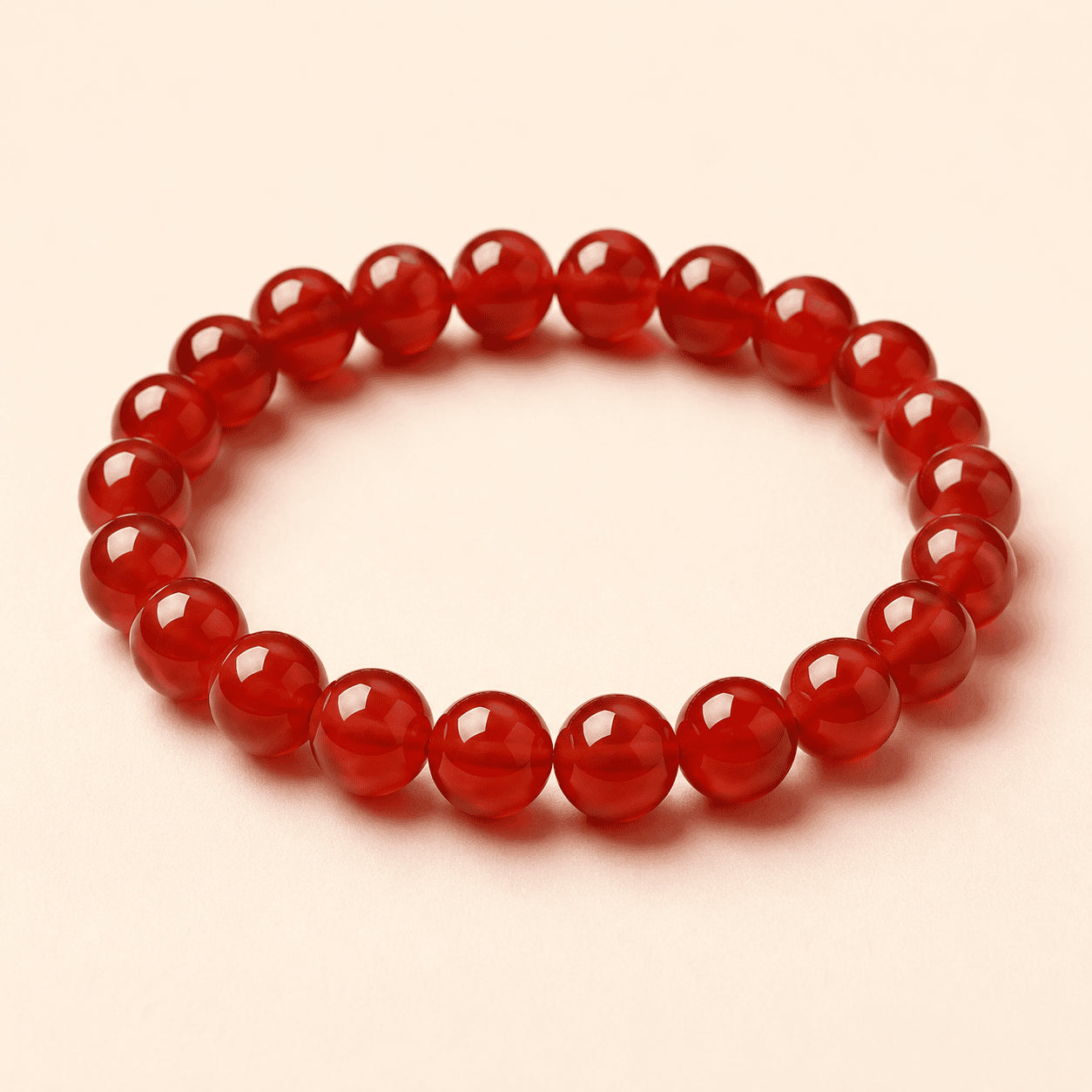
Carnelian Bracelet
A quiet bracelet for turning this intention into a small daily ritual.
Shop This Authentic Piece →Everyday Uses of Carnelian: Jewelry, Home Decor, and Personal Energy Practices
Carnelian's 6.5–7 Mohs hardness makes it a practical choice for everyday wear. Rings and bracelets are fine with normal care; pendants and earrings are even lower-risk. For home decor, a small carnelian sphere, tower, or palm stone on a desk or shelf adds warmth without demanding maintenance. For personal energy practices, a palm stone kept in a pocket or on a bedside table is the simplest option.
The main everyday caution is impact and abrasion. Carnelian can chip if struck against a hard surface, and it can scratch if stored loose with harder stones such as sapphire or diamond. A soft pouch or a divided jewelry tray solves most of this.
How to Choose Genuine Carnelian: Color, Treatment, Quality, and Price Signals
Genuine carnelian is natural chalcedony colored by iron oxide, and it should look translucent rather than flatly opaque. Deep, saturated red-orange with visible depth and slight color variation is generally a better sign than uniform, neon-bright orange. Be cautious of stones that look too perfect, too evenly dyed, or unusually cheap for their size — dyeing and heat treatment are common in the market, and resin filling can mask cracks.
This is where the Lumina Grade AAA Integrity Standard is useful as a buying filter: it means natural rough origin, zero chemical resin filling, and no irradiation or dye treatment. Ask for clear, natural-light photos and a stated treatment status. If a seller cannot answer whether the stone is dyed or heat-treated, treat that as a reason to slow down rather than a reason to guess.
Step-by-Step Buyer's Checklist for Genuine Carnelian
Use this checklist in order when evaluating a piece, whether online or in person:
- Check translucency. Hold the stone to soft light. Natural carnelian typically glows with some depth; a flat, opaque surface may indicate glass, plastic, or heavy treatment.
- Look for natural variation. Slight banding, color zoning, or tiny internal inclusions are normal in chalcedony. Perfectly uniform color at a low price is a warning sign.
- Ask about treatment explicitly. Request a written statement on dye, heat, irradiation, and resin filling. "Natural" alone is not enough.
- Confirm the hardness match. At 6.5–7 Mohs, carnelian suits rings and bracelets — but confirm the setting protects the stone from impact.
- Compare price against size and clarity. Large, clean, deeply saturated natural pieces cost more. A very low price for a large clean stone usually means treatment or imitation.
- Apply the Lumina Grade AAA Integrity Standard. Prefer pieces documented as natural origin, untreated, and unfilled; walk away from vague listings.
- Check the return policy. A seller confident in natural material will usually offer a clear return window.
Caring for Your Carnelian: Cleansing, Charging, and Avoiding Damage
Carnelian is durable but not immune to damage. Clean it with lukewarm water and a soft cloth, and dry it promptly. Avoid harsh household chemicals, prolonged direct sun (which can fade some dyed or heat-treated stones), and repeated ultrasonic cleaning, which can loosen settings or worsen existing fractures. For "charging," there is no verified physical mechanism — the meaningful practice is simply setting the stone in soft light or on a clean surface as a ritual of attention.
Store carnelian separately from harder gemstones to prevent scratches, and remove rings before heavy manual work. These small habits keep the stone's polish and color intact for years.
Carnelian vs. Sard and Similar Stones: A Quick Comparison
Carnelian and sard are the closest pair, and the difference is mainly tone: carnelian is typically the brighter red-orange, while sard leans darker and browner. Both are chalcedony colored by iron oxide. Red jasper is opaque rather than translucent, so it reads as a different stone entirely. Orange glass or dyed agate can imitate carnelian's color but usually lacks its internal depth and natural variation.
If you want a bright, warm everyday stone, carnelian is the straightforward choice. If you prefer a deeper, more muted red-brown, sard may suit you better. Neither is "better" — the decision is about tone, translucency, and how the piece will be worn.
Frequently Asked Questions About Carnelian Stone
What is carnelian stone and what does it mean?
Carnelian is a translucent red-to-reddish-brown variety of chalcedony, a silica mineral colored by dispersed hematite. It is traditionally associated with courage, confidence, and vitality as symbolic and personal-reminder meanings, not medical outcomes.
Which chakra is carnelian associated with, and how do you use it?
Carnelian is most often associated with the sacral chakra. A simple practice is to hold it for five quiet minutes and set one intention; this is a personal-energy ritual rather than a physiological treatment.
How do you tell if carnelian is real, and how should you care for it?
Real carnelian is translucent with natural color variation and a waxy luster, and a reputable seller will state whether it is dyed, heat-treated, or resin-filled — look for the Lumina Grade AAA Integrity Standard. Clean it with lukewarm water and a soft cloth, avoid harsh chemicals and ultrasonic cleaners, and store it away from harder stones.
Final Takeaways: A Simple Daily Ritual With Carnelian
Keep one small carnelian piece where you will see it each morning — a bedside palm stone or a ring you wear often. Hold it for a slow breath, name one thing you want to move toward today, and put it back down. That is the whole ritual: a grounded, repeatable pause, with a stone that has carried the same symbolic warmth for thousands of years.
Sources
© 2026 Lumina Quartz. This article shares cultural and mineral information for educational purposes only. Crystal traditions are symbolic and personal; they are not medical advice and are not a substitute for professional care.
Product Facts From the Current Catalog
These details come from the active Lumina Quartz catalog record checked on 2026-10-26. They are product-listing facts, not laboratory results or invented wear-test claims.
| Listed product | Carnelian Bracelet – Creative Courage |
|---|---|
| Format | Bracelet |
| Listed price snapshot | 49.99 |
Price, availability, and options may change. Check the live product listing before choosing.