The Complete Everyday Guide to Crystals Root Chakra: Meaning and Uses
Table of Contents
- What Is the Root Chakra and Why It Matters
- 10-Second Executive Summary / The Verdict Box
- Signs Your Root Chakra Is Blocked or Out of Balance
- Best Crystals for the Root Chakra (Red Jasper, Black Tourmaline, Garnet, Smoky Quartz, Hematite)
- Red Crystals: Red Jasper and Garnet
- Black Crystals: Black Tourmaline and Smoky Quartz
- How to Use Root Chakra Crystals Every Day: Wear, Meditate, Place
- Where to Place Root Chakra Crystals at Home
- Quick Choosing Table: Which Root Chakra Stone Fits Your Need
- Choosing Ethically Sourced Root Chakra Stones at Lumina Quartz
- FAQ: Root Chakra Crystals for Beginners
- What crystals are best for the root chakra?
- How do I know if my root chakra is blocked?
- How do I use root chakra crystals in everyday life?
- Sources
What Is the Root Chakra and Why It Matters
The root chakra (Muladhara) is a concept from yogic and tantric traditions, traditionally described as the energy center at the base of the spine that relates to stability, safety, and a sense of being grounded. It is a cultural and spiritual symbol, not a measurable anatomical structure, and modern crystal practices borrow this idea as a framework for reflection rather than a medical diagnosis.
In everyday crystal practice, the root chakra is most often associated with red and black stones that feel steadying to hold — a visual and tactile reminder to slow down, plant your feet, and notice what makes you feel secure.
10-Second Executive Summary / The Verdict Box
- Direct Verdict: If you want a simple, everyday grounding set, start with red jasper (gentle, easy for beginners), black tourmaline (a classic for a sense of protection), and smoky quartz (calm and neutral). These are traditional pairings for root-chakra practice, not medical tools.
- Quantitative parameters: Red jasper — Mohs hardness 6.5–7. Black tourmaline — Mohs hardness 7–7.5. Garnet — Mohs hardness 6.5–7.5. Smoky quartz — Mohs hardness 7. Hematite — Mohs hardness 5–6.5 (softer, so keep it away from abrasive surfaces).
- Best used for: grounding rituals, meditation anchors, desk or bedside placement, and everyday wear.
- Beginner note: Beginners can absolutely use red jasper; it is one of the most forgiving root-chakra stones.
Signs Your Root Chakra Is Blocked or Out of Balance
Within crystal and chakra traditions, a "blocked" root chakra is often described as feeling ungrounded, scattered, or unsettled — for example, difficulty feeling safe, restlessness, or a sense of being disconnected from your routine. These are traditional interpretive signs, not clinical symptoms; if you are experiencing persistent distress, a qualified professional is the right person to talk to.
Use these signs as a self-reflection prompt, not a diagnosis. A useful, practical test: ask yourself whether your body feels steady right now. If not, a simple grounding practice — holding a stone, standing barefoot, or taking slow breaths — may support a calmer frame of mind.
Best Crystals for the Root Chakra (Red Jasper, Black Tourmaline, Garnet, Smoky Quartz, Hematite)
Red Crystals: Red Jasper and Garnet
Red jasper (Mohs 6.5–7) is a beginner-friendly, readily available stone often associated with steady, patient energy. Garnet (Mohs 6.5–7.5) is a harder, more vivid red stone that is traditionally linked with vitality and motivation. In practice, choose red jasper if you want something soft and durable for daily wear; choose garnet if you want a brighter, more assertive stone for a meditation focus piece.
Black Crystals: Black Tourmaline and Smoky Quartz
Black tourmaline (Mohs 7–7.5) is one of the most common "protection" stones in crystal traditions and is a practical choice for a desk or entryway because it resists scratches well. Smoky quartz (Mohs 7) is neutral, elegant, and often associated with calm and clarity. Hematite (Mohs 5–6.5) is heavier and metallic-looking and is often used as a grounding touchstone, though its softer hardness means it scratches more easily.
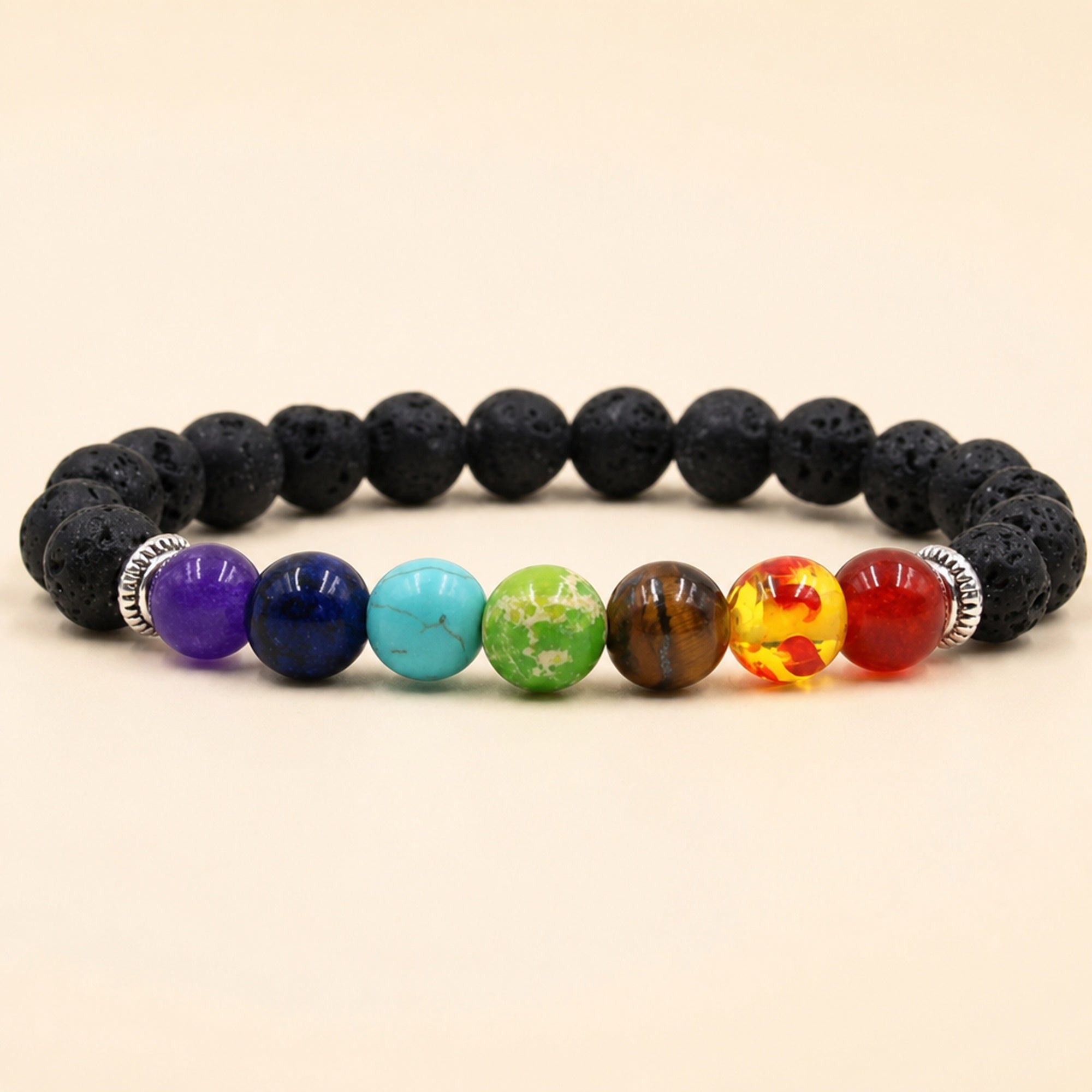
Seven Chakra Bracelet
A quiet bracelet for turning this intention into a small daily ritual.
Shop This Authentic Piece →How to Use Root Chakra Crystals Every Day: Wear, Meditate, Place
Keep it simple and repeatable. A practical daily routine:
- Morning: Hold a red jasper or hematite touchstone for one minute and take three slow breaths before you start your day.
- Wear: Choose a single stone — for example, a black tourmaline pendant or a garnet ring — rather than a full set, so the practice stays focused.
- Meditate: Sit cross-legged with a smoky quartz or red jasper stone in your hand or at the base of your seat, and use it as a physical anchor for attention.
- Evening: Place your stone on a bedside table and use it as a visual cue to wind down.
Remember that these are personal reminders, not medical treatments. Crystals may support a grounding routine, but they do not diagnose, treat, or cure any condition.
Where to Place Root Chakra Crystals at Home
Placement is mostly about visibility and routine, so put stones where you will actually notice them:
- Entryway: Black tourmaline near the door as a "landing" cue when you come home.
- Desk: Hematite or smoky quartz within arm's reach for a steadying pause during work.
- Bedside: Red jasper for a gentle evening reminder to slow down.
- Meditation corner: A garnet or smoky quartz as a focal point.
Keep softer stones such as hematite off rough surfaces and out of direct contact with abrasive decor.
Quick Choosing Table: Which Root Chakra Stone Fits Your Need
| Need / Scenario | Best Fit | Why It Fits |
|---|---|---|
| First stone, beginner | Red jasper | Beginner-friendly, durable (Mohs 6.5–7), gentle in tone |
| Protective/anchoring cue for a desk or entryway | Black tourmaline | Traditional "protection" stone, harder (Mohs 7–7.5), scratch-resistant |
| Calm, neutral meditation anchor | Smoky quartz | Neutral look, Mohs 7, versatile for wear or placement |
| Motivation and vitality focus | Garnet | Vivid red, hardness 6.5–7.5, suited for a focus piece |
| Heavy, grounding touchstone | Hematite | Dense, metallic look; softer (Mohs 5–6.5), needs care |
Choosing Ethically Sourced Root Chakra Stones at Lumina Quartz
Quality matters more than marketing. When you choose a root chakra stone, check for natural color and surface texture, ask whether the stone has been chemically treated, and confirm the stone type and hardness. At Lumina Quartz, we apply our Lumina Grade AAA Integrity Standard — a commitment to natural, unaltered crystals, with no chemical resin filling, no irradiation, and no dyeing — so you know what you are holding. A genuine red jasper, for example, shows natural banding and variation; a dyed stone tends to look uniformly saturated.
Cultural note: chakra concepts come from yogic and tantric traditions, and their historical meaning is spiritual and symbolic. Treat crystal use as a personal, reflective practice rather than a health claim.
FAQ: Root Chakra Crystals for Beginners
What crystals are best for the root chakra?
Red jasper, black tourmaline, garnet, smoky quartz, and hematite are the most commonly used root chakra stones in crystal traditions. Choose based on your preferred feel and use — red jasper for beginners, black tourmaline for a protective cue, smoky quartz for a calm anchor.
How do I know if my root chakra is blocked?
Traditional interpretations describe feeling ungrounded, scattered, or unsettled as signs of an out-of-balance root chakra. These are self-reflection prompts, not medical symptoms — if distress is persistent, consult a qualified professional.
How do I use root chakra crystals in everyday life?
Keep it simple: hold one stone for a minute in the morning, wear a single piece, use a stone as a meditation anchor, and place one on your bedside table. The value is in the consistent routine, not the quantity of stones.
Sources
- Yoga: The Art of Transformation — National Museum of Asian Art (historical context for chakra and yoga traditions)
- Chakra (wheel of Dharma) with attending pair of deer — Smithsonian's National Museum of Asian Art (cultural context)
© 2026 Lumina Quartz. This article is for educational and cultural interest only and is not medical advice.
Product Facts From the Current Catalog
These details come from the active Lumina Quartz catalog record checked on 2026-10-22. They are product-listing facts, not laboratory results or invented wear-test claims.
| Listed product | Seven Chakra Bracelet – Balanced Ritual (8mm Natural Stones) |
|---|---|
| Format | Bracelet |
| Listed price snapshot | 34.99 |
Price, availability, and options may change. Check the live product listing before choosing.