The Complete Everyday Guide to Dalmatian Stone: Meaning and Uses
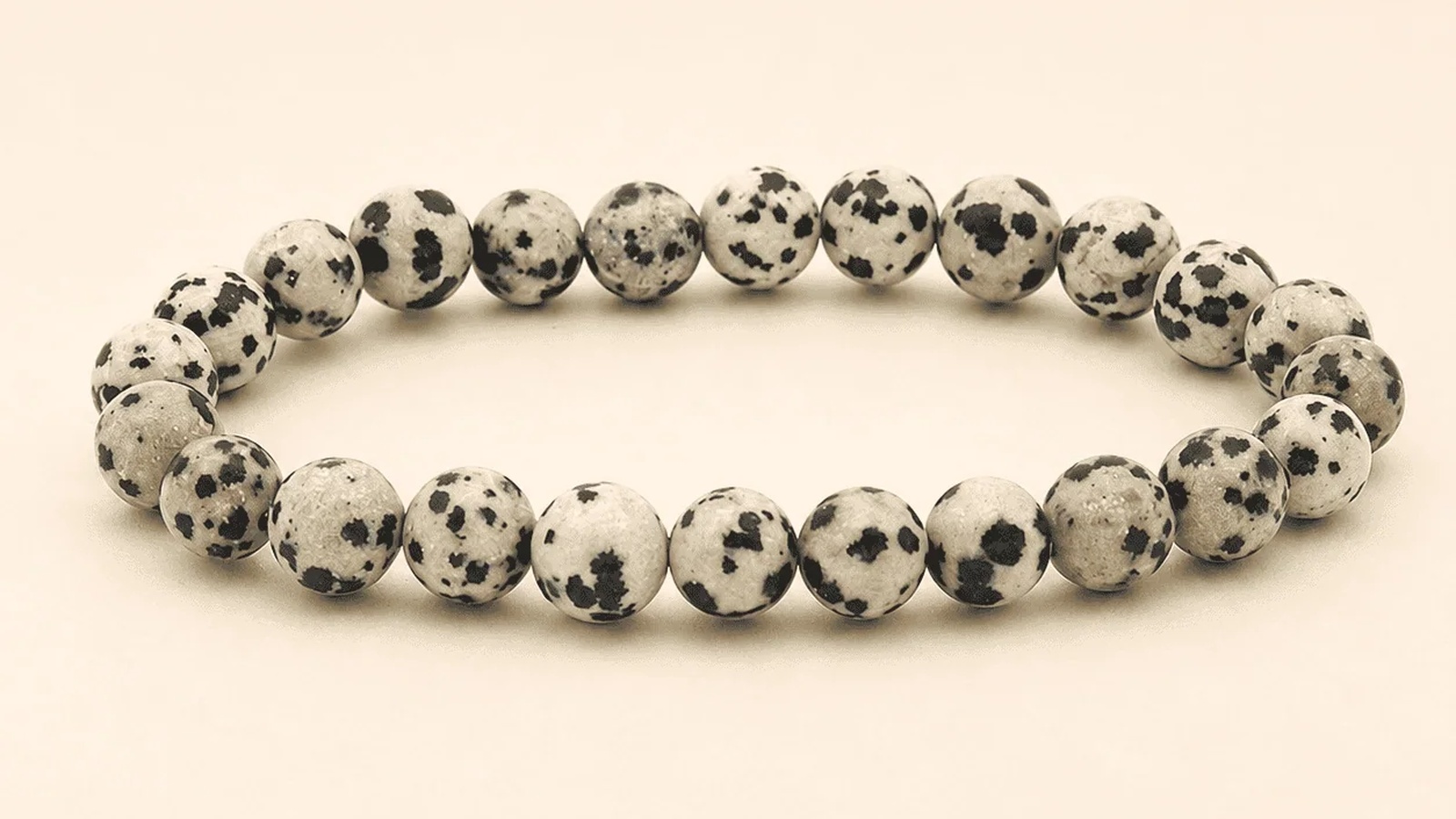
Table of Contents
- What Is Dalmatian Stone? The Spotty Rock Behind the Name
- 10-Second Executive Summary / The Verdict Box
- Dalmatian Stone vs. Dalmatian Jasper: Why the Name Is Misleading
- Feldspar, Quartz, and Arfvedsonite: What the Spots Really Are
- Where Dalmatian Stone Comes From (Chihuahua, Mexico, and Beyond)
- Dalmatian Stone Meaning and Metaphysical Properties
- Everyday Uses: Jewelry, Tumbled Stones, and Decor
- Styling Ideas and Who It Suits Best
- Hardness, Durability, and Care for Everyday Wear
- Decision Table: Is Dalmatian Stone Right for This Use?
- Real vs. Dyed: How to Tell Genuine Dalmatian Stone
- FAQ: Quick Answers Before You Buy
- Is dalmatian stone a real jasper, and what is it actually made of?
- Where does dalmatian stone come from and is it natural or dyed?
- How do you clean, care for, and spot a fake dalmatian stone?
- Sources
What Is Dalmatian Stone? The Spotty Rock Behind the Name
Dalmatian stone is a peralkaline igneous rock—not a jasper—made up of a pale feldspar-and-quartz groundmass scattered with black arfvedsonite spots, and it is most often sold as tumbled stones, beads, and small carvings rather than as high-grade gem material. If you searched for what this stone actually is before buying a bracelet or a palm stone, that single sentence is the honest answer: a spotted rock, a trade name, and a piece of geology that the gemological literature has been quietly correcting for years.
10-Second Executive Summary / The Verdict Box
- Direct Verdict: Dalmatian stone is a genuine natural rock, but it is not jasper. It is a peralkaline feldspar-quartz rock with black arfvedsonite spots, and the name “dalmatian jasper” is a commercial misnomer.
- Composition: Predominantly feldspar (mesoperthite) and quartz, with arfvedsonite as the black spotting mineral and minor hematite and epidote.
- Mohs Hardness: Roughly 6–6.5 for the feldspar-quartz groundmass (feldspar ~6, quartz 7); the arfvedsonite amphibole spots sit lower, around 5–6. Treat the stone as a mid-hardness material, not a scratch-proof one.
- Best For: Tumbled pocket stones, beaded bracelets and necklaces worn with care, cabochon pendants, and small decorative specimens.
- Not Best For: Daily-worn rings, rough-and-tumble children’s jewelry, or anything exposed to repeated abrasion and household chemicals.
- Buying Standard: Look for natural, untreated material with crisp black-on-cream contrast—the kind of sourcing we hold to under the Lumina Grade AAA Integrity Standard (natural rough, no chemical stabilization, no irradiation or dye).
Dalmatian Stone vs. Dalmatian Jasper: Why the Name Is Misleading
The two names describe the same material, but only one is accurate. In gemology, jasper is a dense, opaque variety of chalcedony or chert—a silica-rich material. Dalmatian stone does not meet that definition, which is why researchers publishing in Gems & Gemology recommend dropping “jasper” altogether and calling it dalmatian stone. The “jasper” label survives because it sells: it sounds familiar, earthy, and collectible.
There is a second, smaller naming trap. Sellers sometimes describe the black spots as tourmaline. Mineralogical records are clear that the spots are arfvedsonite, a sodium amphibole—not tourmaline. Neither error changes how the stone looks, but both tell you something about how carefully a listing was written.
Feldspar, Quartz, and Arfvedsonite: What the Spots Really Are
Think of dalmatian stone as a light canvas with dark ink. The canvas is mesoperthite, an alkali feldspar with fine intergrown layers, mixed with quartz. The ink is arfvedsonite, an amphibole that crystallized dark and distinct. Minor hematite can add a faint warm blush, and epidote may appear in small amounts. Knowing this matters when you assess a stone: the groundmass gives it body and a soft vitreous luster, while the amphibole spots are slightly softer and can weather or pit before the surrounding feldspar does.
Where Dalmatian Stone Comes From (Chihuahua, Mexico, and Beyond)
Most dalmatian stone on the market is associated with Chihuahua, Mexico, where it occurs in peralkaline igneous bodies. The scientific literature is more cautious than the market: the Gems & Gemology study describes the material as a peralkaline rock of uncertain provenance in the samples examined, so treat “Mexico” as the dominant commercial origin rather than a geologically nailed-down fact for every piece. It formed in a silica-rich, alkali-rich igneous environment—the same broad family of rocks that hosts rare amphiboles and unusual feldspars.
Practically, origin labels are hard to verify on a tumbled stone. A seller who can tell you the region, the rough form, and whether the material was stabilized is giving you more useful information than a country name stamped on a tag.
Dalmatian Stone Meaning and Metaphysical Properties
In crystal and folk traditions, dalmatian stone is often associated with groundedness, playfulness, and steady focus—an association drawn from its dog-like spots and its dense, opaque appearance rather than from any proven physiological effect. Many people use it as a visual reminder: to slow down, to keep a light heart, to return to a task after distraction.
It is worth being precise here. These are cultural and personal-reminder meanings, not medical claims. Dalmatian stone is not known to stabilize mood, calm the nervous system, or substitute for care from a qualified professional. What it may support is a simple, repeatable ritual: holding a smooth tumbled stone during a pause, keeping one on a desk as a cue for focus, or wearing it as a gentle daily anchor. The stone supplies the object; the meaning is yours to assign.
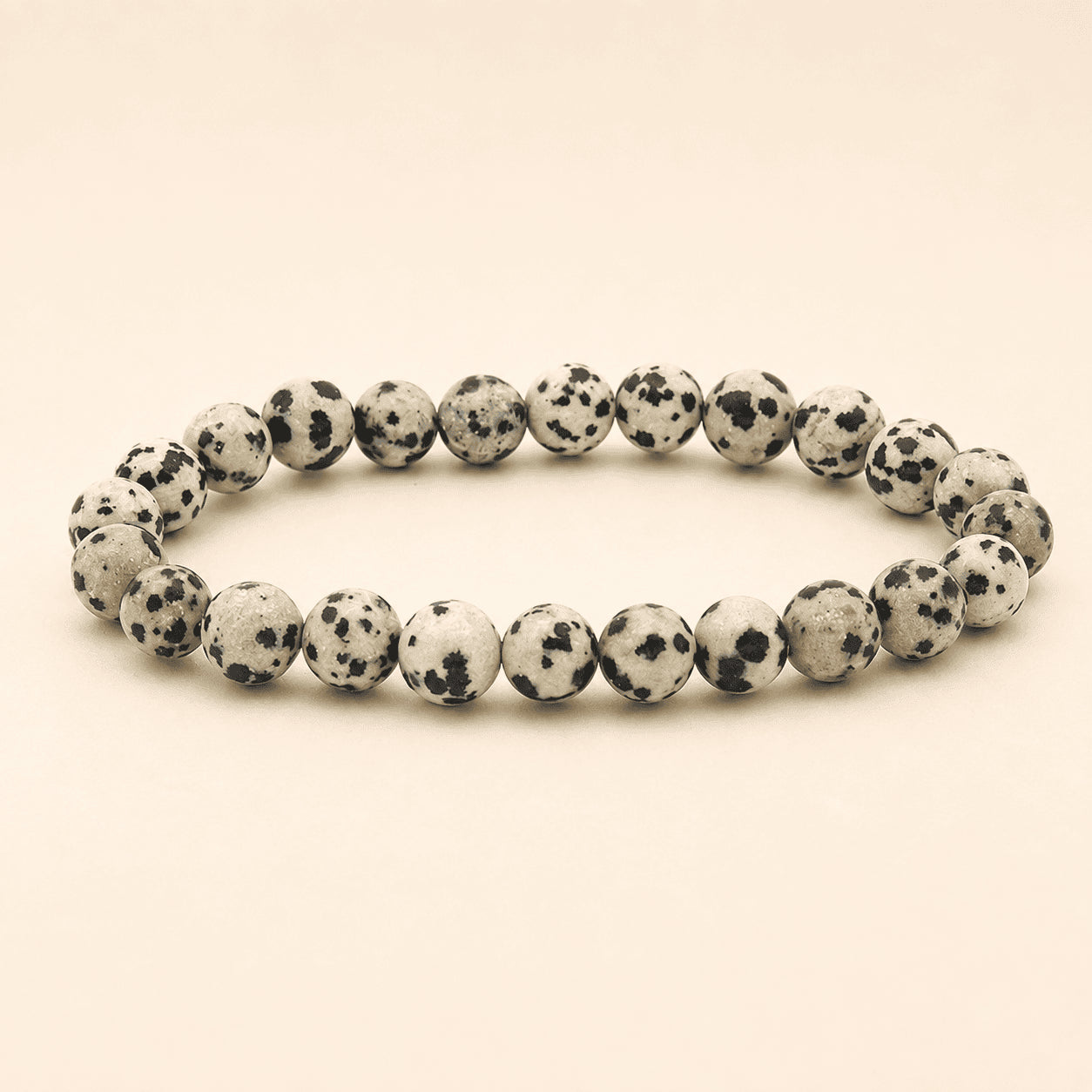
Dalmatian Jasper Bracelet
A quiet bracelet for turning this intention into a small daily ritual.
Shop This Authentic Piece →Everyday Uses: Jewelry, Tumbled Stones, and Decor
Because dalmatian stone is opaque and takes a soft polish, it shines in pieces where its pattern is the whole point. Tumbled stones are the most forgiving format and the most common entry point. Beaded bracelets, stretch cords, and simple pendants are popular because the black-on-cream contrast reads well against skin and neutral clothing. Small spheres, slices, and cabochons work as desk or shelf accents where the pattern can be seen up close.
What it is not is a workhorse gem for rings. The groundmass is mid-hardness, and the amphibole spots are softer still, so a ring worn daily through handwashing, keys, and counters will show wear faster than a quartz or corundum piece would.
Styling Ideas and Who It Suits Best
Dalmatian stone suits people who like graphic, high-contrast patterns in a matte-to-satin finish. It pairs naturally with denim, oatmeal linen, black leather, and warm wood. A beaded bracelet with matte dalmatian stone and a single silver spacer reads modern and understated; a cabochon pendant on a short chain reads more classic. It sits comfortably alongside smoky quartz, black onyx, and clear quartz in a layered look. If you want a stone that looks distinctive without being precious, this is a sensible choice for casual, everyday styling—provided you are realistic about its hardness.
Hardness, Durability, and Care for Everyday Wear
Treat dalmatian stone as a mid-hardness stone on the Mohs scale: roughly 6 to 6.5 overall, with feldspar near 6, quartz at 7, and the arfvedsonite spots around 5 to 6. That means it resists a fingernail and copper coin but can be scratched by steel, sand, and grit. On the everyday-wear spectrum, it sits comfortably in a bracelet or pendant zone and uncomfortably in a ring zone.
Care is simple but specific. Clean with lukewarm water and a drop of mild soap, then rinse and pat dry with a soft cloth. Avoid ultrasonic cleaners and steam, which can stress softer amphibole inclusions. Keep it away from household acids, bleach, and prolonged direct sun, which may fade some porous materials. Store it separately from harder stones—quartz, corundum, even steel jewelry—so it does not get abraded in a drawer. Re-string beaded pieces periodically, because wear happens at the knots long before it happens at the stone.
Decision Table: Is Dalmatian Stone Right for This Use?
| Use Case | Fit | Why | What to Choose Instead |
|---|---|---|---|
| Tumbled pocket or palm stone | Excellent | No abrasion, pattern fully visible, easy to clean | — |
| Beaded bracelet or necklace | Good | Mid-hardness groundmass tolerates light wear; secure knots matter more than the stone | Quartz beads for higher durability |
| Cabochon pendant | Good | Protected position, soft polish shows off contrast | — |
| Daily-worn ring | Poor | Softer arfvedsonite spots pit and scratch against counters, keys, and grit | Quartz, agate, or corundum for rings |
| Children’s jewelry | Check first | Durability is acceptable, but small beads and cord fastenings are the real risk | Larger, securely knotted pieces |
| Outdoor or gym wear | Avoid | Abrasive dust and impact are harder on this stone than on quartz-family materials | Reserve dalmatian stone for gentler settings |
Boundary note: this table assumes untreated, naturally patterned material. Stabilized or dyed pieces may behave differently in water, heat, and wear.
Real vs. Dyed: How to Tell Genuine Dalmatian Stone
Genuine dalmatian stone has an irregular pattern: spots of different sizes, uneven distribution, some merging at the edges, set in a feldspar groundmass that is slightly translucent in thin areas and warm cream to gray-white in tone. Dye and fake material tend to look too tidy—uniform spot size, evenly spaced dots, or a groundmass that looks chalky and flat. Under a loupe, natural arfvedsonite spots have soft, sometimes diffuse boundaries and a duller luster than the surrounding feldspar; painted or resin-filled “spots” often sit on the surface and can be felt or flaked.
Our approach to sourcing is what we call the Lumina Grade AAA Integrity Standard: natural rough, no chemical stabilization, no irradiation, no dye. Applied to this stone, that means we look for crisp black-on-cream contrast, a clean feldspar groundmass, and spots that read as mineral inclusions rather than decoration. When you shop, ask three questions—Is it natural? Is it stabilized? Is it dyed?—and look for a seller who answers all three without hedging.
FAQ: Quick Answers Before You Buy
Is dalmatian stone a real jasper, and what is it actually made of?
No. Dalmatian stone is a peralkaline feldspar-quartz rock with black arfvedsonite spots, and it does not meet the gemological definition of jasper. Reliable guides now recommend the name “dalmatian stone,” not “dalmatian jasper.”
Where does dalmatian stone come from and is it natural or dyed?
Most commercial material is associated with Chihuahua, Mexico, though gemological literature describes the provenance of studied samples as uncertain. Natural pieces show irregular spots and a warm cream groundmass; uniform dots or a flat, chalky background suggest dye or imitation, so buy from sellers who state treatment clearly.
How do you clean, care for, and spot a fake dalmatian stone?
Clean with lukewarm water and mild soap, dry with a soft cloth, and avoid ultrasonic cleaners, steam, acids, and harsh abrasives. To spot a fake, examine spot irregularity, check that black marks sit below the surface rather than on it, and confirm the piece is untreated—natural, un-dyed material is the standard we hold to under Lumina Grade AAA Integrity.
Sources
© 2026 Lumina Quartz. This guide shares mineral information and cultural associations for general interest; it is not medical advice, and no crystal is a substitute for professional care.
Product Facts From the Current Catalog
These details come from the active Lumina Quartz catalog record checked on 2026-11-06. They are product-listing facts, not laboratory results or invented wear-test claims.
| Listed product | Dalmatian Jasper Bracelet – Playful Grounding |
|---|---|
| Format | Bracelet |
| Listed price snapshot | 39.99 |
Price, availability, and options may change. Check the live product listing before choosing.