The Complete Everyday Guide to Obsidian Crystal Jewellery: Meaning and Uses
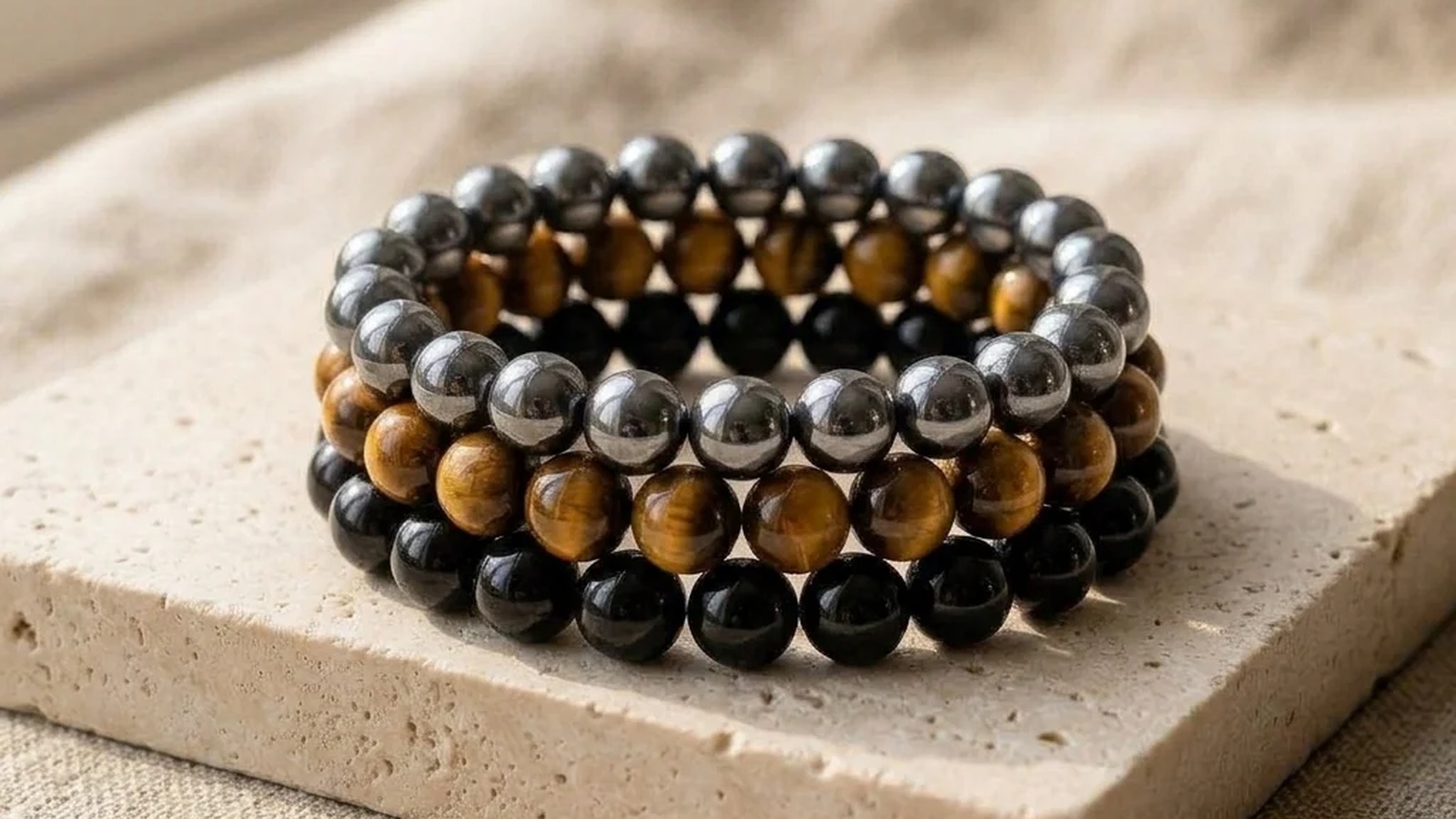
Table of Contents
- 10-Second Executive Summary / The Verdict Box
- What Is Obsidian Crystal Jewellery?
- How Obsidian Forms: Volcanic Glass Explained
- Obsidian vs. Other Black Crystals
- The Meaning of Obsidian: Protection, Grounding & Shadow Work
- Obsidian's Historical & Cultural Significance
- Types of Obsidian Used in Jewellery
- Black, Rainbow, Snowflake, Mahogany & Fire Obsidian
- Everyday Uses: How to Wear Obsidian Jewellery Daily
- Jewellery Formats & Styling (Necklaces, Bracelets, Rings, Earrings)
- Obsidian Jewellery Care: Cleansing, Charging & Cleaning
- How to Choose Obsidian Jewellery: A Buyer's Decision Table
- Decision Table: Matching Obsidian to Your Everyday Life
- Frequently Asked Questions
- What does obsidian crystal jewellery mean and what is it used for?
- Is obsidian jewellery good for everyday wear?
- How do I cleanse, charge, and care for obsidian crystal jewellery?
- Sources
Obsidian crystal jewellery is jewellery made from volcanic glass, and it is most often worn as a protective, grounding talisman rather than a precious gemstone in the traditional sense. Its meaning centres on shielding, honesty, and shadow work, while its everyday use comes down to sturdy formats such as bracelets, pendants, and rings that tolerate frequent wear. Because obsidian is glass, not a crystal lattice, it scratches and chips more easily than quartz-family stones, so "good for everyday wear" depends on how you style and store it.
10-Second Executive Summary / The Verdict Box
- Direct Verdict: Obsidian crystal jewellery is a sound everyday choice for grounding and protective intent, provided you accept glass-level durability and avoid knock-prone settings. It is a poor choice for anyone who wants a scratch-proof daily ring.
- Mohs Hardness: Roughly 5 to 5.5 — softer than quartz (7) and far softer than diamond (10).
- Composition: Volcanic glass (amorphous silica), not a crystalline mineral; colour comes largely from refraction by microscopic bubbles and inclusions such as magnetite.
- Best Formats: Beaded bracelets, smooth pendants, cabochon rings in protective settings, and stud or short-drop earrings.
- Best For: Daily grounding rituals, shadow-work prompts, minimalist black styling, and gifting to someone new to crystal jewellery.
- Avoid If: You need a stone for heavy manual work, abrasive cleaning, or constant water exposure.
What Is Obsidian Crystal Jewellery?
Obsidian crystal jewellery refers to ornaments cut and polished from obsidian, a natural volcanic glass. Although the word "crystal" is used loosely in the jewellery trade, obsidian is technically glass: it cooled too quickly to form an ordered crystal structure. That single geological fact explains most of its behaviour as jewellery — its glassy lustre, its deep black opacity, its conchoidal (shell-like) fracture, and its moderate softness. The U.S. Geological Survey describes obsidian simply as volcanic glass, and that is the honest starting point for anyone buying it.
How Obsidian Forms: Volcanic Glass Explained
Obsidian forms when silica-rich lava cools so rapidly that atoms freeze in place before they can arrange into crystals. The result is a natural glass, often black but sometimes banded, sheened, or flecked. The colour varieties are not pigments in the usual sense: Mindat notes that obsidian's black, bluish, mahogany, golden, peacock, grey-green, and brown-green tones arise largely from refraction by microscopic bubbles and from microscopic mineral inclusions such as magnetite in rainbow obsidian.
For a jewellery buyer, this means two practical things. First, variety in obsidian is a geological signature, not a marketing invention — snowflake, mahogany, and rainbow patterns are real material differences. Second, because obsidian is glass, it has no cleavage planes but does fracture in smooth curved surfaces, so a hard knock can produce a chip rather than a clean crack.
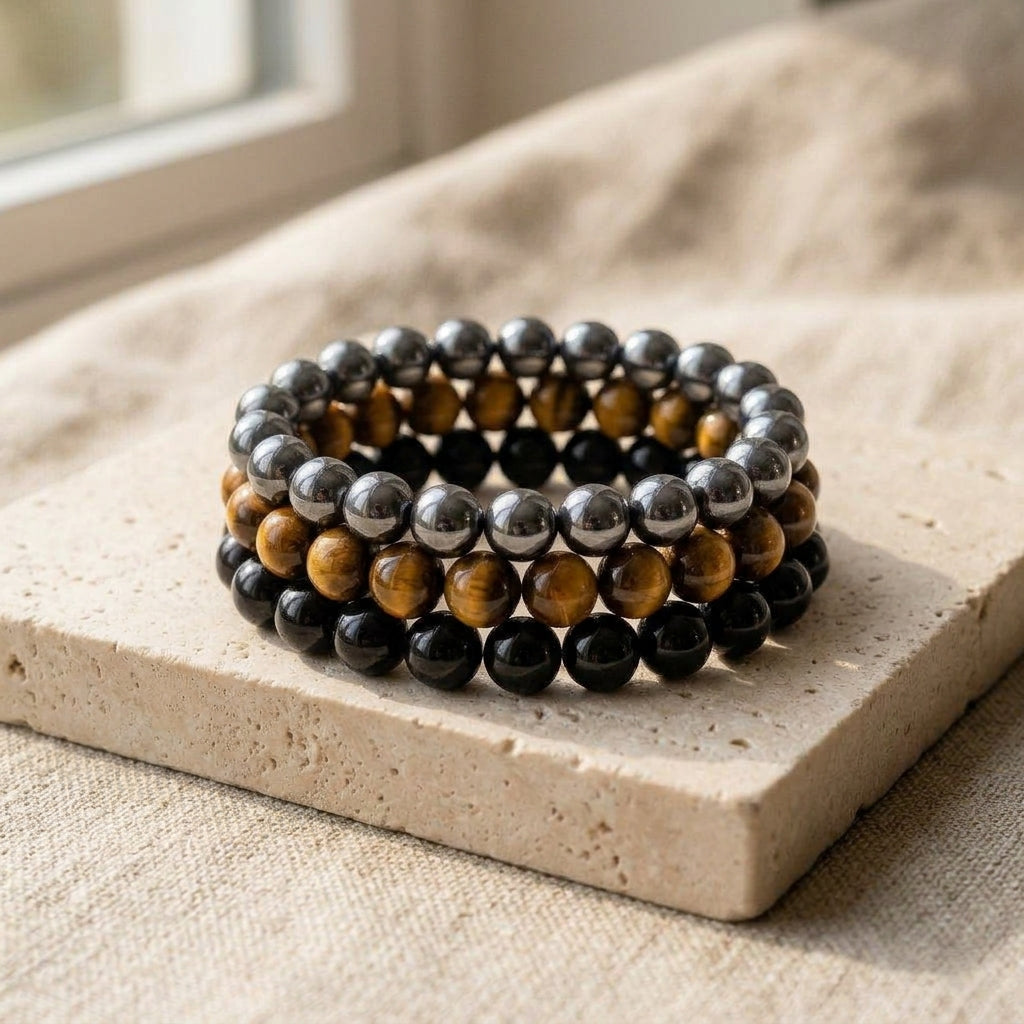
The Master Triple Protection Ritual Stack (Natural Tiger's Eye, Black Obsidian & Hematite)
Black obsidian is often worn as a grounding ritual piece for days that ask for steadier energy.
Shop This Authentic Piece →Obsidian vs. Other Black Crystals
Obsidian is frequently confused with black onyx, black tourmaline, and black agate. The distinctions matter for both care and expectations:
- Obsidian is volcanic glass, Mohs 5–5.5, with a vitreous (glass) lustre and conchoidal fracture.
- Black onyx is a variety of chalcedony (microcrystalline quartz), harder at about Mohs 6.5–7, and usually more uniform and opaque.
- Black tourmaline is a crystalline mineral, harder at about Mohs 7–7.5, and often shows striations.
- Black agate is also chalcedony, and may show banding under strong light.
If you want a durable everyday ring, onyx or tourmaline will outlast obsidian. If you want the deepest, glassiest black with genuine volcanic origin and a lower price point, obsidian is the honest choice.
The Meaning of Obsidian: Protection, Grounding & Shadow Work
In crystal lore, obsidian is most often associated with protection, grounding, and shadow work — the practice of gently examining uncomfortable thoughts and patterns. These are cultural and personal-reminder meanings, not medical claims: obsidian is not a treatment for anxiety, and wearing it does not regulate the nervous system. What it may support is a ritual of pause: a tactile cue to slow down, check in with yourself, and set an intention for the day.
Grounding, in this context, usually means a felt sense of steadiness and presence. Many wearers describe obsidian as a "mirror" stone, often associated with honest self-reflection rather than comfort. That framing is useful if you want a piece that invites accountability; it is less useful if you are looking for reassurance. Choose your intention before you choose your stone.
Obsidian's Historical & Cultural Significance
Obsidian's human story is long and well documented. The Smithsonian notes that shifts in obsidian use over time within the Central Plains may indicate larger socioeconomic shifts, and that obsidian in Northern Plains assemblages suggests interaction networks at least as old as the first Plains Village sites. The Smithsonian's Museum Conservation Institute has studied obsidian trade specifically, using material analysis to trace how this glass moved between communities.
In other words, obsidian was a traded, valued material long before it was a jewellery stone. Its modern association with protection is a cultural layer added on top of a genuinely ancient material history — and it is worth holding both truths together rather than treating the metaphysical meaning as geology.
Types of Obsidian Used in Jewellery
The main jewellery-grade obsidians differ in appearance, rarity, and price. Knowing which one you are looking at is the single most useful buying skill.
Black, Rainbow, Snowflake, Mahogany & Fire Obsidian
- Black obsidian: The most common and most affordable. Opaque, uniform, glossy. Best for everyday bracelets and pendants.
- Rainbow obsidian: Shows layered iridescent sheen, linked by Mindat to microscopic inclusions such as magnetite. The rainbow effect is directional, so look at the stone from several angles before buying.
- Snowflake obsflake obsidian: Black glass with grey-white cristobalite clusters that look like snowflakes. The pattern is natural and should appear irregular, never printed or repeated.
- Mahogany obsidian: Brown-red and black banding caused by iron-rich inclusions. Warmer in tone than black obsidian, and flattering in bronze or gold settings.
- Fire obsidian: The rarest jewellery variety, prized for vivid iridescent layers. The Gemological Institute of America describes how, under proper diffuse reflected light, fire obsidian reveals flow structures — stretched, sheared, and compressed patterns preserved in the solidified glass and brought out through careful lapidary work. Expect small stones and high prices; treat unusually large "fire obsidian" with scepticism.
Everyday Uses: How to Wear Obsidian Jewellery Daily
Obsidian works best in daily wear when the format protects the glass. A pendant or a beaded bracelet takes far less impact than a ring, and a smooth cabochon resists chipping better than a faceted or pointed cut. If your day involves keyboards, gym equipment, or manual work, take rings off first — that is the single most effective care habit.
Jewellery Formats & Styling (Necklaces, Bracelets, Rings, Earrings)
- Necklaces and pendants: The safest daily format. A smooth obsidian drop on a short chain sits close to the body and rarely contacts hard surfaces. Style it as a grounding anchor with neutral tailoring.
- Bracelets: Beaded bracelets are popular and practical, but beads chip against desks and door frames. Choose rounded beads over faceted ones and remove the bracelet for sport.
- Rings: Beautiful but the most vulnerable. Prefer a bezel setting that wraps the stone edge, and reserve the ring for low-impact days.
- Earrings: Studs and short drops are comfortable daily; long obsidian drops swing into hair and bags, so save them for evenings.
For styling, obsidian's deep black reads as minimalist and modern. Pair it with silver for a cooler, more protective feel or with warm metals for mahogany and golden varieties. Wearing several obsidian pieces at once is a matter of taste, not rule — but if one piece is your "pause" cue, keep it singular so the reminder stays clear.
Obsidian Jewellery Care: Cleansing, Charging & Cleaning
Care for obsidian as you would care for glass jewellery, because that is what it is. Clean it with lukewarm water, a drop of mild soap, and a soft cloth; dry immediately. Avoid ultrasonic cleaners, steam cleaners, and harsh chemicals, all of which can damage a polished glass surface or loosen settings. Store obsidian separately from harder stones so quartz and diamond pieces do not scratch it.
For cleansing and charging in the ritual sense, keep it simple: a brief rinse, a wipe with a soft cloth, and a few quiet minutes in morning light are enough. Moonlight is gentler than direct sun, and obsidian's dark colour means sun exposure offers no brightening benefit anyway. Skip salt-water soaks, which can dull the surface and degrade cord or elastic over time. If a piece is strung on elastic, replace the cord periodically rather than waiting for it to fail.
How to Choose Obsidian Jewellery: A Buyer's Decision Table
Decision Table: Matching Obsidian to Your Everyday Life
| Your Situation | Best Obsidian Format | Variety to Choose | Why |
|---|---|---|---|
| Desk job, daily wear, first obsidian piece | Smooth pendant or rounded-bead bracelet | Black obsidian | Low impact, affordable, reads as minimalist; glass softness is not a daily problem in this format. |
| Active lifestyle, gym, or manual work | Pendant only; remove rings and bracelets | Black or mahogany obsidian | Obsidian's Mohs 5–5.5 means knocks chip it; a pendant stays out of the way. |
| Collector or gift for a crystal enthusiast | Cabochon ring in a bezel setting or small pendant | Rainbow, snowflake, or fire obsidian | Visible natural patterning; fire obsidian is scarce and should come with provenance. |
| Warm-toned wardrobe, bronze or gold jewellery | Bracelet or short-drop earrings | Mahogany obsidian | Iron-rich brown-red banding flatters warm metals better than stark black. |
| Wants a scratch-proof everyday ring | Consider black onyx or tourmaline instead | Not obsidian | Both are harder (about Mohs 6.5–7.5) and better suited to constant hand wear. |
Integrity check before you buy: apply the Lumina Grade AAA Integrity Standard. Ask whether the obsidian is natural and untreated, whether any "rainbow" or "fire" effect is a genuine optical phenomenon rather than a coating, and whether the piece is free of chemical resin filling, irradiation, and dye. Look for natural irregularity in snowflake and mahogany patterns — perfect repetition is a warning sign.
Frequently Asked Questions
What does obsidian crystal jewellery mean and what is it used for?
It is most often associated with protection, grounding, and honest self-reflection, and is worn as a daily reminder or talisman. These are cultural and personal meanings rather than medical effects.
Is obsidian jewellery good for everyday wear?
Yes in durable formats such as pendants and rounded-bead bracelets, but obsidian is glass at roughly Mohs 5–5.5, so it chips more readily than quartz. Keep rings for low-impact days and remove bracelets for sport.
How do I cleanse, charge, and care for obsidian crystal jewellery?
Wipe with lukewarm water and mild soap, dry immediately, and avoid ultrasonic or steam cleaners and salt soaks. For charging, a few quiet minutes in soft morning or moonlight is enough — no special equipment is required.
Sources
- Mindat — Obsidian: Mineral information, data and localities
- U.S. Geological Survey — Obsidian
- Smithsonian Profiles — Obsidian use and interaction networks
- Smithsonian Museum Conservation Institute — Obsidian trade research
- GIA — Fire Obsidian's Beguiling Spectrum
This guide is for general information and cultural context only. Crystal meanings are personal and symbolic, and this article makes no medical or therapeutic claims.
© 2026 Lumina Quartz. All rights reserved.
Product Facts From the Current Catalog
These details come from the active Lumina Quartz catalog record checked on 2026-11-23. They are product-listing facts, not laboratory results or invented wear-test claims.
| Listed product | The Master Triple Protection Ritual Stack (Natural Tiger's Eye, Black Obsidian & Hematite) | Grade AAA Set // Lumina Quartz |
|---|---|
| Format | Bracelets |
| Listed price snapshot | 54.90 |
Price, availability, and options may change. Check the live product listing before choosing.