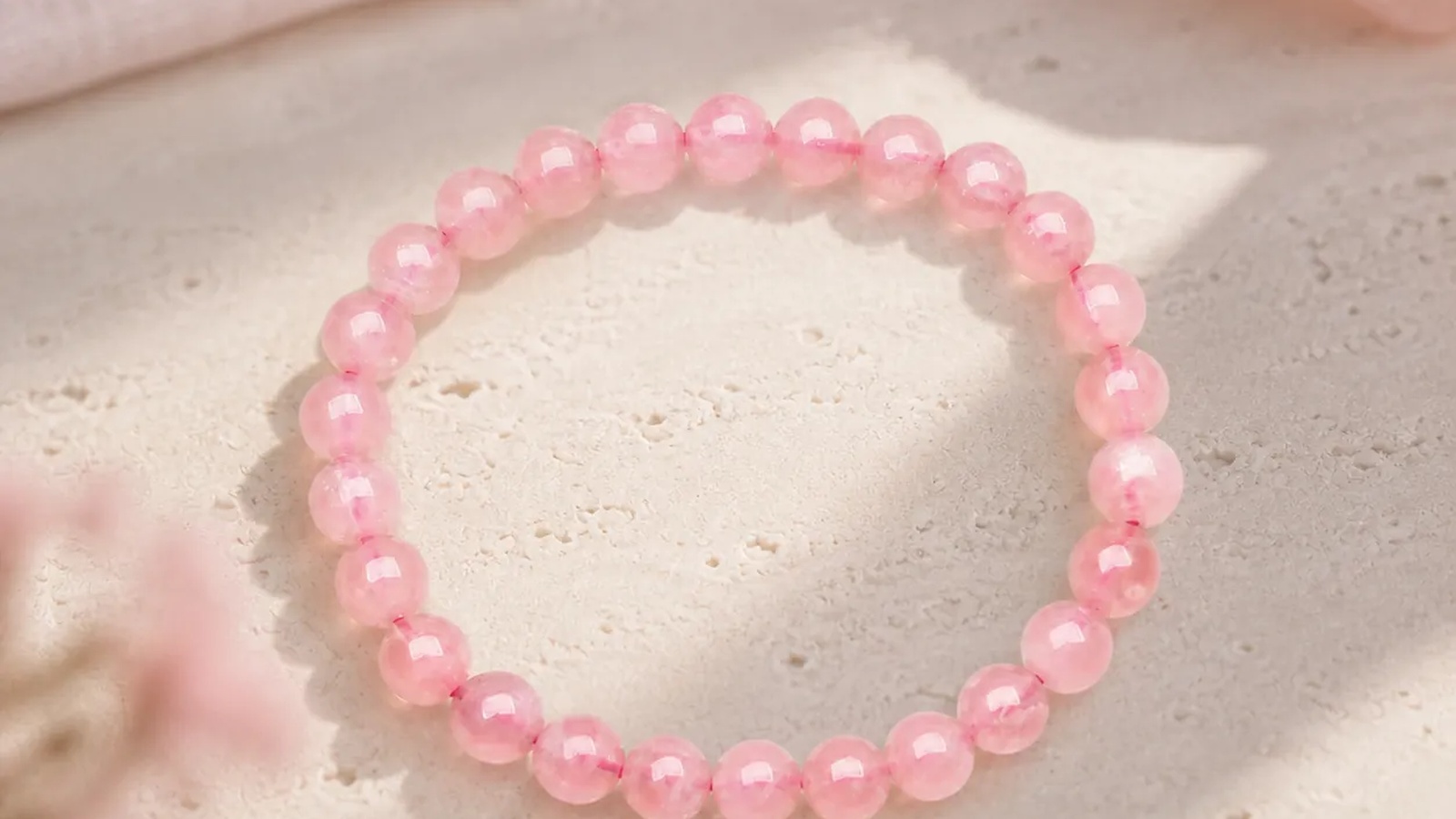
A pink quartz bracelet is a bracelet strung with rose quartz—a pink variety of the mineral quartz (SiO₂)—traditionally associated with the heart chakra and often worn as a daily reminder of self-compassion and emotional gentleness. In practice, the bracelet itself is simply polished rose quartz; the meaning comes from how you use it as a personal symbol, not from any proven physiological effect.
The Verdict Box: 10-Second Executive Summary
- Direct Verdict: A genuine pink quartz bracelet is a natural rose quartz beaded bracelet. It is a symbolic and aesthetic object—often used as a reminder of self-compassion and heart-centered intentions—not a medical or therapeutic device.
- Mineral Identity: Quartz (SiO₂), Mohs hardness 7.0, refractive index 1.544–1.553, specific gravity 2.66 (GIA).
- Quality Benchmark: Look for clearly disclosed natural rose quartz with no dye or irradiation treatment stated. Brand grading labels are marketing terms, not gemological certifications—ask for the actual material description.
- Best For: Everyday symbolic wear, gifting, and personal ritual. Traditional guidance places it on the left wrist for inward reflection; this is a convention, not a physical rule.
- Hard Test: Genuine rose quartz (Mohs 7) scratches ordinary window glass (Mohs ~5.5) without surface damage; dyed "vivid pink" fakes often bleed pigment under acetone.
What Is a Pink Quartz Bracelet? (Rose Quartz Explained Simply)
"Pink quartz" is commonly used as a synonym for rose quartz, the massive (non–well-crystallized) pink variety of quartz colored by microscopic mineral inclusions (Mindat). A pink quartz bracelet is therefore a strand of polished rose quartz beads. The gem's color ranges from very light pink to medium-dark pink, and its cloudy translucence comes from those same microscopic inclusions (GIA).
Two practical details matter for a bracelet. First, rose quartz is usually found in massive form, so well-shaped crystals are prized—bracelets use cut and polished beads rather than natural crystal points. Second, the deepest colors tend to occur in larger pieces, which is why small, richly colored beads are relatively scarce and worth a closer look before you buy.
The Meaning of Pink Quartz: Love, Self-Compassion, and the Heart Chakra
In crystal and folk traditions, rose quartz is often called the heart stone and linked to the Heart Chakra (Anahata). GIA notes that some refer to it as the "love stone" because it is traditionally believed to support emotional balance (GIA Pink Gemstone Buying Guide). This is cultural and traditional symbolism—not a medical claim, and not a substitute for care from a qualified professional.
Traditional Symbolism vs. Modern Everyday Use
Traditionally, rose quartz is linked to romantic love, gentleness, and the fifth wedding anniversary, which the gem commemorates (GIA). Modern everyday use tends to be quieter and more personal: a bracelet worn as a tactile anchor for patience or a daily intention. The tradition supplies the poetry; the modern use supplies the habit. Keep them separate and both stay honest.
How to Wear It: Which Wrist, Layering, and Daily Styling
Traditional guidance wears rose quartz on the left wrist as a gesture toward inward reflection and self-compassion. This is a convention, not a rule with physical effects—wear it on whichever wrist feels comfortable and practical for you.
For layering, consider hardness. Rose quartz at Mohs 7 is durable but will be scratched by harder stones such as sapphire or diamond, so keep it away from high-hardness pieces in the same stack and let softer metals sit between them. Style-wise, the pastel, cloudy translucence pairs naturally with neutral tones and silver; a single bead bracelet reads as quiet, while a stack invites texture.
Real vs. Imitation: How to Spot Genuine Natural Pink Quartz
Authentic rose quartz gets its delicate pink hue from microscopic mineral inclusions that give it a cloudy translucence, not from surface dyes (GIA). That single fact powers most honest tests. Overly saturated "vivid pink" beads sold on mass marketplace platforms are frequently dyed crackle quartz, cheap calcite, or dyed glass, which may bleed pigment when tested with acetone.
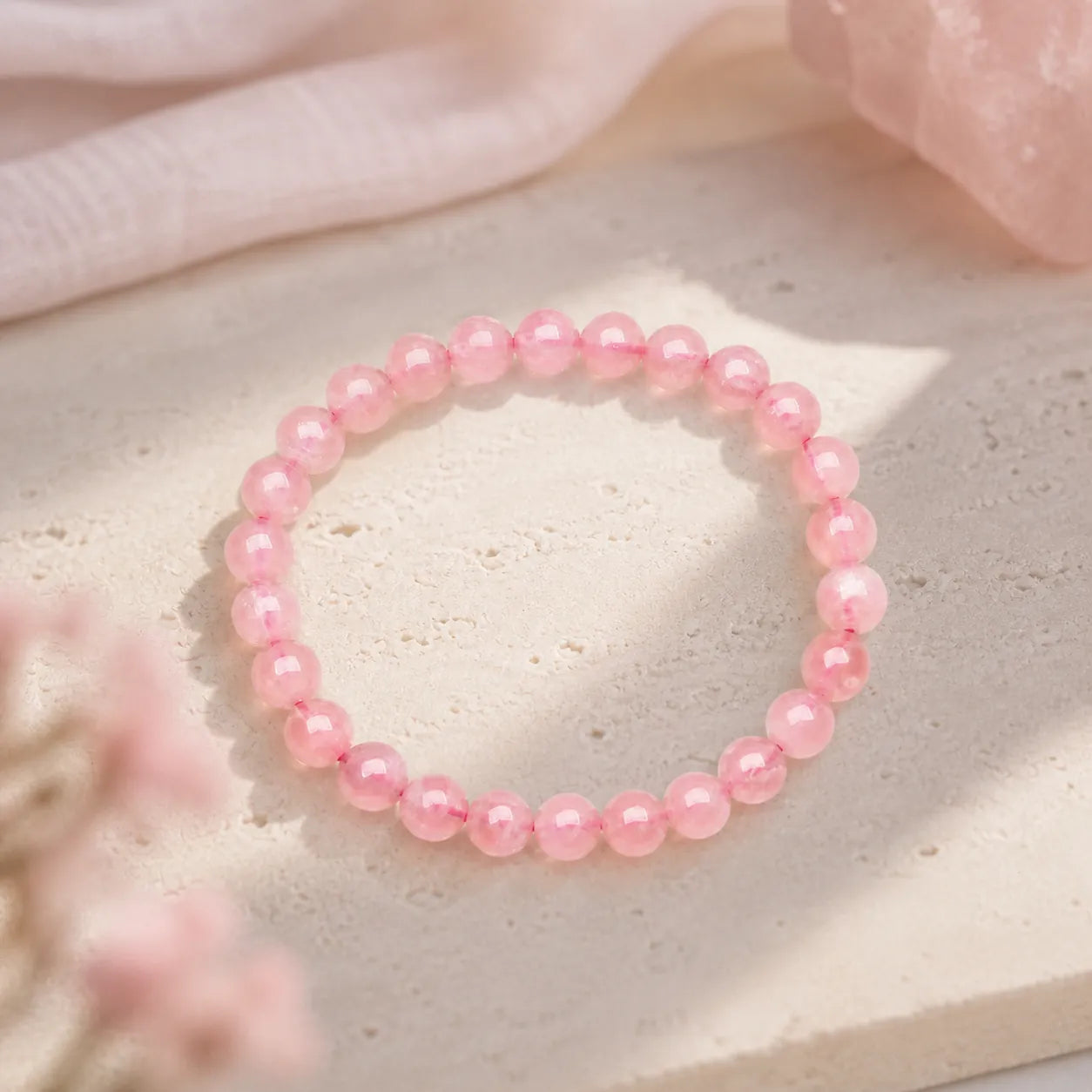
Rose Quartz Love Bracelet
Rose quartz can become a soft daily reminder to return to tenderness, self-trust, and emotional ease.
Shop This Authentic Piece →Rather than relying on a brand grade label, judge the stone itself: ask what the material is, whether it is natural, and whether any treatment is disclosed. See the checklist below for a practical, verifiable routine.
Step-by-Step Genuine Rose Quartz Check
- Read the color honestly. Expect very light to medium-dark pink with cloudy translucence. Uniform neon-pink saturation is a warning sign, not a premium.
- Run the glass scratch test. A true quartz bead at Mohs 7.0 should scratch ordinary window glass (Mohs ~5.5) without being damaged itself. Test a discreet area and accept that this is a hardness check, not a lab certificate.
- Do an acetone spot test. Dab a cotton swab with acetone on an inconspicuous bead. Dye on crackle quartz, calcite, or glass may bleed pigment; natural color does not come off. (Do this only on a bead you are prepared to inspect closely.)
- Look for asterism in high-grade specimens. Some rose quartz can show a soft six-pointed star under focused single-point light, caused by oriented inclusions (GIA). Absence of a star is normal—presence in a well-cut bead is a quality signal, not a guarantee.
- Check the bead consistency. Natural massive rose quartz varies subtly bead to bead. Perfectly identical, glassy, bubble-free beads suggest glass or treatment.
- Ask for treatment disclosure. GIA notes rose quartz is subject to a number of processes; a seller who cannot clearly state "natural" and describe any treatment has not given you enough to verify.
Decision Table: Matching Your Intent to the Right Bracelet Check
| Your goal | What to verify first | Red flag to avoid |
|---|---|---|
| Daily symbolic wear | Comfortable fit, natural color range, clear material disclosure | Neon-pink uniformity sold as "premium" |
| Gifting (anniversary) | Material description and care card included | Only brand grade labels, no mineral detail |
| Collecting higher-grade beads | Cloudy translucence, bead-to-bead variation, possible asterism | Glass-smooth, bubble-free, identical beads |
| Budget purchase | Honest description of dye risk and treatment | Vague "genuine stone" claims with no specifics |
Applicability Boundaries
This checklist is a practical home screening, not gemological certification. The scratch and acetone tests cannot confirm origin, and a passing result does not prove a stone is untreated natural rose quartz. For high-value pieces, consult a qualified gemologist.
Care, Cleansing, and Charging Your Bracelet
Physically, rose quartz is durable but not indestructible. Store it apart from harder stones, avoid prolonged harsh chemical exposure, and wipe beads with a soft damp cloth. Avoid ultrasonic or steam cleaning if your bracelet includes glued settings or softer fittings.
For cleansing and "charging" as a personal ritual—not a physical process—some people simply rinse the bracelet in cool water, dry it fully, and pause with a clear intention while holding it. Brief sunlight exposure is fine, though long sun exposure is not a color guarantee. Treat cleansing as a moment of attention, and the practice stays grounded.
Pink Quartz Bracelet Uses: Rituals, Gifting, and Everyday Moments
Because rose quartz commemorates the fifth wedding anniversary (GIA), a pink quartz bracelet makes a considered anniversary or milestone gift—especially paired with a short note about why you chose it. In everyday life, it works as a small tactile ritual: a pause before a difficult conversation, a reminder to speak to yourself gently, a marker for a new season of self-care. These are symbolic uses, often associated with emotional softness, and they are entirely yours to define.
Choosing Your Lumina Quartz Pink Quartz Bracelet (Fit, Size, What's Included)
Start with fit: measure your wrist snugly and add roughly 1–1.5 cm of ease for a comfortable drape, or more if you prefer a loose bracelet. Bead diameter changes the look more than the length—smaller beads read delicate, larger beads read grounding and are easier to see the stone's translucence in.
Then check the details: ask for a clear material description (natural rose quartz), any stated treatment, bead sizes, and care guidance. A trustworthy listing gives you enough information to verify color, hardness, and provenance yourself—rather than asking you to take a label on faith.
FAQ: Pink Quartz Bracelet Questions Answered
What does a pink quartz bracelet mean and what is it used for?
A pink quartz bracelet is a rose quartz beaded bracelet traditionally associated with love, self-compassion, and the heart chakra. It is used as a symbolic everyday reminder or gift, not as a medical or therapeutic device.
Which wrist should I wear a pink quartz bracelet on?
Traditional guidance places rose quartz on the left wrist as a gesture toward inward reflection and self-compassion. This is a convention rather than a rule—choose the wrist that is comfortable and practical for you.
How can I tell if a pink quartz bracelet is genuine natural rose quartz?
Check for cloudy translucence and soft pink rather than uniform neon saturation, test that a bead scratches glass (quartz hardness 7.0), and spot-test with acetone for dye bleed. A genuine bracelet should also come with clear material and treatment disclosure.
Can I wear my pink quartz bracelet every day—in the shower, to sleep, or to the gym?
Yes, with care: rose quartz is durable but can be scratched by harder stones and stressed by harsh chemicals or impacts. Remove it for heavy gym sessions and avoid prolonged chemical exposure; showering is generally fine but dry it afterward.
How do I cleanse, charge, and care for a pink quartz bracelet?
Wipe beads with a soft damp cloth, store separately from harder gems, and rinse in cool water as a personal cleansing ritual. Treat "charging" as an intention-setting practice rather than a physical process.
Sources
- GIA — Rose Quartz Gem | Rose Quartz Stone
- GIA — Pink Gemstone Buying Guide
- Mindat — Pink Quartz: Mineral information, data and localities
© 2026 Lumina Quartz. This guide shares cultural and traditional symbolism alongside verified mineral properties. Crystal meanings are not medical claims, and no bracelet is a substitute for professional care.