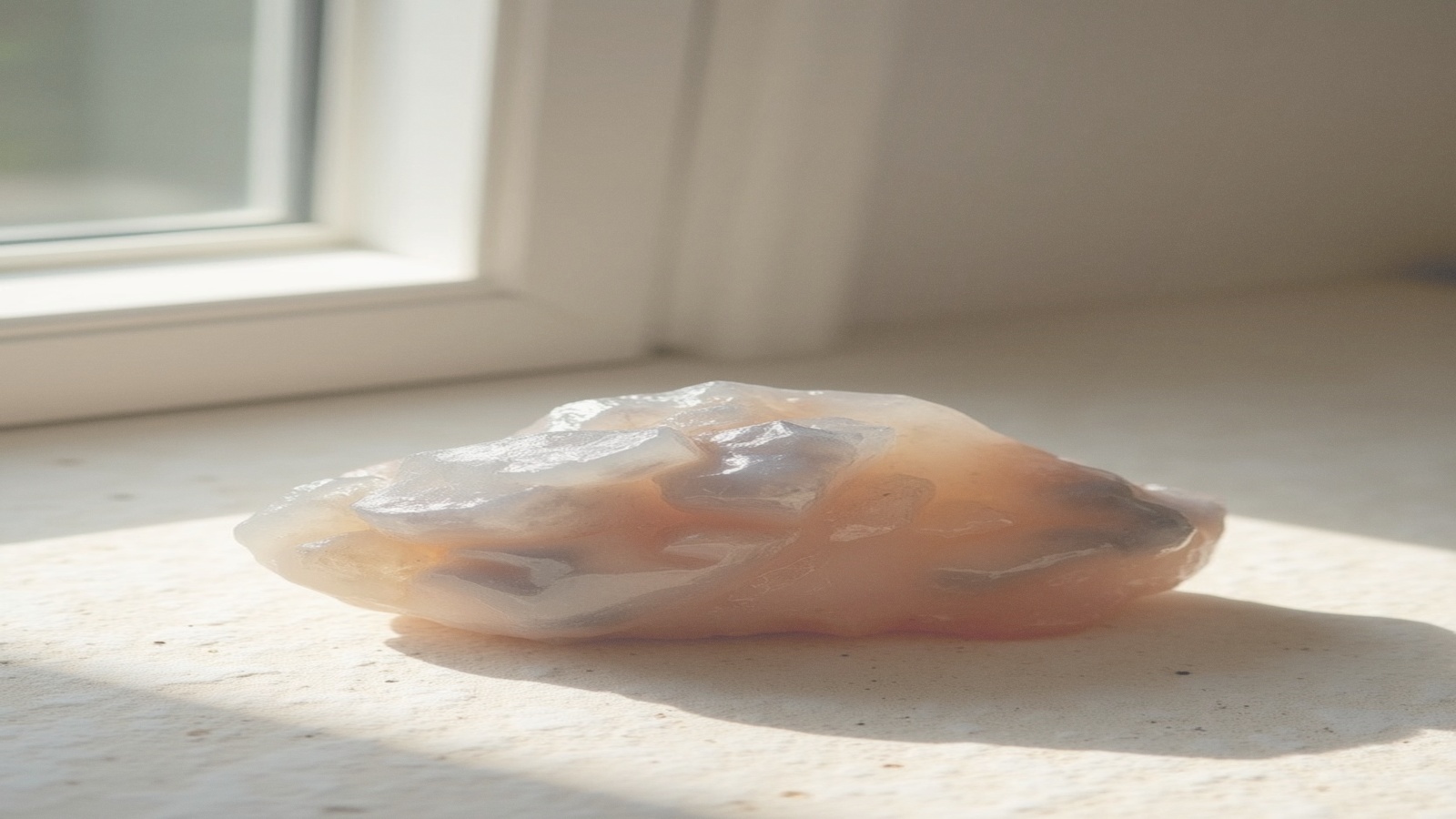
The stone sold as turritella agate is a fossil-bearing chalcedony, a fine-grained variety of quartz, in which the tightly packed spiral shells of an ancient freshwater snail are preserved. The species is actually Elimia tenera, not Turritella, so the popular name is a long-standing misnomer. The material is valued for its readable fossil pattern, its grounding brown-to-charcoal palette, and its practical hardness for beads and everyday jewelry.
10-Second Executive Summary / The Verdict Box
- Direct Verdict: Turritella agate is a genuine fossil agate (chalcedony) from the Green River Formation in Wyoming. It is not made of Turritella shells — the fossils are the freshwater snail Elimia tenera.
- Mineral family: Chalcedony, a fine-grained variety of quartz (SiO₂), a microcrystalline quartz.
- Mohs hardness: Approximately 6.5–7, the standard range for quartz-family gemstones — suitable for beads, pendants, and tumbled pieces, with care against hard knocks.
- Color cause: Brown, gray, and charcoal tones typically come from iron oxide and carbonaceous material in and around the fossil shells.
- Best for: Fossil lovers, grounding everyday jewelry, beaded bracelets and malas, and display specimens that reward close looking.
- Buying signal: Look for crisp, high-contrast shell patterns and untreated surface — our Lumina Grade AAA Integrity Standard means natural rough, zero chemical stabilization, and no irradiation or dye.
What Is Turritella Agate? A Fossil Stone Explained
Turritella agate is a silicified fossil stone: silica-rich water once permeated snail shells and the surrounding sediment, and over time the material hardened into chalcedony with the shells preserved inside. Agate itself is a banded, fine-grained quartz (chalcedony), and the Smithsonian describes its colors as coming from microscopic mineral inclusions within the quartz. In turritella agate, the “inclusions” are whole fossilized snails — often hundreds packed into a single cabochon.
Because the stone is mostly quartz, it shares the durability of the quartz family: hard enough for daily wear in beads and pendants, but not indestructible. A hard strike against a table edge can still chip a polished dome or crack a bead hole.
The Naming Mix-Up: Why It's Not Really Turritella
The name stuck because early collectors saw spiral shells and assigned them to the marine genus Turritella. Later study identified the fossils as Elimia tenera, a freshwater snail that lived in the ancient lakes of what is now Wyoming. The trade name has never fully corrected, so “turritella agate” remains the searchable, recognizable label — just know that the fossil is a freshwater gastropod, and the stone is often called Elimia agate by more precise sellers.
Where Turritella Agate Comes From: Wyoming's Green River Formation
The classic source is the Green River Formation, a lakebed deposit spanning parts of Wyoming, Utah, and Colorado. The commercially familiar turritella agate is most strongly associated with Wyoming material, where lake sediments and volcanic ash created the silica-rich conditions for fossilization. The result is a stone with a distinct regional character: dark, warm-toned chalcedony threaded with pale to near-white spiral shells.
This origin matters for buyers. A genuine Wyoming piece usually shows irregular, densely packed shell cross-sections rather than a painted or printed repeat pattern. If a strand looks too uniform — identical spirals spaced like wallpaper — treat that as a question to ask, not a bargain to grab.
Turritella Agate Meaning and Healing Properties
In crystal and folk traditions, turritella agate is often associated with endurance, protection, and connection to ancestry — fitting symbolism for a stone that literally holds the remains of ancient life. These are cultural and personal meanings, not medical claims. Keep the distinction clear: the stone's quartz hardness and fossil content are measurable facts; its “grounding” reputation is symbolic language used by wearers.
Strength, Protection, and Ancestral Connection
Many people are drawn to turritella agate because it reads like a record of survival — shells that endured millions of years of sediment and pressure. Practitioners may use it as a reminder stone for persistence during long projects or transitions. It is often associated with protective traditions simply because of its dark, earthy appearance and fossil content, not because of any proven physical effect.
Grounding, Home, and Emotional Roots
The stone's brown-and-charcoal palette lends itself to “grounding” symbolism: home altars, desk stones, and entryway bowls. Some wearers use turritella agate as a tactile anchor during moments when they want to feel steady or connected to family history. That is a personal ritual, and it should be described as such — a meaningful reminder, not a treatment for anxiety, stress, or any health condition.
Everyday Uses: Jewelry, Beads, and Décor
Turritella agate works best where its pattern can be seen. Rounded beads show shell spirals across the surface; flat cabochons and tumbled stones reveal larger cross-sections. Because the material is opaque and patterned, it pairs naturally with matte finishes, silver, and warm metal tones, and it reads especially well in unisex designs.
Practical uses include beaded bracelets and malas, pendant cabochons, worry stones, bookends, and small display bowls. For décor, keep polished pieces out of direct, long-term sun to limit gradual color fading, and avoid placing them where they will be knocked against harder stone surfaces.
How to Cleanse, Charge, and Care for Turritella Agate
Cleanse turritella agate with lukewarm water and a drop of mild soap, then pat dry with a soft cloth. Avoid ultrasonic cleaners, steam cleaners, and harsh chemicals — the fossil inclusions and any natural surface pits can be vulnerable to aggressive cleaning. For energetic cleansing, common traditions include moonlight, sound, or resting the stone on a selenite plate; these are symbolic practices, not measurable effects.
Charging, in the folk sense, is usually done by leaving the stone in soft moonlight or setting an intention while holding it. Neither water nor sun is strictly necessary, and prolonged sun exposure is better avoided for color stability. Store beaded pieces flat or hung rather than in a tangled pile, and check bead holes periodically for wear if you wear a bracelet daily.
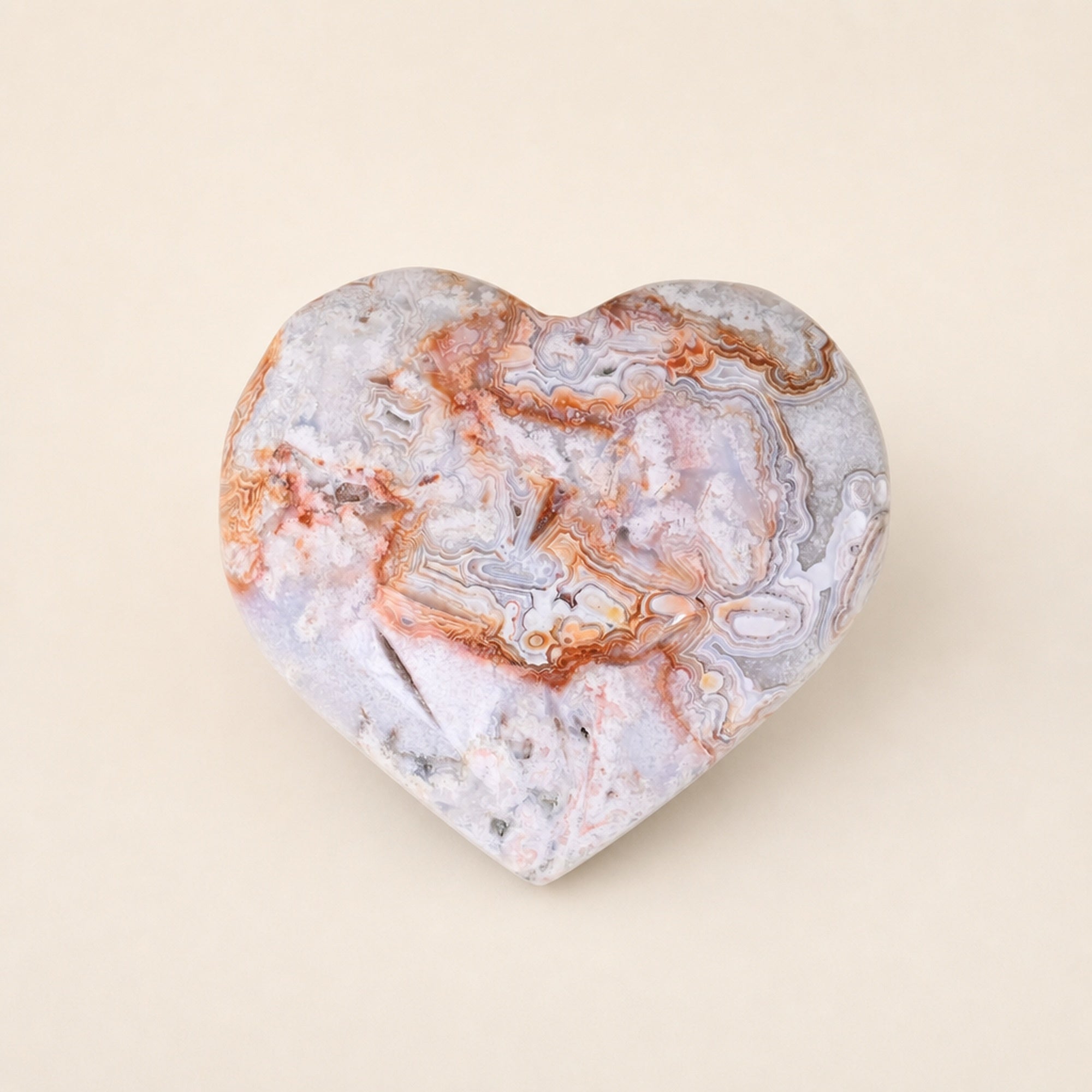
A related stone-family option
Crazy Lace Agate Heart Stone – Joyful Movement
This is a related variety in the same stone family, not a Agate product. We only identify jewelry as Agate when that exact material is verified.
Explore this related optionHow to Spot Real vs. Treated or Imitation Turritella Agate
Agate has a long history of artificial treatment, and historic sources describe how porous agate could be penetrated by coloring fluids to alter its appearance. That legacy is why “treated agate” is a normal category in the trade — and why a careful buyer should know what they are looking at. Turritella agate's fossil pattern is the key diagnostic: real material shows irregular shell cross-sections at varying angles, with slight color variation and natural pits or fractures. Dye tends to pool in cracks and along bead holes; printed imitations repeat too perfectly.
Step-by-Step Check: Is This Turritella Agate Genuine and Untreated?
Use this checklist when you have the stone in hand or are reviewing close-up photos.
- Read the pattern at two scales. Real fossil agate shows shell spirals that vary in size, orientation, and spacing; a printed or cast imitation repeats at a fixed interval.
- Follow the color into the holes and fissures. Natural color sits within the chalcedony and fossil fill; dyes often concentrate as a darker line in cracks, drilled holes, or pits.
- Check for a painted surface. Genuine pieces show the shell pattern continuing through the stone's body; an imitation may show pattern only on the face.
- Look for natural imperfections. Small pits, hairline fractures, and slight matte areas are normal in fossil material and are a sign of honest, unstabilized rough.
- Ask about treatment directly. Request confirmation of natural color, no dye, no irradiation, and no polymer stabilization when buying beads or cabochons.
Our Lumina Grade AAA Integrity Standard is built around that checklist: natural rough, zero chemical stabilization, and no irradiation or dye. If a seller cannot answer these questions, treat the piece as an unknown and price it accordingly.
Buying Guide: Choosing Turritella Agate Beads, Tumbled Stones, and Rough Pieces
For beads, judge a strand by pattern consistency within reason and by hole quality — clean, unchipped holes matter more than perfect color match. For tumbled stones, look for a smooth polish that does not hide the fossil pattern under heavy resin. For rough pieces, favor specimens with visible shell cross-sections and stable, uncrumbly edges.
Prices vary with pattern density and size, so compare material, not marketing language. A strand with dramatic, densely packed shells is worth more than a plain strand of similar weight, and untreated material in good polish is worth more than dyed or stabilized pieces. Under the Lumina Grade AAA Integrity Standard, we prioritize stones whose fossil pattern is readable and whose finish is honest — no resin fills hiding flaws, no color enhancement imitating the natural brown-to-gray range.
Frequently Asked Questions
What is turritella agate and what is it made of?
It is a fossil-bearing chalcedony — a fine-grained quartz — in which the spiral shells of the freshwater snail Elimia tenera are preserved. The brown and charcoal tones typically come from iron oxide and carbonaceous material within the fossil stone.
Is turritella agate a real turritella fossil or a misnomer?
It is a misnomer: the fossils are Elimia tenera, a freshwater snail, not the marine genus Turritella. The trade name persists as a familiar label, and precise sellers may call it Elimia agate.
How can you tell if turritella agate is genuine and untreated?
Genuine pieces show irregular shell cross-sections at varying angles, with natural pits or hairline fractures and no dye pooling near holes. Ask for confirmation of natural color and no stabilization — our Lumina Grade AAA Integrity Standard means natural rough, zero chemical stabilization, and no irradiation or dye.
Sources
- Quartz (var. agate) | Smithsonian National Museum of Natural History
- Daniel Russell - Historic Methods of Artificially Coloring Agates | mindat.org
Cultural and symbolic meanings described here are traditional associations, not medical advice. Turritella agate is a natural fossil stone whose properties are mineral and geological; it is not a treatment for any health condition. © 2026 Lumina Quartz. All rights reserved.