The Complete Everyday Guide to Types Of Agate: Meaning and Uses

Table of Contents
- What Is Agate? Formation, Composition, and Why Varieties Differ
- How to Identify Types of Agate: Banding, Inclusions, and Optical Effects
- The Main Types of Agate (With Pictures and Descriptions)
- Banded and Fortification Agates (Lake Superior, Fairburn, Botswana, Condor)
- Lace and Patterned Agates (Crazy Lace, Blue Lace, Sulaimani/Eye, Polka Dot)
- Inclusion Agates (Moss, Dendritic, Plume, Sagenite)
- Optical and Specialty Agates (Iris, Fire, Enhydro, Geode, Turritella, Petrified Wood)
- Agate Meanings and Metaphysical Properties by Type
- Agate Type Comparison at a Glance
- Everyday Uses: Jewelry, Home Decor, and Collecting
- Natural vs. Dyed vs. Synthetic Agate: Buying Tips and Care
- How many types of agate are there, and how are they classified?
- Which types of agate are best for jewelry and everyday wear?
- How can I tell real agate from dyed or synthetic agate?
- Sources
What Is Agate? Formation, Composition, and Why Varieties Differ
Agate is a variety of chalcedony — a cryptocrystalline form of quartz — that forms when silica-rich water deposits microscopic quartz crystals in layers inside cavities of volcanic rock. Its Mohs hardness of 6.5–7 makes it durable enough for everyday jewelry. Varieties differ because each cavity records its own conditions: the chemistry of the silica solution, the rate of deposition, temperature, and whatever minerals or organic matter were present. Those variables produce the banding, colors, inclusions, and optical effects that separate one agate type from another. Agate is also recognized as an alternative birthstone for Gemini, which makes it a meaningful gift choice for people born under that sign (International Gem Society).
Core Diagnostic Verdict: Agate is a variety of chalcedony — a cryptocrystalline form of quartz — that forms when silica-rich water deposits microscopic quartz crystals in layers inside cavities of volcanic rock.
- Core Intention: Types Of Agate
- Authenticity Standard: Grade AAA Genuine Natural // Verified Untreated
- Lumina Standard: Grade AAA Natural Gemstones // Verified Untreated
How to Identify Types of Agate: Banding, Inclusions, and Optical Effects
Identification starts with a simple question: what is the dominant visual feature? A gemologist or collector typically sorts agate into banded (fortification) patterns, lace and patterned forms, inclusion types, and optical or specialty forms. Banding is assessed by whether lines follow the cavity wall (fortification) or form irregular, curved ribbons (lace). Inclusions are judged by shape — mossy, dendritic, or plume-like growths indicate mineral or organic content rather than pure silica. Optical effects such as iris or fire require light to interact with fine internal layers. This sorting method is the same practical framework used in buying guides for chalcedony and agate (IGS).
For a quality check, apply the Lumina Grade AAA Integrity Standard: look for natural color variation, visible banding or inclusions that continue through the stone, and no uniform dye lines. A stone that meets this standard is natural rough material with no chemical stabilization, no irradiation, and no dye.
The Main Types of Agate (With Pictures and Descriptions)
Banded and Fortification Agates (Lake Superior, Fairburn, Botswana, Condor)
Fortification agates show angular or concentric bands that follow the shape of the original cavity. Lake Superior agates from the upper Midwest are known for red, orange, and white banding. Fairburn agates from South Dakota are prized for tight, sharply defined fortification patterns. Botswana agates from southern Africa display fine parallel bands in pink, grey, and white. Condor agates from Argentina are appreciated for bold, contrasting bands. These are collector and jewelry staples because the banding is stable and visually distinctive.
Lace and Patterned Agates (Crazy Lace, Blue Lace, Sulaimani/Eye, Polka Dot)
Crazy Lace agate from Mexico shows swirling, irregular white and brown lines that resemble lace. Blue Lace agate from South Africa is pale blue with fine white banding. Sulaimani or "eye" agate, often associated with the Middle East, shows a central eye-like formation within the stone. Polka Dot agate from Oregon features round inclusions that create a spotted pattern. Most of these are cut as cabochons or beads, and their patterns are natural, not painted.
Inclusion Agates (Moss, Dendritic, Plume, Sagenite)
Moss agate is clear or milky chalcedony with green, brown, or black inclusions that look like moss or plant matter. Dendritic agate contains branching, tree-like patterns formed by manganese or iron oxides. Plume agate has feathery mineral growths, and sagenite agate contains needle-like inclusions, often rutile. These inclusions are the identifying feature, and they are entirely natural in unenhanced stones.
Optical and Specialty Agates (Iris, Fire, Enhydro, Geode, Turritella, Petrified Wood)
Iris agate shows a rainbow effect when light passes through fine internal bands. Fire agate from the southwestern United States displays iridescent play of color caused by layered iron oxide. Enhydro agate contains trapped water or gas bubbles, visible as a moving inclusion. Geode agate is a hollow or partially filled nodule lined with agate. Turritella agate contains fossilized snail shells, and petrified wood agate is wood replaced by silica. These specialty types carry the highest collector interest and need careful inspection before purchase.
Agate Meanings and Metaphysical Properties by Type
In crystal traditions, agate is often associated with grounding, stability, and gentle balance. These meanings are cultural and symbolic, not medical claims. Moss agate is traditionally linked to growth and nature connection. Blue Lace agate is often associated with calm communication. Crazy Lace agate may be used as a reminder to find joy in complexity. Dendritic agate is frequently connected to patience and personal growth. Fire agate is associated with vitality, and Botswana agate with grounding. Use these as personal reminders, not as treatment for any condition.
Agate Type Comparison at a Glance
This table helps match a type to its best use rather than relying on vague descriptions.
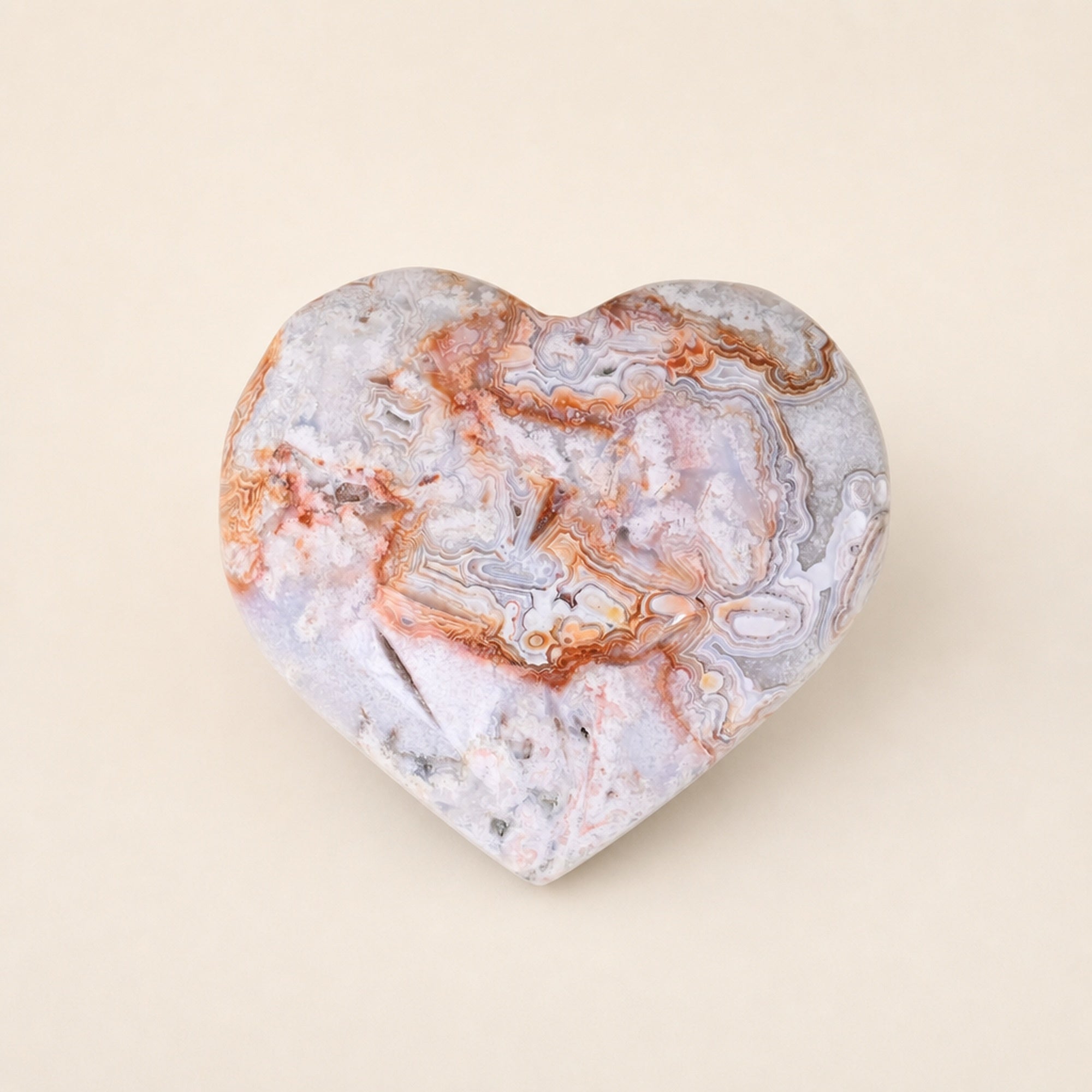
A related stone-family option
Crazy Lace Agate Heart Stone – Joyful Movement
This is a related variety in the same stone family, not a Agate product. We only identify jewelry as Agate when that exact material is verified.
Explore this related option| Type | Defining Feature | Typical Use | Buying Note |
|---|---|---|---|
| Banded / Fortification | Concentric or angular bands | Cabochons, beads, decor | Check banding continuity across the stone |
| Lace / Patterned | Swirling or spotted patterns | Jewelry, statement pieces | Pattern should be natural, not painted |
| Inclusion (Moss, Dendritic) | Mineral growths inside | Pendants, collectors | Inclusions should show depth |
| Optical (Iris, Fire) | Light-based effects | Collector pieces | Best judged in person or video |
| Specialty (Enhydro, Geode) | Water, cavity, or fossil content | Display collection | Verify authenticity of the included feature |
Everyday Uses: Jewelry, Home Decor, and Collecting
Agate's hardness of 6.5–7 supports everyday wear in rings, pendants, bracelets, and earrings. Banded and lace agates are most common in jewelry. Larger fortification pieces are often polished as decorative slabs or used in home decor. Inclusion and specialty agates are better suited to collector display, where their internal features can be seen. For a complete piece, check that the setting protects the stone edge and that the surface is polished, not resin-coated.
Natural vs. Dyed vs. Synthetic Agate: Buying Tips and Care
Natural agate shows uneven color distribution, natural banding or inclusions, and subtle variation under light. Dyed agate often shows concentrated color in fractures or unnaturally uniform hues. Synthetic or reconstituted material may show sharp, repeating patterns and no visible internal depth. The Lumina Grade AAA Integrity Standard means natural rough, no chemical stabilization, and no irradiation or dye. Care is simple: clean with mild soap and water, avoid prolonged heat and harsh chemicals, and store separately to prevent scratches.
How many types of agate are there, and how are they classified?
There is no fixed count because agate varies by locality and formation. Practical classification uses four groups: banded, lace and patterned, inclusion, and optical or specialty types.
Which types of agate are best for jewelry and everyday wear?
Banded agates, Crazy Lace, and Blue Lace are the most common jewelry choices. Their hardness of 6.5–7 supports regular wear if the setting is protective.
How can I tell real agate from dyed or synthetic agate?
Look for natural color variation, continuous banding or inclusions, and no concentrated dye in fractures. Uniform color and repeating patterns are warning signs.
Sources
© 2026 Lumina Quartz. This guide is for educational and cultural interest. Metaphysical meanings are symbolic and are not medical claims.