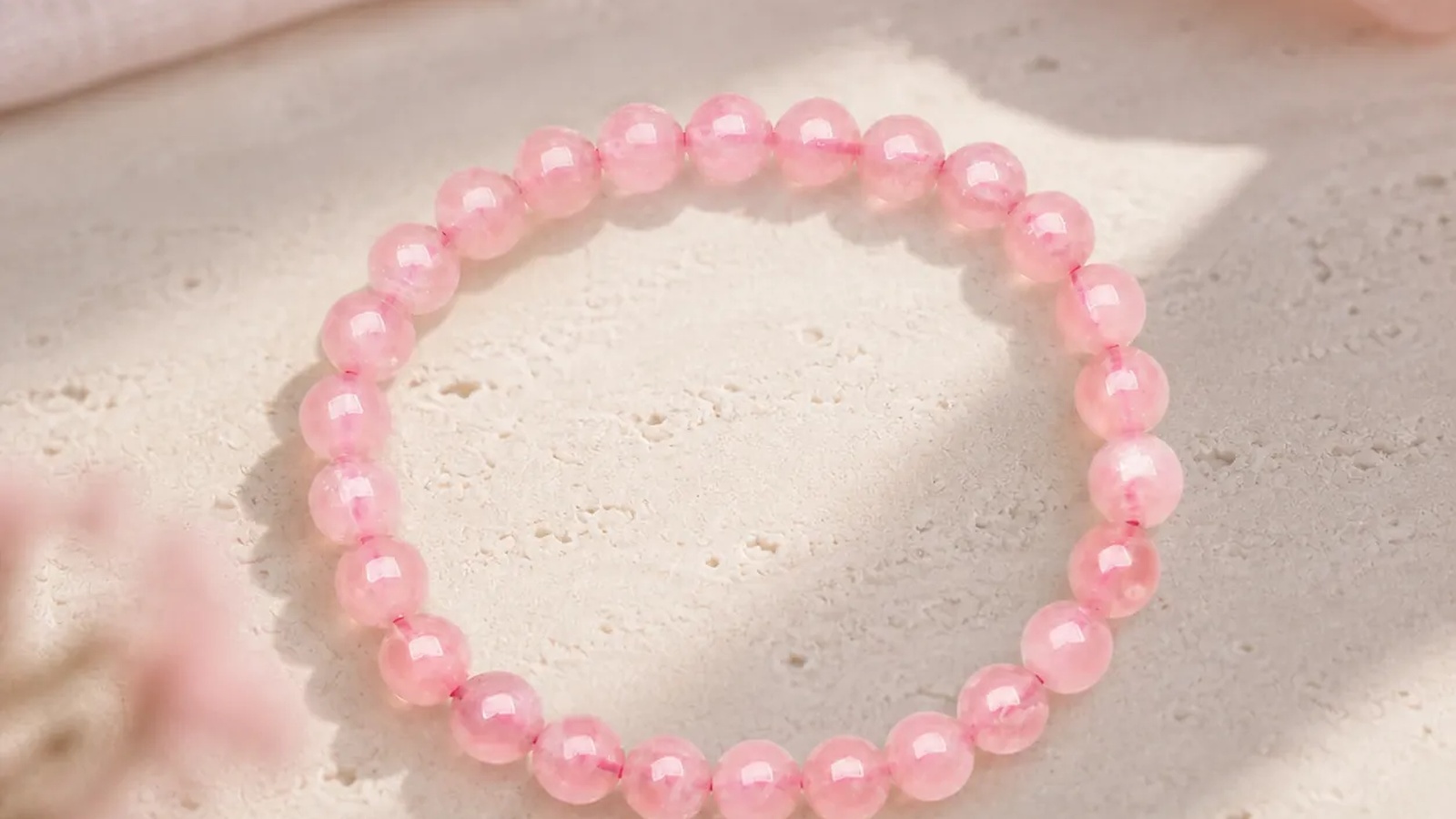
To choose a real rose quartz bracelet, verify three things before you buy: the beads should be cool and glass-hard (Mohs 7.0, hard enough to scratch ordinary window glass), the pink should be pale-to-medium and cloudy rather than uniformly vivid, and the seller should disclose origin and treatment honestly rather than using vague words like "natural energy stone." A genuine bracelet at the Lumina Grade AAA Integrity Standard is earth-mined, untreated, and priced to reflect real material cost — not dye chemistry.
10-Second Executive Summary / The Verdict Box
- Direct Verdict: Real rose quartz is a translucent-to-cloudy pink quartz with natural internal inclusions — not a saturated, evenly pink translucent bead. If the color looks "too perfect," suspect dye or glass.
- Mohs Hardness: 7.0 — a genuine bead can scratch ordinary window glass (Mohs 5.5) without being scratched itself.
- True Color Source: Microscopic fibrous borosilicate nanoinclusions (closely related to dumortierite), not surface dye.
- Quality Benchmark: Lumina Grade AAA Madagascar Earth-Mined Rose Quartz Standard — natural origin, zero chemical resin filling, no irradiation or dye.
- Best For: Buyers seeking a genuine, softly translucent heart-centered stone bracelet; traditionally worn on the left wrist in crystal healing traditions for self-compassion practices.
- Skip If: You want a vivid neon-pink look — that is usually treated material, and honest sellers will not pretend otherwise.
Why Buyers Get Confused About "Real" Rose Quartz
The confusion is manufactured, not accidental. Mass marketplace platforms flood search results with overly saturated "vivid pink" bracelets, and over 70% of those crystals are dyed crackle quartz, cheap calcite, or dyed glass that bleeds pigment when tested with acetone. Because buyers compare against these artificial reference points, a genuine pale, cloudy stone can feel "wrong" by contrast. Real rose quartz gets its delicate hue from microscopic fibrous borosilicate nanoinclusions closely related to dumortierite — a geological feature that produces softness, not saturation. Once you recalibrate what real looks like, the market becomes far easier to read.
How to Tell a Real Rose Quartz Bracelet from Fake or Dyed Beads
Color, Cloudiness, and Natural Inclusions
Authentic rose quartz is rarely uniform. Natural material from translucent intergrown masses shows gentle variation from bead to bead, with cloudy zones and faint internal structure. The GIA notes that tiny inclusions are exactly what create rose quartz's translucent appearance — clarity is a spectrum, not a pass/fail. Dyed crackle quartz, by contrast, shows pigment pooled in fracture lines and an unnaturally even hot-pink tone across every bead.
Temperature, Weight, and Surface Texture Checks
Quartz feels noticeably cool against warm skin and holds that coolness longer than glass or resin. Genuine beads also have heft and a fine, slightly waxy surface under the thumb — never slick like plastic or chalky like calcite. The most objective check remains hardness: natural rose quartz at Mohs 7.0 will scratch ordinary window glass (Mohs 5.5) without sustaining surface damage. Test on an inconspicuous bead and an old glass item, never on a surface you care about.
Grading and Quality Factors That Actually Matter
Ignore marketing tiers like "AAAAA" unless the seller defines them. What matters geologically: translucency depth, color evenness within each bead, absence of dye pooling, and absence of resin filling in surface pits. High-grade Madagascar specimens exhibit characteristic soft translucency with asterism potential — a star effect visible under focused single-point light, caused by oriented fibrous micro-silk. At Lumina Quartz, the Lumina Grade AAA Integrity Standard means natural origin, zero chemical resin filling, and no irradiation or dye treatment; that standard, not a letter grade, is what you should ask sellers to confirm in writing.
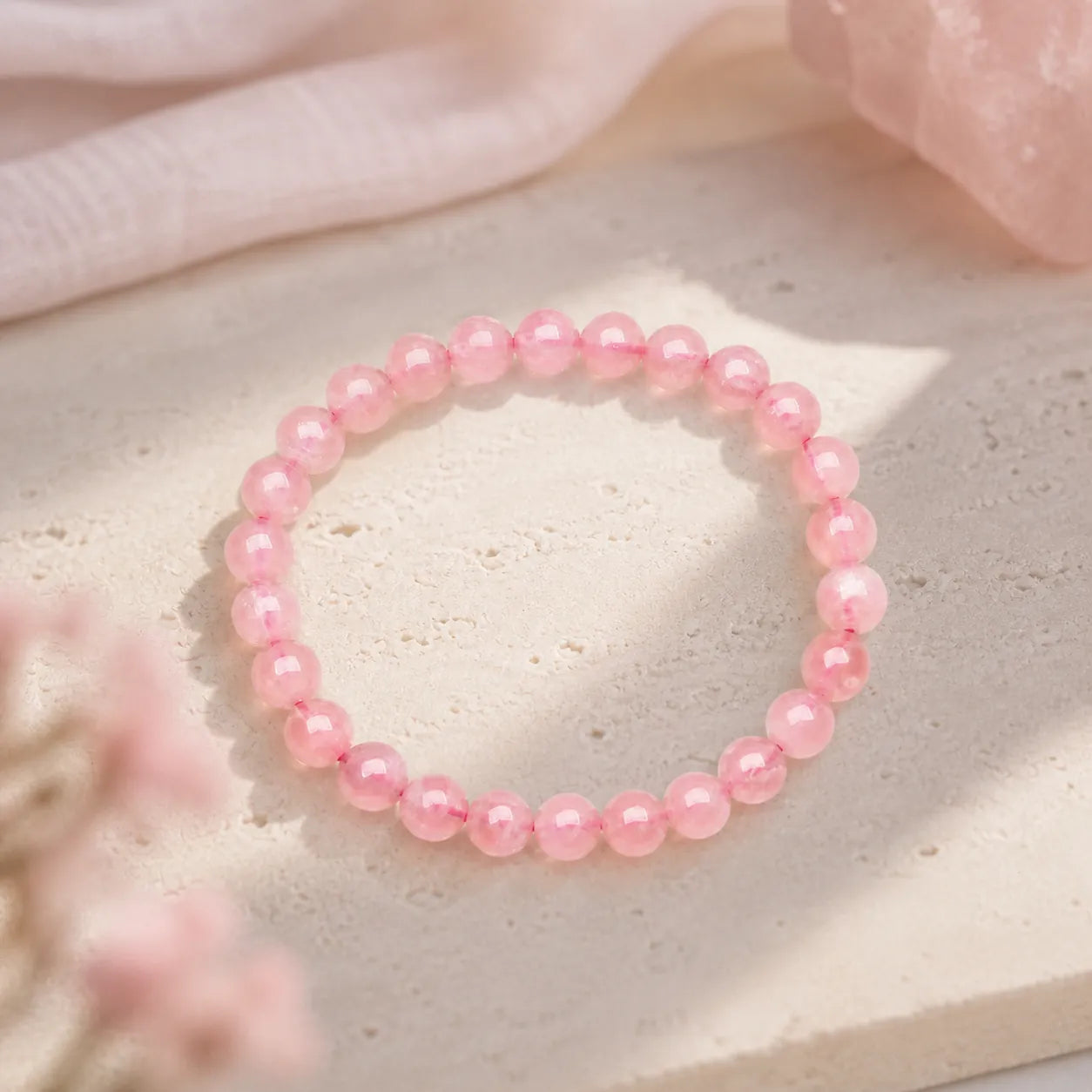
Rose Quartz Love Bracelet
Rose quartz can become a soft daily reminder to return to tenderness, self-trust, and emotional ease.
Shop This Authentic Piece →Bead Shape, Cut, and Bracelet Construction
Round beads show the stone honestly; faceting or heavy tumbling can mask inclusions and dye patterns, so be warier of carved or crackled finishes on low-priced pieces. Check drill holes: genuine quartz drilling looks clean and slightly matte inside, while dyed material often shows concentrated color around hole edges. Confirm the elastic cord is doubled and knotted inside a bead, and ask for bead diameter in millimeters — sizing inconsistencies between listing photos and delivered product are a common complaint that says nothing about authenticity but everything about seller reliability.
Price Benchmarks: What a Genuine Bracelet Should Cost
Genuine untreated rose quartz is an affordable mineral, so a real bracelet should not be priced like a luxury gem — but it also cannot be priced like costume jewelry once you account for mining, sorting, and stringing. Be cautious of two extremes: rock-bottom prices that only make sense for dyed glass, and premium pricing justified solely by "rare energy." Ask what specifically raises the price — bead size, translucency grade, asterism, or origin — and expect a concrete answer. If the seller cannot explain the premium in material terms, the premium is marketing.
Red Flags and Common Seller Claims to Question
Treat these claims with healthy skepticism: "100% natural, no need to test," "the pink gets brighter the more you wear it," "certified by a spiritual council," and any listing that shows the same saturated pink photo across dozens of unrelated stone types. Also question "heat-treated for clarity" — while heat treatment exists in the gem trade, undisclosed treatment on inexpensive rose quartz usually signals dye processes being reframed. Irradiation can alter quartz color centers and add a gray tone, per mineralogical records, so transparency about treatment matters more than the treatment itself.
Care, Wear, and Long-Term Color Fading
Genuine dyed-free rose quartz is stable; its color comes from the stone's structure, not a coating, so it does not "wash out" from normal wear. Clean with lukewarm water and a soft cloth, avoid prolonged direct sun and harsh chemicals, and store separately from harder stones. If your bracelet's pink fades dramatically within weeks, that is diagnostic: you likely bought dyed material, not a real stone that changed. In crystal healing traditions, rose quartz is associated with the Heart Chakra (Anahata) and is traditionally worn on the left wrist to support self-compassion rituals — a cultural and personal practice, not a medical effect.
Pre-Purchase Comparison: Real vs. Dyed Crackle vs. Glass
| Check | Real Rose Quartz | Dyed Crackle Quartz / Calcite | Dyed Glass |
|---|---|---|---|
| Color pattern | Pale-to-medium, cloudy, varies bead to bead | Uniform vivid pink, pigment in cracks | Perfectly even, often neon |
| Acetone test | No bleed | Pigment bleeds onto cotton swab | Pigment bleeds |
| Glass scratch test (Mohs 5.5) | Scratches glass, stays undamaged (Mohs 7.0) | Calcite is softer (Mohs 3) and will not scratch glass | May scratch weakly or not at all |
| Temperature feel | Cool, lingers | Room temperature or cool briefly | Warms quickly |
| Internal look | Fibrous cloudiness, possible asterism under point light | Web of dye-filled fractures | Bubbles or perfectly clear |
Quick Buyer's Checklist Before You Check Out
- Confirm the seller states earth-mined origin and "no dye, no resin filling" explicitly — the Lumina Grade AAA Integrity Standard is a fair benchmark to request.
- Run the acetone swab test on delivery; any pink transfer means return it.
- Perform the window-glass scratch test on an old pane, using an inconspicuous bead edge.
- Inspect drill holes and fracture lines in bright light for pooled pigment.
- Hold the bracelet to your skin for 30 seconds — it should feel cool, not neutral.
- Under a single-point flashlight, look for soft internal silk; asterism potential is a bonus, not a requirement.
- Reject any listing that promises emotional or physical health outcomes — those claims overstep what any stone can honestly offer.
Frequently Asked Questions
How can I tell if a rose quartz bracelet is real or fake?
Test hardness (Mohs 7.0 quartz scratches window glass) and do an acetone swab — real stone never bleeds pink pigment. Real beads are also pale and cloudy with natural internal variation, not uniformly vivid.
What should I look for when buying a real rose quartz bracelet?
Look for disclosed earth-mined origin, no dye or resin treatment, cool-to-the-touch beads, and soft translucency. Ask the seller to confirm the Lumina Grade AAA Integrity Standard or an equivalent no-treatment policy in writing.
Why does my real rose quartz bracelet look cloudy or pale pink?
Cloudiness is the natural signature of genuine rose quartz — microscopic fibrous inclusions create its delicate pink and translucency. Perfect clarity and saturation are more often signs of glass or dye than quality.
Sources
© 2026 Lumina Quartz. Mineral facts reflect cited geological sources; cultural and energetic associations are traditional practices, not medical claims.