The Complete Everyday Guide to Rose Quartz Birthstone: Meaning and Uses
Table of Contents
- What Is Rose Quartz? Composition, Colour and Why It Looks Cloudy
- Which Birth Month Does Rose Quartz Belong To? Sorting Out the Confusion
- January, October, or Neither? Traditional vs Modern Birthstone Lists
- Zodiac and Anniversary Associations (Libra, Scorpio, 5th Anniversary)
- The Meaning of Rose Quartz: Love, Compassion and Emotional Healing
- Ancient Greek and Roman Lore Behind the Pink Stone
- Heart Chakra, Self-Love and Modern Crystal Healing Claims
- Rose Quartz vs Other Pink Gems: Morganite, Pink Sapphire and Pink Tourmaline
- Pink Gem Decision Table: Match the Stone to Your Life
- How to Tell Real Rose Quartz from Dyed or Fake Stone
- Everyday Wear Guide: Hardness, Settings and Which Jewellery Suits Daily Life
- Rose Quartz Buying Checklist: Step by Step
- How to Care for Rose Quartz Jewellery So It Keeps Its Colour
- What month is rose quartz the birthstone for — January, October, or both?
- Is rose quartz durable enough for everyday wear?
- How can I tell real rose quartz from fake or dyed stone?
- Sources
What Is Rose Quartz? Composition, Colour and Why It Looks Cloudy
Rose quartz is a pink variety of the mineral quartz (chemical composition SiO₂) with a Mohs hardness of 7. Its colour ranges from very light pink, almost white, to medium-dark pink, and the stone typically appears massive rather than as well-formed crystals. Because rose quartz is usually found in massive form, well-shaped crystals are highly prized among collectors.
Core Diagnostic Verdict: Rose quartz is a pink variety of the mineral quartz (chemical composition SiO₂) with a Mohs hardness of 7.
- Core Intention: Rose Quartz Birthstone
- Authenticity Standard: Grade AAA Genuine Natural // Verified Untreated
- Lumina Standard: Grade AAA Natural Gemstones // Verified Untreated
Two practical points follow from its described properties. First, the most appealing saturated colour typically occurs in larger specimens, so a small stone with a vivid, storybook-pink tone is comparatively rare and may warrant extra scrutiny. Second, the Gemological Institute of America (GIA) describes this pastel gem as having cloudy translucence, which is part of its characteristic appearance rather than a flaw in every case.
In jewellery, rose quartz is most commonly cut en cabochon, tumbled, or shaped into beads — cuts that show off its soft translucency. When rose quartz contains small, well-oriented inclusions, it can sometimes show asterism, a six-pointed star effect under a single-point light.
Which Birth Month Does Rose Quartz Belong To? Sorting Out the Confusion
Rose quartz is not a traditional modern birthstone for any single month, but it is a widely used alternative or supplementary stone — most commonly offered for January and October, and paired with Libra in zodiac-based listings. In other words, the "rose quartz birthstone" question has a cultural answer rather than a gemmological one, and honest sellers explain the difference rather than inventing a month.
January, October, or Neither? Traditional vs Modern Birthstone Lists
Traditional and modern birthstone charts are cultural conventions, not scientific classifications. January's established garnet and October's opal and tourmaline occupy those slots in mainstream lists; rose quartz appears as a popular alternative choice, often recommended for people born in those months who prefer a softer, pink palette or a lower-cost entry point into gemstone jewellery.
What the gem trade does formally recognise is an anniversary role. According to the GIA, rose quartz has been recognised as the gem that commemorates the fifth wedding anniversary — a widely cited association you can plan a gift around with confidence.
Zodiac and Anniversary Associations (Libra, Scorpio, 5th Anniversary)
In contemporary crystal and astrology culture, rose quartz is frequently associated with Libra (and sometimes Scorpio) because of its gentle, harmonising symbolism. These attributions are cultural and symbolic, not gemmological facts. The anniversary association is the most durable reference point: if you are buying for a fifth anniversary, rose quartz is the recognised gem, and its Mohs hardness of 7 makes it practical for a ring or pendant worn regularly.
The Meaning of Rose Quartz: Love, Compassion and Emotional Healing
Rose quartz is most often symbolised as the "stone of love" — a cultural and symbolic association with compassion, tenderness and self-regard, not a measured physical property. Some people use it as a personal reminder to practise self-compassion or to mark an intention; it is not a medical or psychological treatment, and there is no credible evidence that wearing or carrying it changes mood or physical health.
Ancient Greek and Roman Lore Behind the Pink Stone
Popular retellings link rose quartz to Greek and Roman love mythology, casting the pink stone as a token of affection exchanged between lovers. These stories are lore rather than documented history, and the GIA page used for this guide covers the gem's mineralogy and description rather than its mythic origins. It is fair to describe this lore as tradition and storytelling — enjoyable context, not evidence.
Heart Chakra, Self-Love and Modern Crystal Healing Claims
In modern crystal traditions, rose quartz is often called a Heart Chakra stone and is sometimes worn on the left wrist as a symbolic reminder of kindness and self-compassion. Treat this as a personal practice with symbolic value: the stone may serve as a reminder to be kinder to yourself, while the actual work of emotional care belongs to you and, where needed, to qualified professionals.
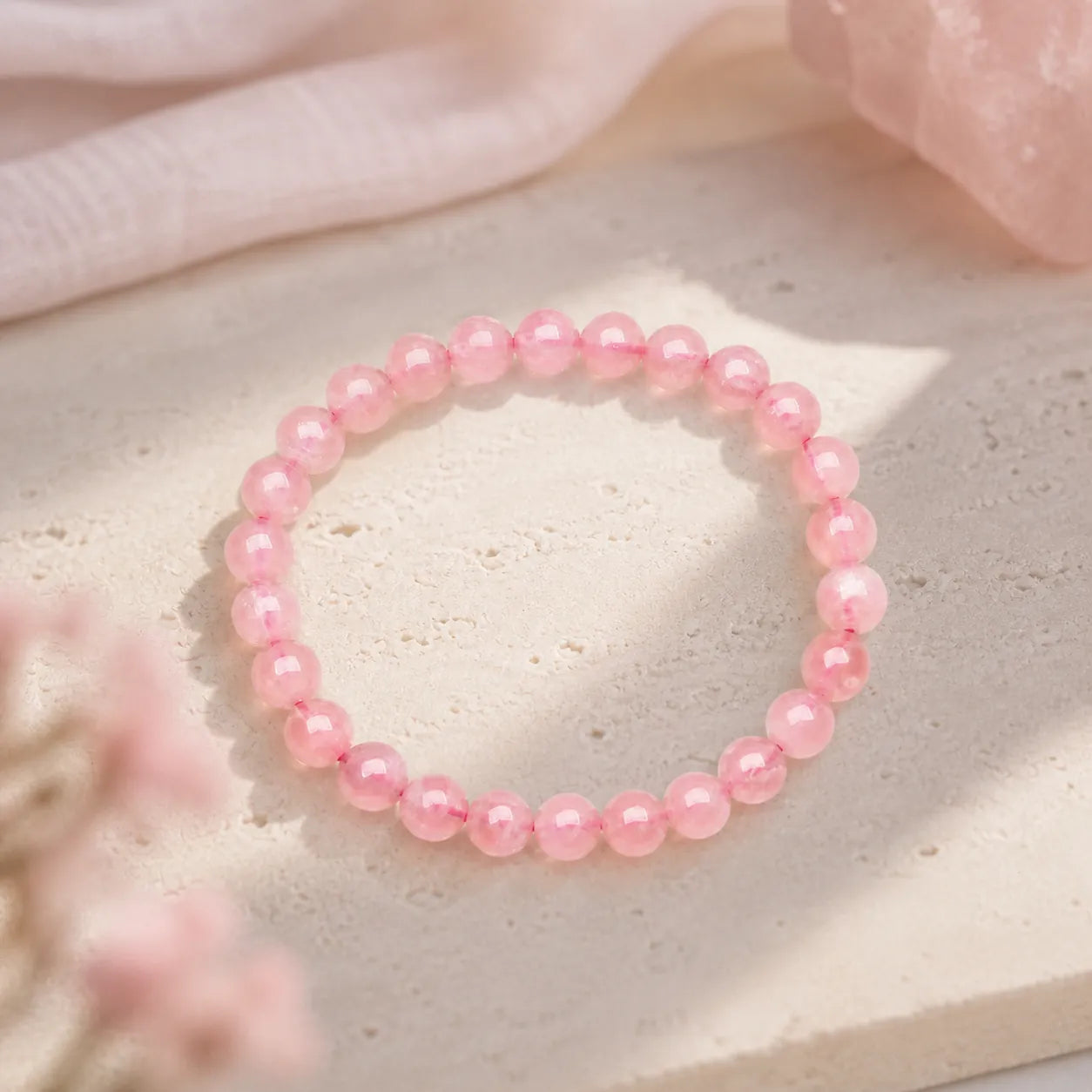
Rose Quartz Love Bracelet
Rose quartz can become a soft daily reminder to return to tenderness, self-trust, and emotional ease.
Shop This Authentic Piece →Rose Quartz vs Other Pink Gems: Morganite, Pink Sapphire and Pink Tourmaline
Rose quartz is the most affordable and most recognisable of the pink gems, but it is not the hardest or the most brilliant. The comparison below helps you choose by lifestyle rather than by hype; hardness figures follow standard mineralogical references, and finish characteristics reflect how each stone is typically cut.
Pink Gem Decision Table: Match the Stone to Your Life
| Stone | Typical Hardness | Colour Character | Best Suited To | Watch-Outs |
|---|---|---|---|---|
| Rose quartz | 7.0 (Mohs) | Soft, cloudy pink; can show asterism under a single-point light | Daily pendants, beads, casual rings, fifth-anniversary gifts, symbolic self-compassion pieces | Colour can fade with prolonged direct sun exposure; avoid harsh chemicals and ultrasonic cleaning |
| Morganite | 7.5–8.0 | Peachy-to-pink beryl; often faceted with high clarity | Engagement-style rings and fine jewellery where brilliance matters | Higher price point; lighter saturation than sapphire |
| Pink sapphire | 9.0 | Vivid to pastel pink corundum with sharp sparkle | Everyday rings, heirloom pieces, scratch-prone wear | Significantly higher cost; heat treatment is common and should be disclosed |
| Pink tourmaline | 7.0–7.5 | Rich, sometimes multi-toned pink | Statement stones, collector cuts | Pleochroism (colour shifts with angle); more brittle than sapphire |
How to use this table: choose rose quartz when you want an accessible, gentle pink for symbolic or everyday wear and are willing to store it thoughtfully; choose pink sapphire when the piece will take daily knocks (a work ring, for example); choose morganite or tourmaline when a faceted, saturated look is the priority. Whatever you pick, ask the seller directly whether the material is natural, whether it has been dyed, resin-filled or irradiated, and request documented treatment disclosure in writing.
How to Tell Real Rose Quartz from Dyed or Fake Stone
Genuine rose quartz has a delicate pink hue and, per the GIA, cloudy translucence from microscopic inclusions — not a uniform, glassy, hot-pink surface. That single fact underpins most reliable field checks, and it is the reason an unusually saturated stone is worth questioning before you buy.
Imitations and dyed materials do circulate widely in the marketplace, so a practical check sequence helps:
- Wipe test: rub a hidden area with a cotton swab dipped in nail-polish remover (acetone). Some surface-dyed or crackle-dyed stones transfer colour to the swab; natural rose quartz generally does not — a useful signal, not a definitive proof.
- Hardness test: quartz has a Mohs hardness of 7.0 and can easily scratch ordinary window glass (Mohs 5.5). Calcite and glass imitations generally fail this test — but never scratch a finished piece you intend to keep; test a rough or hidden edge only.
- Look for crackle patterns: dyed crackle quartz often shows pigment concentrated in fracture lines, giving a spiderweb look that natural rose quartz does not typically have.
- Assess translucency: natural rose quartz is characteristically cloudy to translucent, and some stones show asterism under focused single-point light. A perfectly uniform, glassy, hot-pink stone is a caution sign.
- Check disclosure: sellers should state origin, treatment and grade where known. Ask for documented treatment disclosure and treat any unverified "grade" label as marketing rather than certification.
Everyday Wear Guide: Hardness, Settings and Which Jewellery Suits Daily Life
With a Mohs hardness of 7.0, rose quartz sits comfortably above the glass you handle daily, which makes it practical for regular wear — with sensible caveats. Quartz is tough against scratches but can chip along edges if struck, so the setting matters as much as the stone.
For daily life, prefer:
- Pendants and necklaces: the lowest-risk placement for a softer-behaving gem; ideal for symbolic everyday wear.
- Bead bracelets: traditionally worn on the left wrist in crystal traditions; beads protect stone edges from knocks.
- Bezel-set rings: a metal rim protects the girdle far better than exposed prongs.
- Stud or small-drop earrings: lightweight and low-contact.
Be more cautious with large faceted rings and tennis-style settings, where exposed edges meet doors, gym equipment and hard surfaces. When in doubt, ask the seller whether the setting and stone were sold with honest treatment disclosure.
Rose Quartz Buying Checklist: Step by Step
- Confirm the intended use: a daily ring, a pendant, or a symbolic gift — each points to a different format and setting.
- Ask about treatment: natural, dyed, resin-filled or irradiated; request written disclosure.
- Inspect colour and translucency: a gentle, cloudy pink is characteristic; uniform hot-pink glassiness warrants caution.
- Check the setting: bezel settings protect edges better than exposed prongs for daily wear.
- Test only hidden edges: if you choose to test hardness, use a rough or concealed surface, never a polished face.
- Plan storage and care: a soft pouch, away from direct sun and harsh chemicals, keeps the piece looking its best.
- Set expectations: treat crystal-healing and astrology associations as cultural context, not as product claims.
Applicability boundaries: this checklist applies to gem-quality and ornamental rose quartz sold as jewellery or display pieces. It does not cover industrial quartz, synthetic quartz sold as "rose quartz" without disclosure, or any claimed health or wellness benefits, which are outside the scope of gemmological evaluation.
How to Care for Rose Quartz Jewellery So It Keeps Its Colour
Rose quartz colour can fade with prolonged direct sun exposure, so store pieces away from a sunny windowsill and remove them before long sunbathing or all-day outdoor events. When cleaning:
- Wash gently in lukewarm water with a drop of mild soap.
- Use a soft brush for crevices; avoid ultrasonic cleaners and steam, which can stress filled or treated material.
- Rinse, pat dry with a soft cloth, and let air-dry fully before storage.
- Keep away from perfume, hairspray and household chemicals, which can dull a polished surface over time.
- Store separately in a soft pouch to prevent scratches from harder gems and metal.
If the stone is set in sterling silver, polish the metal carefully around the gem rather than over it.
What month is rose quartz the birthstone for — January, October, or both?
Rose quartz is not an official birthstone for any month; it is a popular alternative stone often offered for January and October, while its formally recognised role is the fifth wedding anniversary gem per the GIA.
Is rose quartz durable enough for everyday wear?
Yes, with care: at Mohs 7.0 it resists scratching, but its edges can chip, so pendants, bead bracelets and bezel-set rings are the safest daily formats.
How can I tell real rose quartz from fake or dyed stone?
Check for dye transfer with an acetone swab on a hidden area, look for colour pooled in crackle lines, and consider hardness: genuine quartz can scratch window glass. Soft translucency with possible asterism and honest treatment disclosure are further signals of natural material.
Sources
Editorial note: crystal-healing associations in this guide are presented as cultural and symbolic traditions, not medical claims. Rose quartz jewellery may support personal intentions and self-compassion practices; it is not a substitute for professional care.
© 2026 Lumina Quartz
Product Facts From the Current Catalog
These details come from the active Lumina Quartz catalog record checked on 2026-11-10. They are product-listing facts, not laboratory results or invented wear-test claims.
| Listed product | Rose Quartz Love Bracelet |
|---|---|
| Format | Bracelet |
| Listed price snapshot | 28.80 |
Price, availability, and options may change. Check the live product listing before choosing.