Mahogany Obsidian Meaning: The Complete Guide to Grounding, Strength, and Protection
Table of Contents
- Introduction to Mahogany Obsidian
- Mahogany Obsidian Meaning and Symbolism
- Geological Properties and Formation
- Metaphysical and Symbolism
- Emotional Grounding and Reflection
- Creativity and Strength
- Protection and Boundary Setting
- How to Use Mahogany Obsidian
- Jewelry and Everyday Wear
- Home and Workspace Placement
- Mahogany Obsidian vs. Other Obsidian Types
- Caring for Your Mahogany Obsidian
- Where to Buy Genuine Mahogany Obsidian
- Final Thoughts
- Frequently Asked Questions
There are stones that whisper, and there are stones that hold space for you to find your own voice. Mahogany obsidian belongs to the second kind. Born from volcanic lava that cooled too quickly for crystals to form, this natural glass carries threads of iron and hematite that paint it in shades of deep mahogany brown, rust, and smoky black. It is humble in origin, mysterious in presence, and quietly profound in the way it meets you exactly where you are.
For those drawn to the energy of crystals, the mahogany obsidian meaning opens like a slow conversation. It does not promise transformation overnight, nor does it claim to erase difficulty. Instead, it is often associated with grounding, honesty, and the kind of strength that grows when we stop running from our own reflection. It asks you to come home to yourself.
Introduction to Mahogany Obsidian
Mahogany obsidian is a variety of volcanic glass that takes its name from the rich, reddish-brown color of mahogany wood. It forms when felsic lava erupts and cools rapidly, preventing the growth of mineral crystals. The result is a smooth, dense glass with swirling patterns of brown, black, and sometimes a subtle reddish glow, depending on how light passes through it. The mineral database Mindat lists mahogany among the recognized color varieties of obsidian, noting that obsidian's colors arise largely from how microscopic bubbles and mineral inclusions refract and absorb light.
Unlike many other stones that have been shaped over millions of years within the earth, obsidian is essentially frozen lava — a snapshot of the earth's molten interior, preserved in a single moment. That instantaneous birth may be part of why this stone feels so honest. It comes into being quickly, with nothing to hide, and that quality echoes throughout its symbolic presence.
In crystal practice, mahogany obsidian meaning is often associated with the root chakra, the energy center linked to stability, physical safety, and belonging. Its warm earthy tones mirror the soil, the bark, and the steady pulse of the natural world. For anyone feeling scattered, ungrounded, or disconnected from their body, this stone is often used to support a return to inner steadiness.
Mahogany Obsidian Meaning and Symbolism
The symbolism of mahogany obsidian runs deep, yet it never feels heavy. It draws its meaning from both its volcanic heritage and its wooden appearance. The name itself evokes enduring trees, sturdy furniture passed down through generations, and the warm intimacy of a home lit by firelight. There is something ancestral about this stone.
Mahogany obsidian meaning is intertwined with the concept of the shadow self — the parts of our psyche that we tend to avoid, suppress, or deny. Obsidian, as a family of stones, has long been associated with truth-telling and reflection. The dark surface offers a mirror, not in a literal sense, but in the way it invites you to look inward without flinching. The mahogany tones soften this process, wrapping hard truths in warmth so that self-awareness feels less like punishment and more like reunion.
Symbolically, this stone represents the marriage of fire and earth. It holds the raw energy of the volcano, tempered by the grounded nature of iron-rich soil. It reminds us that we can be both fierce and gentle, both powerful and grounded, both passionate and patient. This duality is not a contradiction — it is wholeness.
Geological Properties and Formation
Mahogany obsidian, like all obsidian, is not a mineral in the strict geological sense. It is a natural glass, formed when silicic lava cools so rapidly that atoms do not have time to arrange themselves into a crystalline structure. This is why obsidian has a smooth, conchoidal fracture and can be worked into sharp edges that have been used historically for tools, arrowheads, and ceremonial objects. Obsidian's role in ancient toolmaking and trade networks is well documented — Smithsonian researchers have studied obsidian artifacts to trace how far these materials traveled and what those patterns reveal about early exchange between communities.
The distinct mahogany color comes from microscopic inclusions of hematite and other iron-rich minerals suspended within the glass. These inclusions scatter and absorb light in a way that produces warm browns and reddish tones, sometimes rhythmically layered with black bands. Some pieces show distinct "clouds" of mahogany color; others display fine, wood-like striations that make each stone genuinely one of a kind. The Gemological Institute of America has noted that such flow structures in obsidian are essentially a record of the molten glass stretching, shearing, and compressing before it solidified.
Major sources of mahogany obsidian include the western United States, particularly Oregon, California, and Arizona, as well as Mexico and parts of Central America. The stone is relatively hard, rating around 5 to 5.5 on the Mohs scale, and it is brittle by nature. This means it benefits from thoughtful handling — a quality that mirrors its gentle emphasis on treating yourself with care.
Metaphysical and Symbolism
The mahogany obsidian meaning in crystal work is broad, but its core themes remain consistently grounded: emotional truth, resilience, and protection. As with any crystal or stone, these associations are best understood as symbolic and reflective rather than medicinal. Mahogany obsidian is used by many as a mindfulness aid and a symbolic companion, but it is not a substitute for professional care of any kind.
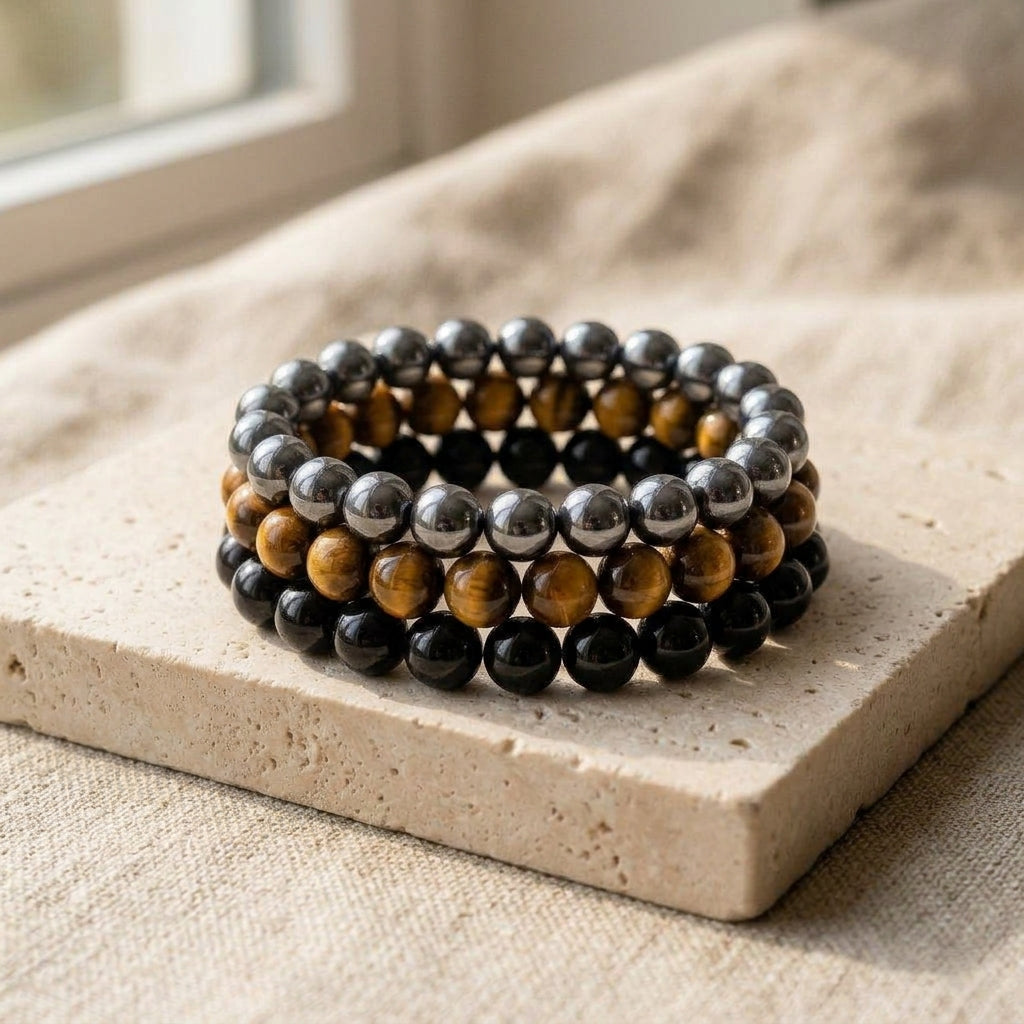
The Master Triple Protection Ritual Stack (Natural Tiger's Eye, Black Obsidian & Hematite)
Black obsidian is often worn as a grounding ritual piece for days that ask for steadier energy.
Shop This Authentic Piece →Emotional Grounding and Reflection
Where other stones might be associated with lifting your spirits or sparking creativity, mahogany obsidian works differently. It does not distract you from discomfort; it accompanies you through it. This stone is often associated with reflective practice that begins at the root level — meaning it may support you in feeling steady enough to examine what you have been carrying. It invites you to place your feet on the ground, breathe, and allow old patterns to surface without judgment. For those who feel scattered, overthinking, or "in their head too much," mahogany obsidian is often used as a symbolic anchor for bringing awareness back to the present moment.
Creativity and Strength
Because mahogany obsidian is born from volcanic fire, it carries an innate symbolic association with creative energy and personal power. Yet its expression of strength is not loud or forceful. Rather, it is the strength of endurance — the ability to keep going when the path is unclear, to stand firm in your values, and to trust the slow, quiet work of transformation. In this sense, mahogany obsidian meaning is often used by anyone navigating a creative block, a difficult transition, or a time when courage is needed simply to continue.
Protection and Boundary Setting
Obsidian has long been regarded as a protective stone across many traditions. Mahogany obsidian is no exception. It is often associated with energetic boundary-setting, absorbing the weight of heavy emotions, and creating a gentle separation between yourself and the demands of the external world. That said, protection here is not about building walls. It is about remembering your own sense of personal space, and giving yourself permission to say no without guilt. The mahogany tone softens this protective quality, making it less intense than pure black obsidian and more aligned with self-compassion.
Mahogany Obsidian Meaning in Daily Practice
If you are searching for "mahogany obsidian" as a starting point, the most useful way to understand the stone is through what it actually asks of you day to day. Rather than a long list of abstract properties, the following boundaries can keep your expectations clear and grounded.
What Mahogany Obsidian Is — and What It Is Not
| Attribute | What It Is | What It Is Not |
|---|---|---|
| Origin | Volcanic glass formed when silicic lava cools too fast for crystals to grow | A crystalline mineral that formed slowly underground over millions of years |
| Color | Warm mahogany brown and rust from microscopic iron-rich inclusions, often banded with black | A dyed or artificially colored stone |
| Symbolic use | A grounding, reflective presence often tied to the root chakra in crystal practice | |
| Protection | A symbolic reminder of personal boundaries and saying no without guilt | A force field that blocks all negativity or replaces professional support |
| Use | A mindfulness tool for meditation, journaling, wear, or home placement | A passive charm that works without your participation |
| Care | Gentle handling, since the stone is brittle and rates about 5–5.5 on the Mohs scale | A hard stone that can be worn into abrasive work or dropped carelessly |
Decision Checklist: Is Mahogany Obsidian Right for You Right Now?
- You want a symbolic anchor for grounding. Mahogany obsidian is often chosen by people who feel scattered and want a tangible reminder to stay present.
- You are drawn to a softer alternative to black obsidian. Its warm brown tones make it a good fit if pure black obsidian feels too intense.
- You want a mindfulness prop, not a treatment. This stone is best used alongside reflection, journaling, or meditation — not as a replacement for professional care.
- You prefer natural variation. Every piece of mahogany obsidian looks different, so you should be comfortable with irregular color and pattern.
- You are not expecting overnight transformation. The stone is associated with slow, steady work, not instant change.
When Mahogany Obsidian May Not Be the Best Fit
- If you are looking for a solution to a medical or mental health concern, a crystal cannot provide that. Please work with a qualified professional.
- If you need a stone for hard, abrasive work or rough daily wear, mahogany obsidian's brittleness makes it a poor choice.
- If you prefer perfectly uniform, consistent color, natural mahogany obsidian's variation may not appeal to you.
- If you are not interested in reflective or mindfulness practice, the stone's symbolic value will be limited.
How to Use Mahogany Obsidian
The mahogany obsidian meaning becomes most tangible when the stone is actually incorporated into daily life. Crystals are often used as tools for mindfulness, not passive charms. Their value increases when you pair them with intention and attention.
Meditation and Reflective Practice
Hold a piece of mahogany obsidian in your hand during meditation or set it beside you on a mat. Let its weight draw your awareness downward, toward the base of your body. You might begin with a slow breath and a simple question: what am I actually feeling right now? Mahogany obsidian is well suited to this honest, grounded style of practice, where you observe rather than fix.
Jewelry and Everyday Wear
Because mahogany obsidian is a personal stone, bracelets, pendants, and rings are common ways to keep it close. Worn on the body, it serves as a quiet reminder to stay present and steady throughout the day. If you work in demanding or emotionally charged environments, wearing a piece may help you notice when your boundaries are being tested. A softly chosen piece from our crystal jewelry collection can make this an easy part of your daily ritual.
Home and Workspace Placement
Placed on a desk, windowsill, or bedside table, mahogany obsidian brings its warm, earthy tone into a space. Some people keep a piece near the entryway to mark the transition between the outside world and the calm of home. Whether it functions as a visual anchor or a symbolic one, the stone's presence can support a more settled atmosphere.
Mahogany Obsidian vs. Other Obsidian Types
Mahogany obsidian is part of a family of volcanic glasses, and each variety carries its own character. Black obsidian is deep, mirror-like, and often described as the most direct and protective of the group. Snowflake obsidian contains pale gray-white patches of cristobalite and is often associated with patience and acceptance. Rainbow obsidian displays colorful sheen when light hits its layered inclusions. Fire obsidian, prized by collectors, reveals vibrant flowing patterns under diffuse reflected light.
Mahogany obsidian sits quietly among these. Its warm brown and rust tones make it feel softer than pure black obsidian, while its grounding quality keeps it connected to the earth. If black obsidian feels too sharp for where you are right now, mahogany obsidian offers a gentler way to work with honesty and protection.
Comparison Table: Mahogany Obsidian vs. Other Obsidian Varieties
| Variety | Distinctive Appearance | Common Symbolic Association | Best For |
|---|---|---|---|
| Mahogany Obsidian | Warm brown, rust, and black banding from iron-rich inclusions | Grounding, honesty, gentle protection | Those who want a softer, nurturing grounding stone |
| Black Obsidian | Uniformly dark, glossy, mirror-like | Direct protection, truth-telling, shadow work | Those who prefer a more intense, no-nonsense approach |
| Snowflake Obsidian | Black with pale gray-white cristobalite patches | Patience, acceptance, endurance | Those working through slow, gradual change |
| Rainbow Obsidian | Dark glass with colorful layered sheen | Hope, emotional release, inner reflection | Those navigating emotional transitions |
| Fire Obsidian | Vibrant iridescent flow patterns under reflected light | Creativity, vitality, artistic inspiration | Collectors and those drawn to rare, visual stones |
Caring for Your Mahogany Obsidian
Because obsidian is glass, it prefers kindness. Clean it with a soft, damp cloth and mild soap, then pat it dry. Avoid ultrasonic cleaners and harsh chemicals, which can damage the surface. Store it separately from harder stones to prevent scratches, and handle it with the same attention you would give any slightly brittle treasure.
Many people also treat their stones as part of a personal ritual, resting them in moonlight or morning sunlight, or simply setting an intention while holding them. Whatever routine you choose, trust what feels respectful to both the stone and you.
Where to Buy Genuine Mahogany Obsidian
Genuine mahogany obsidian shows natural variation: swirling brown and black, occasional reddish depth, and no two pieces alike. If a stone looks uniformly colored or seems too perfect, it may be dyed or mislabeled. Buy from sellers who show real photographs of the actual piece and describe its origin and treatment honestly. A brief conversation with a knowledgeable seller is often the easiest way to confirm what you are getting.
Final Thoughts
Mahogany obsidian is not a stone of grand promises. It is a stone of quiet company — a warm, grounded presence that meets you in the middle of real life and asks only for your honesty. In a world that constantly pulls attention outward, it offers a small, steady return to yourself. Whether you wear it, hold it in meditation, or simply keep it near, let it remind you that strength and softness are not opposites. They are the same thing, seen from different angles.
Related Reading
- Black Tourmaline Meaning: Meaning, Properties, and Everyday Uses
- Red Jasper: A Gentle Guide to Meaning, Benefits, and Uses
- Kyanite Crystal Meaning: A Guide to Benefits, Uses, and Chakra Alignment
- Rose Quartz Crystal: A Gentle Guide to Meaning, Benefits, and Uses
- Fluorite Meaning: Meaning, Properties, and Everyday Uses
- Sunstone Meaning: Meaning, Properties, and Everyday Uses
Frequently Asked Questions
What is mahogany obsidian good for?
Mahogany obsidian is most often associated with grounding, emotional honesty, and gentle protection. Many people keep it nearby during meditation, journaling, or difficult transitions because its steady presence supports staying present with what is real rather than avoiding it.
Is mahogany obsidian the same as black obsidian?
No. Both are volcanic glass, but mahogany obsidian gets its warm brown and rust tones from iron-rich inclusions such as hematite. Black obsidian is uniformly dark and tends to be described as more direct and intense in its symbolic character. Mahogany obsidian is often felt to be softer and more nurturing.
Which chakra is mahogany obsidian connected to?
It is most commonly linked to the root chakra in crystal practice, which relates to stability, safety, and a sense of belonging. Its earthy color and grounding quality make that association a natural fit for many practitioners.
Can I wear mahogany obsidian every day?
Yes, many people wear it daily in the form of bracelets, pendants, or rings. Since the stone is relatively brittle, it is best to remove it during vigorous activity or handling that could chip or scratch it.
How do I know if mahogany obsidian is real?
Authentic mahogany obsidian has natural color variation, layered or marbled brown and black patterns, and a smooth glassy surface. Perfectly uniform color or an unusually low price can be warning signs of a treated or imitation material. Buying from sellers who photograph the actual piece helps.
Does mahogany obsidian replace medical or mental health care?
No. Crystals are symbolic and reflective tools, not treatments for any health condition. If you are dealing with a health or mental health concern, please work with a qualified professional, and let your crystal practice be one small, optional part of a broader support system.
Sources
- Mindat — Obsidian: Mineral information, data and localities
- Smithsonian Profiles — Obsidian research
- GIA — Fire Obsidian's Beguiling Spectrum
- Smithsonian Museum Conservation Institute — Obsidian trade research
Crystal traditions are presented here as symbolic, cultural, and personal ritual practices. They are not medical tools; consult a qualified professional for health concerns.