Mahogany Obsidian: Spiritual Meaning, Symbolism, and Daily Use
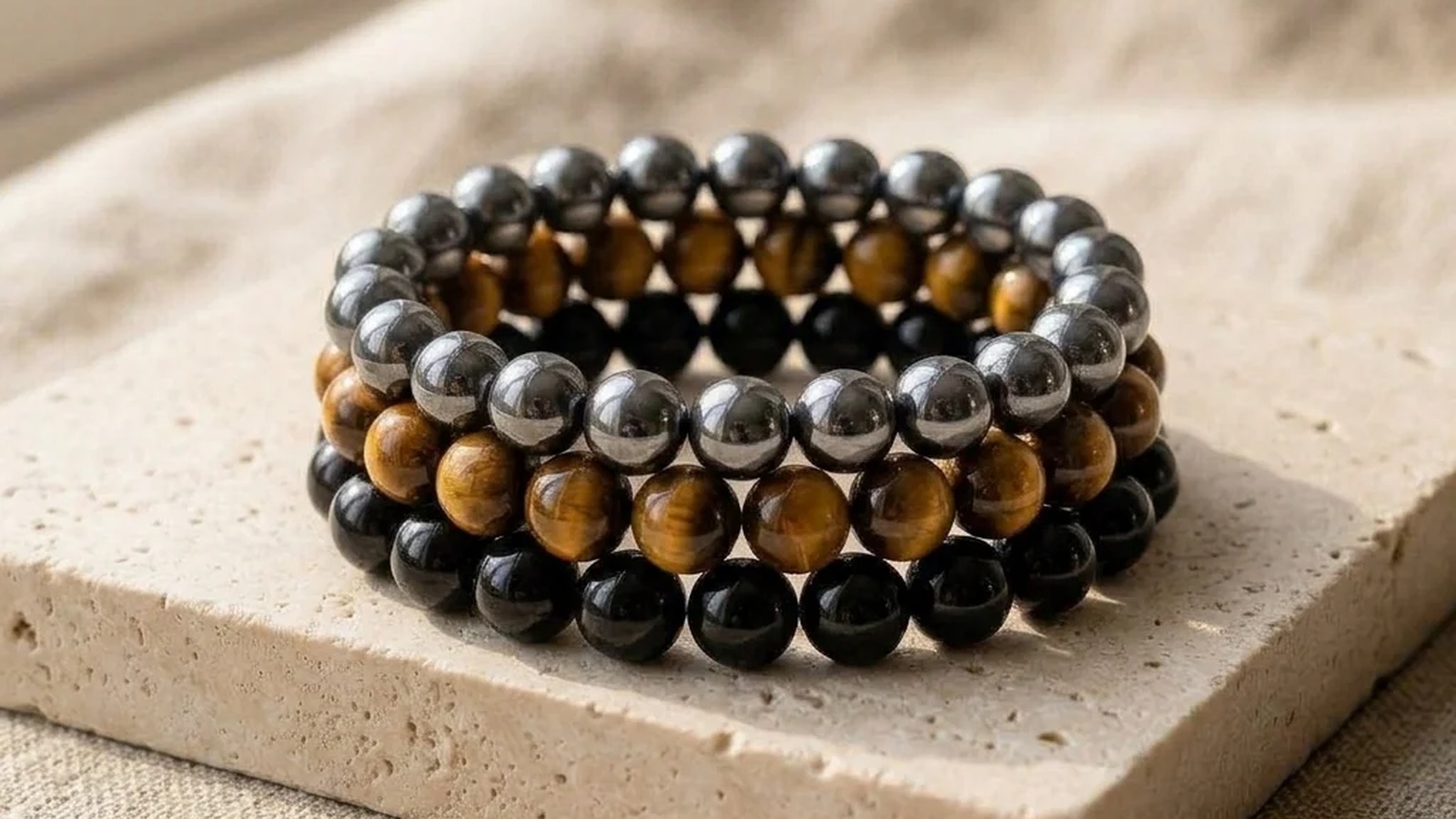
Table of Contents
- The 10-Second Executive Summary / The Verdict Box
- What Is Mahogany Obsidian? (Geology, Color, and Origins)
- Mahogany Obsidian Meaning and Symbolism
- Transformation, Strength, and Shadow Work
- Fire and Earth: The Duality of the Stone
- Healing Properties and the Chakras
- Root, Sacral, and Solar Plexus Connections
- Protection, Boundaries, and Emotional Grounding
- Daily Use: Meditation, Journaling, and Wearable Rituals
- How to Cleanse, Charge, and Care for Mahogany Obsidian
- How to Choose Authentic Mahogany Obsidian (and Spot Fakes)
- Decision Table: Authentic Mahogany Obsidian vs. Imitation Glass
- Frequently Asked Questions
- What does mahogany obsidian symbolize spiritually?
- Is mahogany obsidian good for grounding and protection?
- How can you tell real mahogany obsidian from fake glass?
- Sources
Mahogany obsidian is a natural volcanic glass whose reddish-brown mahogany banding comes from iron oxide within the silica-rich lava — and its spiritual meaning centers on grounded strength, honest transformation, and steady protection. It is often associated with the root and sacral chakras, and it is commonly used in meditation, journaling, and as a daily grounding companion rather than a "high-vibration" stone.
The 10-Second Executive Summary / The Verdict Box
- Direct Verdict: Mahogany obsidian is best understood as a grounding and boundary-supporting stone — practical, earthy, and gentle rather than flashy. Its meaning is often framed around transformation through honest self-reflection, not quick emotional fixes.
- Physical Definition: A variety of obsidian (volcanic glass) with reddish-brown mahogany banding, classed as a silicic volcanic glass on Mindat.
- Mohs Hardness: Approximately 5–5.5 (glass). It is harder and more brittle than it looks; conchoidal fracture makes it edge-sharp, so handle and store it with care.
- Key Geological Traits: Amorphous, no visible crystals except under a microscope; brittle; conchoidal fracture — all documented by GIA.
- Best For: Grounding rituals, boundary-setting journaling, meditation on shadow work, and everyday wearables. Compare with black obsidian (more "mirror-like" intensity) and with red jasper (softer, more purely earthy).
What Is Mahogany Obsidian? (Geology, Color, and Origins)
Obsidian is a volcanic glass formed when silica-rich lava cools so fast that crystal formation is only visible with a microscope; its glassy, amorphous structure makes it hard and brittle, and it fractures with a conchoidal break (GIA). Mahogany obsidian is a reddish-brown variety of that glass, and Mindat classifies it as a rock subtype within silicic volcanic glass rather than as a distinct mineral species (Mindat).
The "mahogany" name describes the warm rust-to-cocoa banding that drifts across the dark base. Geologically, obsidian has been worked since the Neolithic era (roughly 7000–1700 BCE) for cutting tools because of its sharp fracture, and it has remained a popular ornamental and gem material (GIA).
Mahogany obsidian has real historical weight too. Researchers analyzing Mesoamerican obsidian "mirror" tablets traced a mahogany (reddish-brown) obsidian to the Los Azufres super volcano in Central Mexico, in objects polished by skilled artisans roughly 500 years ago (Smithsonian MCI). In Postclassic Mesoamerica, obsidian was the material of choice for mirrors and polished tablets, and such reflective surfaces were associated with divination and self-reflection (Smithsonian Repository). That long association with reflection is a meaningful anchor for how this stone is used today — but note the line: this is cultural history, not a claim about energy or health.
Mahogany Obsidian Meaning and Symbolism
In modern crystal culture, mahogany obsidian is often associated with grounded transformation and honest self-examination. It is a stone of "staying with it" — not sweeping a difficult feeling away, but sitting beside it long enough to understand it. The quiet redness is often read as fire that has learned to warm rather than burn.
Important distinction: the geological facts above are verified; the symbolism below is cultural and personal, offered as a reflective framework rather than a promise of effect.
Transformation, Strength, and Shadow Work
Because obsidian formed from rapid cooling, it is often used as a metaphor for change that happens faster than we can form a "crystal structure" around it. In shadow work, mahogany obsidian may support the practice of naming uncomfortable truths without dramatizing them. It is frequently described as a stone for people who are already doing deep work and need a steadier hand, not a louder push.
Fire and Earth: The Duality of the Stone
Obsidian begins in molten fire, then hardens into something cool and dark. The mahogany bands add a distinctly earthy warmth. That duality — fire that becomes ground — is the heart of its symbolism. Practically, this makes it a useful ritual object for the moment when you need to move from strong feeling into steady action.
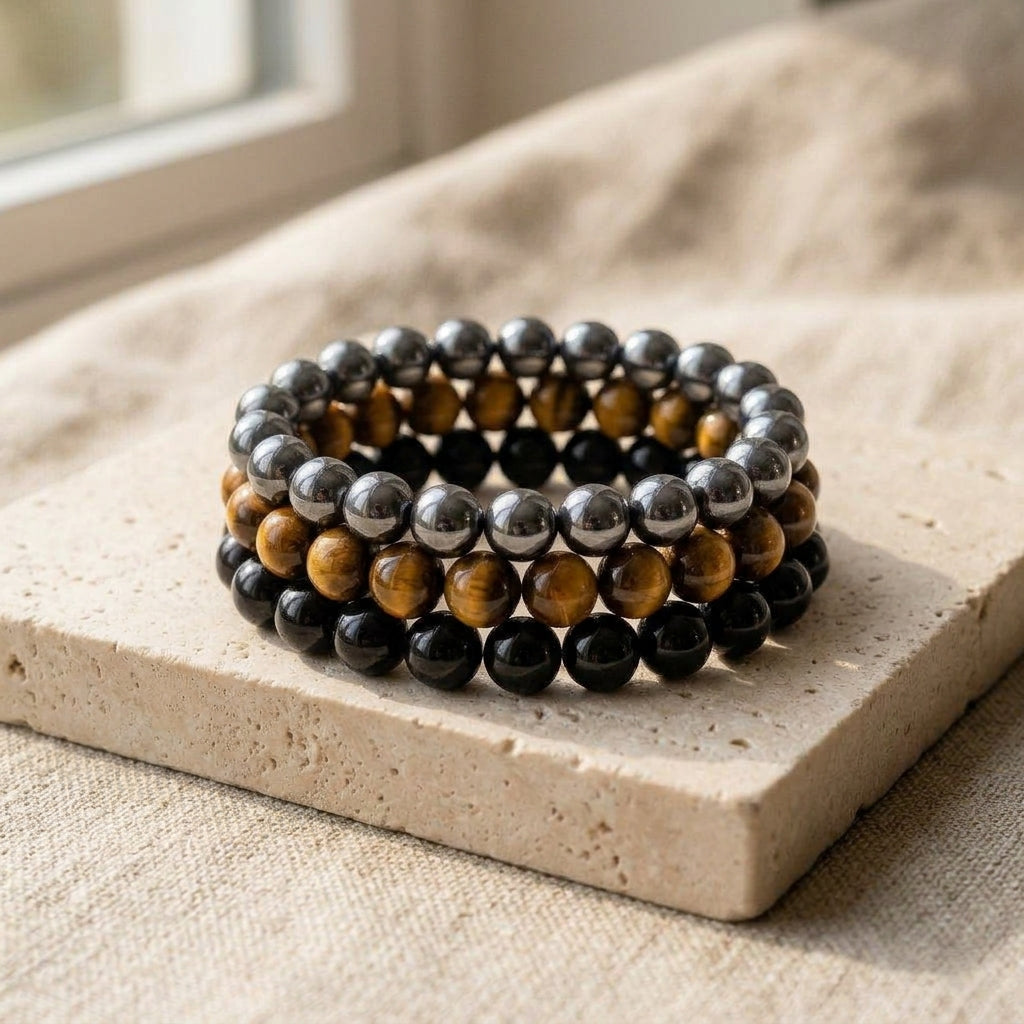
The Master Triple Protection Ritual Stack (Natural Tiger's Eye, Black Obsidian & Hematite)
Black obsidian is often worn as a grounding ritual piece for days that ask for steadier energy.
Shop This Authentic Piece →Healing Properties and the Chakras
Mahogany obsidian is most often associated with the root, sacral, and solar plexus chakras. These associations are symbolic and traditional; they are not medical claims, and no crystal is a substitute for professional care.
Root, Sacral, and Solar Plexus Connections
- Root: often associated with grounding, safety, and a sense of physical steadiness.
- Sacral: sometimes linked to creative flow and the ability to sit with feeling without being overwhelmed.
- Solar Plexus: frequently connected with personal boundaries and self-trust.
A simple way to work with these associations is to hold the stone at the corresponding area during quiet breathing. The value is in the pause and attention, not in the stone "doing" something to the body.
Protection, Boundaries, and Emotional Grounding
Mahogany obsidian is often described as a protection stone, but a more honest framing is that it is a boundary stone. It may support the practice of noticing where your energy leaks and deciding, deliberately, what you let in. Unlike the sharper "mirror" energy sometimes attributed to black obsidian, the mahogany variety is usually characterized as gentler and more reassuring — less confrontational, more companionable.
For grounding, many people pair it with slow breathing or a short body scan. The stone becomes a tactile anchor: something cool and solid that helps you return to the present moment. That is a personal reminder practice, not a treatment.
Daily Use: Meditation, Journaling, and Wearable Rituals
Mahogany obsidian works best when it is used deliberately and often, rather than stored and admired. Here are practical ways to bring it into a day:
- Morning grounding: hold it for three slow breaths before checking your phone.
- Journaling prompt: "What boundary did I hold today, and what boundary do I still need?"
- Meditation: set it on a table or rest it in your palm and use it as a focal point for a five-minute breath practice.
- Wearable ritual: wear a bracelet or pendant on days when you expect to be pulled in many directions, and treat touching it as a cue to slow down.
- Evening reflection: place it beside your journal and name one honest feeling from the day.
How to Cleanse, Charge, and Care for Mahogany Obsidian
Obsidian is glass, so care is more physical than energetic. It is brittle and fractures conchoidally, which means edges can be sharp and pieces can chip. Clean gently:
- Cleanse: wipe with a soft, damp cloth or use a brief rinse and dry immediately. A common practice is moonlight or sound cleansing, both of which are safe for glass.
- Charge: place it in soft light or sunlight for a short time. Prolonged direct sun is unnecessary; the stone does not need it.
- Store: keep it in a pouch or a separate compartment so it does not knock against harder stones.
- Avoid: ultrasonic cleaners, harsh chemicals, and dramatic temperature changes.
How to Choose Authentic Mahogany Obsidian (and Spot Fakes)
Because obsidian is glass, "fake" is a real concern — some pieces sold as mahogany obsidian are manufactured glass. Use this decision table to evaluate a piece before you buy:
Decision Table: Authentic Mahogany Obsidian vs. Imitation Glass
| Check | Authentic Mahogany Obsidian | Imitation / Treated Glass |
|---|---|---|
| Color pattern | Irregular reddish-brown banding or mottling that shifts as you turn the stone; pattern is organic, not perfectly repeated. | Uniform color, evenly spaced stripes, or a painted/surface-only red layer. |
| Surface texture | Smooth to slightly waxy, with natural flow lines; small natural pits or bubbles are possible, since obsidian can be vesicular (GIA). | Overly perfect, plasticky, or suspiciously flawless surface with no natural flow lines. |
| Edges and fracture | Conchoidal (shell-like) fracture is natural to obsidian glass (GIA). | Chips may look different or edges may be molded rather than knapped or tumbled. |
| Weight and feel | Cool, solid, consistent with dense volcanic glass. | Can feel lighter or warmer due to different material. |
| Certification / standard | Look for sellers who state natural origin and no chemical treatment. At Lumina Quartz, the Lumina Grade AAA Integrity Standard means natural, unaltered stone with no chemical stabilizing, no irradiation, and no dye — a standard you can ask any seller to match. | Vague claims about "enhanced" color, or no material disclosure. |
A practical buying step: examine the stone under bright light and turn it slowly. If the red pattern looks identical from every angle, or if the color sits only on the surface, treat it with suspicion. For anything expensive, ask the seller to document origin and treatment in writing.
Frequently Asked Questions
What does mahogany obsidian symbolize spiritually?
It is most often associated with grounded transformation, honest self-reflection, and strong but gentle boundaries. Its symbolism draws on the story of molten fire cooling into solid, steady glass.
Is mahogany obsidian good for grounding and protection?
Yes, it is frequently used for grounding and boundary-setting. It is usually described as gentler than black obsidian, which makes it a comfortable choice for daily grounding rituals.
How can you tell real mahogany obsidian from fake glass?
Look for irregular, organic mahogany banding, natural flow lines, and realistic conchoidal fracture. Avoid pieces with uniform color, surface-only red, or no treatment disclosure, and favor sellers who follow a clear integrity standard such as the Lumina Grade AAA Integrity Standard.
Sources
- GIA — "Bubble Obsidian" from Armenia (obsidian formation, hardness, brittleness, conchoidal fracture, vesicular structure)
- Mindat — Mahogany Obsidian (classification, localities)
- Smithsonian MCI — Obsidian "mirror" tablets from Mesoamerica (Los Azufres mahogany obsidian, ~500-year-old polished objects)
- Smithsonian Repository — Rectangular Obsidian "Mirrors" from Mexico (Postclassic obsidian mirrors, reflective and divinatory use)
This article offers cultural, historical, and reflective information. Crystal meanings are symbolic traditions and personal reminders, not medical advice; no stone is a substitute for professional healthcare.
© 2026 Lumina Quartz
Product Facts From the Current Catalog
These details come from the active Lumina Quartz catalog record checked on 2026-11-10. They are product-listing facts, not laboratory results or invented wear-test claims.
| Listed product | The Master Triple Protection Ritual Stack (Natural Tiger's Eye, Black Obsidian & Hematite) | Grade AAA Set // Lumina Quartz |
|---|---|
| Format | Bracelets |
| Listed price snapshot | 89.00 |
Price, availability, and options may change. Check the live product listing before choosing.