Snowflake Obsidian Meaning: A Guide to This Grounding Crystal
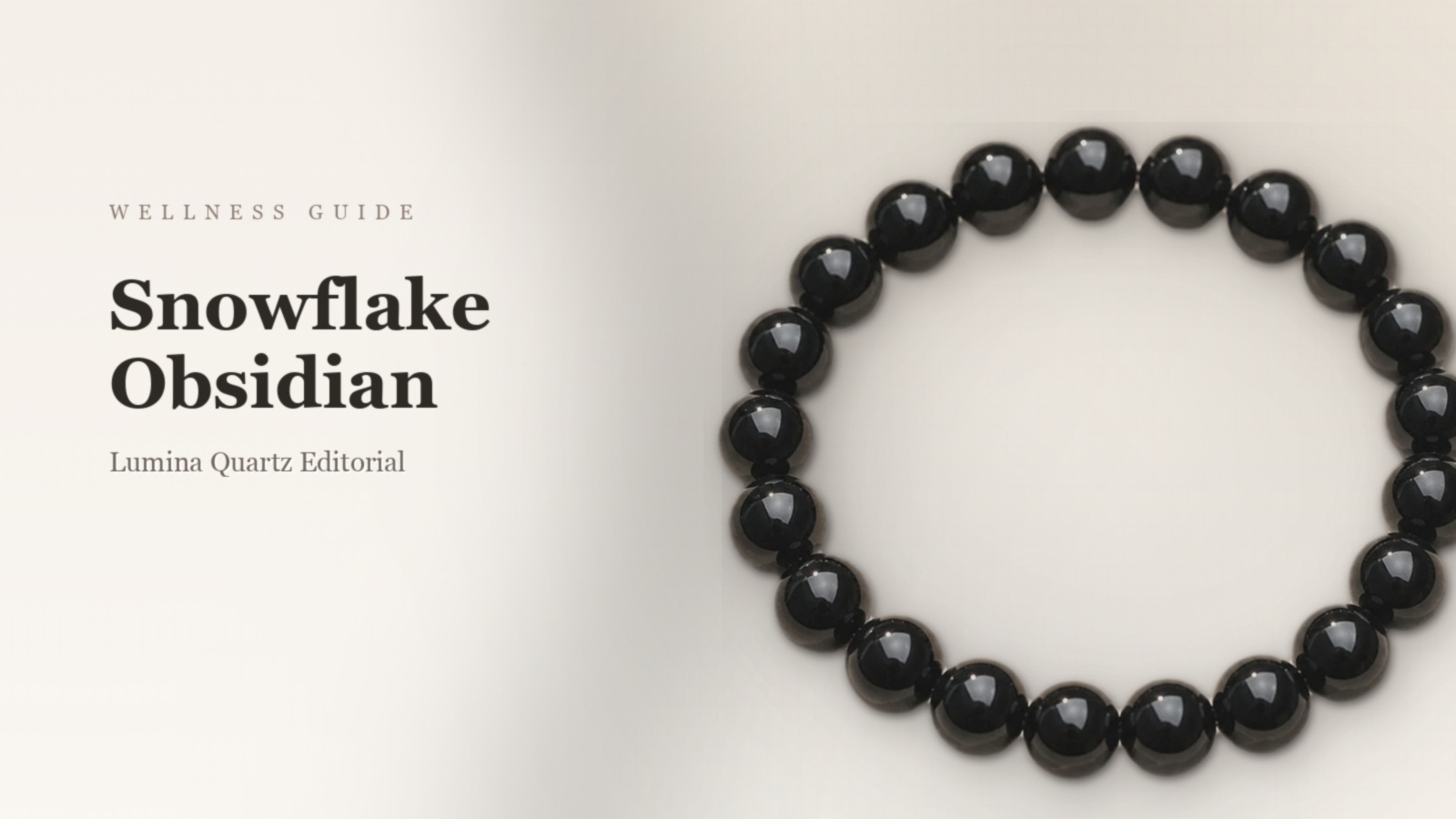
Table of Contents
- Introduction to Snowflake Obsidian
- Snowflake Obsidian Meaning and Healing Energy
- Emotional Healing and Grounding Properties
- Chakras and Spiritual Benefits
- Geological Formation and Characteristics
- How Snowflake Obsidian Forms
- Composition and Appearance
- Where to Find Snowflake Obsidian
- Snowflake Obsidian vs. Other Black Stones
- How to Use Snowflake Obsidian in Daily Life
- Jewelry and Wearables
- Meditation and Crystal Healing
- Buying Guide for Snowflake Obsidian
- Key Takeaways
- Conclusion: Adding Snowflake Obsidian to Your Collection
- Frequently Asked Questions
Introduction to Snowflake Obsidian
There are stones that catch the light, and then there are stones that seem to hold the dark—and gently illuminate it. Snowflake obsidian is one of the latter. A deep, glassy black body, scattered with soft white flecks that resemble fallen snow, it carries an unusual kind of quiet beauty. It is a stone of stillness, of patience, and of noticing what grows in the spaces we often overlook.
For those drawn to crystals not only for their appearance but for the energy they may carry, snowflake obsidian offers a presence that feels both ancient and accessible. It is a volcanic glass, born from rapidly cooled lava, and yet within its darkness, patterns of cristobalite form—tiny white snowflakes that make each piece uniquely itself. No two stones look exactly alike, and perhaps that is part of the lesson it gently offers: your own patterns, too, are singular and meaningful.
In this guide, we will explore what snowflake obsidian is, where it comes from, how it has been used, and how you might invite it into your daily rituals. Whether you are a seasoned collector or simply curious about this striking stone, we hope to offer a grounded, honest perspective—one that honors both the science and the symbolism.
Snowflake Obsidian Meaning and Healing Energy
What does snowflake obsidian mean? Its name alone evokes a poetic paradox: fire and ice meeting in a single form. Volcanic heat creates the black glass, and cooling allows the white snowflake patterns to bloom. This interplay of opposites—dark and light, heat and cold, stillness and movement—is often reflected in the stone's metaphysical reputation.
Snowflake obsidian is frequently described as a stone of purity and balance. In the world of crystal healing, it is often associated with clearing mental clutter, soothing emotional turbulence, and bringing a sense of centered calm. Unlike some stones that feel energizing or activating, snowflake obsidian tends to feel more like a deep breath—a gentle "coming home" to oneself.
Emotional Healing and Grounding Properties
One of the most beloved associations with snowflake obsidian is its grounding presence. Many people who work with crystals describe it as a stone that helps the mind slow down, especially during moments of stress, overwhelm, or circular thinking. The dark, glassy surface seems to absorb scattered energy, while the white snowflake patterns offer a focal point for the eyes—and for the mind—to settle.
Emotionally, snowflake obsidian is often associated with compassion for oneself and others. It is sometimes used as a gentle companion during times of grief, transition, or emotional release. Rather than rushing the process, it may support the kind of healing that unfolds slowly, like snow falling in silence—quiet, cumulative, and transformative.
Some crystal practitioners use snowflake obsidian to encourage honesty with oneself. Because it is a stone of reflection (literally and figuratively), it may help you look at your own patterns without harsh judgment—to notice where you have been carrying pain, and to begin, gently, to set it down.
Chakras and Spiritual Benefits
In chakra-based work, snowflake obsidian is most often associated with the root chakra at the base of the spine. The root chakra is connected to feelings of safety, stability, and being grounded in the physical body. Snowflake obsidian's dense, earthy energy is thought to anchor this center, helping individuals feel more present and secure in their daily lives.
Some practitioners also connect snowflake obsidian to the third eye chakra, which is associated with intuition and inner vision. The white snowflake patterns, set against the black glass, are sometimes seen as a representation of clarity emerging from darkness—an invitation to trust your inner knowing, especially during times of confusion.
It is important to note that these spiritual benefits are based on tradition, intuition, and personal experience. They are not scientifically proven, and snowflake obsidian is not a medical treatment. Rather, it is a tool that some people find supportive for reflection, meditation, and intentional living.
Geological Formation and Characteristics
Beyond its metaphysical associations, snowflake obsidian is also a fascinating geological specimen. Understanding how it forms deepens our appreciation for what we hold in our hands. This is a stone that comes from fire, shaped by the Earth's most dramatic processes.
How Snowflake Obsidian Forms
Snowflake obsidian begins as felsic lava—lava rich in silica—that erupts from a volcano. When this lava cools very quickly, it does not have time to crystallize into a regular mineral structure. Instead, it solidifies into a natural glass. This is why obsidian is often classified as a mineraloid rather than a mineral: its atomic structure is disordered, like glass, rather than crystalline.
The snowflake patterns appear later, during a process called devitrification. Over time, tiny crystals of the mineral cristobalite begin to form within the glass. These white, radiating clusters spread through the black matrix, creating the flower- or snowflake-like patterns that give the stone its name. This process may take millions of years, meaning that each snowflake obsidian stone is a slow work of art—crafted not in a day, but over deep geological time.
Composition and Appearance
Obsidian is composed primarily of silicon dioxide (SiO₂)—the same basic chemistry as quartz, but without quartz's ordered crystal lattice. Its deep black color and glassy luster come from its amorphous structure and from microscopic bubbles and mineral inclusions trapped within the rapidly cooled glass. According to mineral databases such as Mindat, obsidian's color range—including black—is due largely to the refraction of light by these microscopic features.
In snowflake obsidian, the matrix stays black while white to grey cristobalite clusters bloom across its surface. The contrast is what makes the stone so distinctive: a glossy, mirror-like black interrupted by organic, fern-like white patterns. Each stone's pattern is different, which is why no two pieces are ever quite the same.
Obsidian has also been valued by cultures around the world for thousands of years—used for tools, trade, and ornamentation. Research from the Smithsonian has documented how obsidian moved through ancient exchange networks, showing that this volcanic glass has long been a material people sought out and carried across great distances.
Where to Find Snowflake Obsidian
Obsidian forms wherever silica-rich lava cools quickly—typically near volcanic regions. Well-known sources of obsidian, including snowflake obsidian, include:
- Mexico — one of the most familiar sources for snowflake obsidian in the gem and crystal market
- United States — particularly volcanic regions in the West, such as Oregon, Idaho, and Nevada
- Iceland — a classic locale for volcanic glass
- Italy — including the Mediterranean volcanic islands
- New Zealand and Japan — other volcanically active regions where obsidian can be found
Because obsidian is not a rare mineral in a geological sense, snowflake obsidian is generally widely available. What varies most is the quality and density of the snowflake patterning, which is what collectors tend to look for.
Snowflake Obsidian vs. Other Black Stones
If you are drawn to dark, protective-feeling stones, it helps to know how snowflake obsidian differs from its cousins. The table below is a simple orientation, based on how these stones are commonly described in crystal traditions—not a ranking of value.
Quick Comparison of Common Black Stones
| Stone | Appearance | Commonly Associated With | Best For |
|---|---|---|---|
| Snowflake Obsidian | Black glass with white cristobalite "snowflakes" | Grounding, self-reflection, gentle release | Quiet meditation, journaling, transition periods |
| Black Obsidian | Uniform glossy black, sometimes with sheen | Protection, truth-telling, shadow work | Boundary-setting, cutting through denial |
| Black Tourmaline | Opaque black, often striated crystal | Energetic shielding, grounding | Carrying in busy or draining environments |
| Smoky Quartz | Translucent brown-grey to near-black | Grounding, transmuting heavy emotions | Everyday wear, calming anxious energy |
Note: These associations come from crystal-healing traditions rather than clinical research. Use them as reflective prompts, not as medical guidance.
If you already love stones like black tourmaline for their protective feel, snowflake obsidian can make a gentle companion—similar in its steadying presence, but softer in tone thanks to its white patterning. You can read more in our guide to black tourmaline meaning and uses.
How to Use Snowflake Obsidian in Daily Life
One of the loveliest things about snowflake obsidian is how easy it is to live with. It does not demand ritual or ceremony—it simply settles in beside you, whether on a desk, a bedside table, or around your wrist.
Jewelry and Wearables
Because obsidian is relatively durable and polishes beautifully, it is often made into bracelets, pendants, and rings. Wearing snowflake obsidian can feel like carrying a small reminder to pause and breathe—especially if you set an intention for it, such as staying grounded during a busy week or approaching a difficult conversation with honesty.
If you would like to pair it with another protective stone, our obsidian protection bracelet is a simple, everyday way to bring that steadying black-stone energy into your routine.
Meditation and Crystal Healing
Many people enjoy holding or resting snowflake obsidian nearby during meditation. You might try:
- Root chakra anchoring: Sit comfortably and rest the stone near your base or in your hands. Breathe slowly and let your attention settle downward, as though rooting into the ground.
- Reflection journaling: Hold the stone, then write one honest sentence about how you are really feeling. Let the stone be a quiet witness rather than a judge.
- Sleep support: Some people place it on a nightstand to encourage a calmer, more grounded wind-down routine.
- Grief and transition: During periods of change, carry or hold it as a soft reminder that healing does not have to be rushed.
Treat these as personal practices rather than treatments. If you are navigating grief, trauma, or a difficult transition, a crystal can be a meaningful symbol—but so can support from a trusted friend, counselor, or healthcare provider.
Buying Guide for Snowflake Obsidian
Snowflake obsidian is generally an affordable stone, which makes it a friendly entry point for new collectors. Here is a simple checklist when shopping:
- Look at the pattern: Well-defined, distinct "snowflakes" with good contrast against the black are usually more desirable to collectors.
- Check the finish: A smooth, glossy polish with minimal scratches or dull patches suggests careful workmanship.
- Feel the weight: Obsidian should feel solid and cool, not light or hollow-feeling.
- Ask about origin: Reputable sellers can usually tell you where a stone was sourced—Mexico is a common origin for snowflake obsidian.
- Trust your eye: Since every piece is unique, choose the one whose pattern genuinely speaks to you.
You do not need a "perfect" specimen for it to be meaningful. Part of the charm of snowflake obsidian is that its imperfections and variations are the very thing that makes it beautiful.
Key Takeaways
- Snowflake obsidian is a natural volcanic glass with distinctive white cristobalite "snowflake" patterns.
- It is traditionally associated with grounding, self-reflection, and gentle emotional release.
- It is most often linked with the root chakra, and sometimes with the third eye.
- It forms when silica-rich lava cools rapidly, then slowly devitrifies over geological time.
- It is widely available and generally affordable, making it easy to collect or wear.
- Its benefits are based on tradition and personal experience, not medical evidence.
Conclusion: Adding Snowflake Obsidian to Your Collection
Snowflake obsidian is a quiet stone. It does not shine or sparkle in the way some crystals do; instead, it holds a deep, steady darkness and invites you to look more closely. In that looking, you may find something surprisingly tender—a reminder that light and dark are not opposites so much as companions, and that healing often happens slowly, in the spaces between.
Whether you are drawn to it for its grounding presence, its striking appearance, or simply its gentle symbolism, snowflake obsidian is a lovely addition to any collection. Let it be a small anchor in your day—a reminder to slow down, breathe, and come back to yourself.
Frequently Asked Questions
What is snowflake obsidian?
Snowflake obsidian is a type of volcanic glass—obsidian—that contains white, radiating clusters of the mineral cristobalite. These clusters resemble snowflakes scattered across a black background, which is how the stone got its name.
What are the healing properties of snowflake obsidian?
In crystal-healing traditions, snowflake obsidian is associated with grounding, emotional balance, and gentle self-reflection. It is often described as a calming stone that supports honesty and compassion. These associations come from tradition and personal experience rather than scientific research, so it is best treated as a supportive tool rather than a treatment.
How is snowflake obsidian formed?
It begins as silica-rich (felsic) lava that cools very quickly, forming natural glass rather than crystals. Over long periods of geological time, the glass undergoes devitrification, during which tiny cristobalite crystals form. These crystals create the white snowflake patterns the stone is known for.
Where is snowflake obsidian found?
Obsidian forms in volcanic regions around the world. Snowflake obsidian is commonly sourced from Mexico, and obsidian more broadly is found in places such as the western United States, Iceland, Italy, New Zealand, and Japan.
How do you use snowflake obsidian for grounding and reflection?
Many people hold or wear it during meditation, keep it nearby while journaling, or place it on a nightstand for a calmer evening routine. You might set a simple intention with the stone—such as staying present during a stressful week—and let it serve as a quiet reminder to pause and breathe.
Related Reading
If you enjoy working with grounding, protective stones, you may also like these guides:
- Black Tourmaline Meaning: Meaning, Properties, and Everyday Uses
- Red Jasper: A Gentle Guide to Meaning, Benefits, and Uses
- Kyanite Crystal Meaning: A Guide to Benefits, Uses, and Chakra Alignment
- Sunstone Meaning: Meaning, Properties, and Everyday Uses
- Fluorite Meaning: Meaning, Properties, and Everyday Uses
- Rose Quartz Crystal: A Gentle Guide to Meaning, Benefits, and Uses