Snowflake Obsidian Spiritual Meaning: Grounding, Protection & Shadow Work Guide
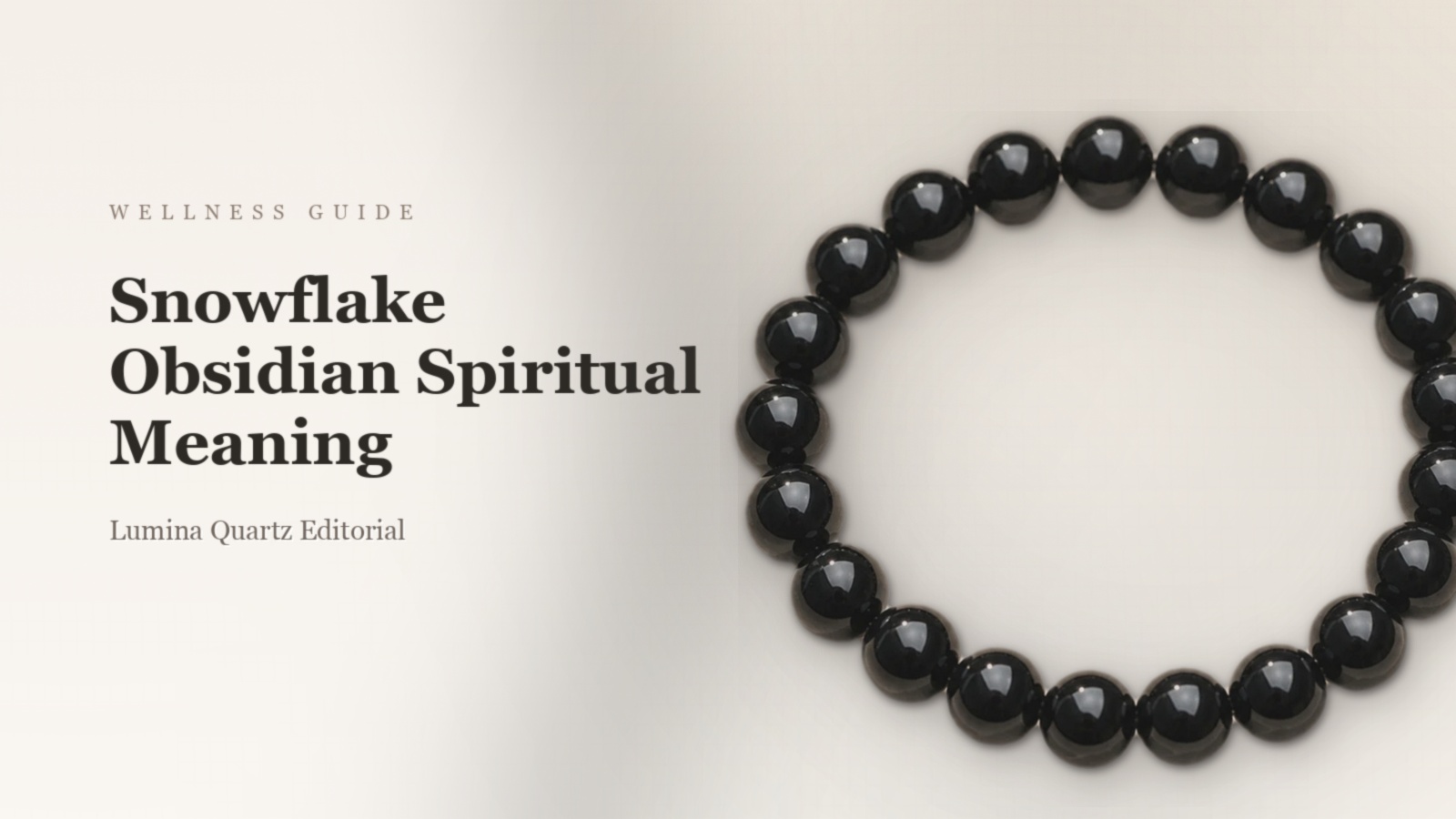
Table of Contents
- Key Takeaways
- Working With Snowflake Obsidian: A Practical Decision Guide
- What is Snowflake Obsidian?
- Snowflake Obsidian Spiritual Meaning
- Balance and Grounding
- Purification and Cleansing
- Shadow Work and Protection
- Snowflake Obsidian and Chakra Healing
- Root Chakra
- Third Eye Chakra
- How to Use Snowflake Obsidian for Spiritual Growth
- Meditation with Snowflake Obsidian
- Wearing and Carrying Snowflake Obsidian
- Cleansing and Charging Snowflake Obsidian
- Frequently Asked Questions about Snowflake Obsidian
- Conclusion
- Sources
There is a quiet kind of magic in stones that hold two stories at once. Snowflake obsidian is one of those gentle paradoxes — a deep, glassy black field scattered with soft white inclusions, like snow falling against a night sky. It does not shout. It does not demand attention. Instead, it invites you to pause, to breathe, and to sit with what is real. For those drawn to crystals not as quick fixes but as companions on a slower path, snowflake obsidian spiritual meaning unfolds as an invitation to turn inward — to meet your own shadows with tenderness, and to remember that contrast is not chaos. It is the very thing that makes you whole.
Key Takeaways
- Snowflake obsidian is a volcanic glass formed when molten lava cools rapidly, with white cristobalite inclusions creating its signature snowflake-like patterns.
- Its spiritual meaning is often associated with balance, grounding, purification, and gentle shadow work.
- Snowflake obsidian may support emotional resilience by encouraging honest self-reflection without harshness.
- It is frequently linked to the root chakra and the third eye chakra, helping to anchor energy while deepening inner vision.
- Simple practices such as meditation, wearing the stone, and mindful cleansing rituals may help you work with its energy over time.
- Snowflake obsidian never claims to "cure" — it offers presence, and that is perhaps its greatest gift.
Working With Snowflake Obsidian: A Practical Decision Guide
Most people come to this stone with a very ordinary question: what do I actually do with it today? The guide below pairs common moments with a simple practice, so you can choose something that fits rather than forcing a ritual that doesn't.
Match the Practice to the Moment
- Your mind won't settle: Hold the stone and notice three points of contact — feet on the floor, back against the chair, hands around the crystal. Snowflake obsidian's dense, earthy feel gives your attention somewhere to rest.
- You keep replaying an old conversation: Keep the stone beside you and write one honest sentence about how you felt. The stone is traditionally associated with clearing mental clutter, not with relitigating the past.
- You're facing a part of yourself you'd rather avoid: Sit quietly with the stone for five minutes and simply name what's there. The white inclusions are a useful reminder that contrast belongs inside the whole, not outside it.
- You're in the middle of a transition: Carry it in a pocket during the move, the goodbye, or the first day. Obsidian is a stone of endings and beginnings, comfortable in both.
- You feel scattered or ungrounded: Wear or hold it before a short breathing practice. It is most often linked to the root chakra, which is about steadiness rather than intensity.
Gentle Boundaries to Keep
- Crystal practices are supportive companions, not treatment. If anxiety, grief, or low mood is persistent or interfering with daily life, a qualified professional is the right next step.
- For decisions with legal, financial, or medical weight, rely on credentialed advice — a stone can help you stay calm while you make the call, and that is where its role ends.
- If inner reflection starts turning into self-punishment, set the stone down and take a break. Snowflake obsidian is associated with tenderness, not with harsh self-scrutiny.
- There is no required schedule. Working with it occasionally, when you feel drawn to it, is a complete practice.
What is Snowflake Obsidian?
Snowflake obsidian is a naturally occurring volcanic glass. When silica-rich lava cools very quickly, it does not have time to form a crystalline structure, so it hardens into a smooth, glossy material we call obsidian. As mineral databases such as Mindat note, obsidian's appearance — including its various color shifts — comes largely from microscopic bubbles and tiny mineral inclusions trapped inside the glass. In snowflake obsidian, those inclusions take the form of small white cristobalite crystals that radiate outward in delicate, branching patterns, giving each stone a fingerprint-like uniqueness.
Unlike many gemstones mined from deep within the earth, obsidian is born at the surface, often at the edges of lava flows. Research from the Smithsonian's Museum Conservation Institute traces how far obsidian traveled in ancient trade networks, and the Smithsonian's archaeological research shows that shifts in how people used obsidian over time often mirrored larger social and economic changes. For thousands of years it was shaped into tools, blades, and mirrors — a stone of practical reflection long before it became a stone of spiritual reflection. The Gemological Institute of America describes how flow structures from that once-molten state are still preserved in the solidified glass, visible only after polishing. There is something quietly moving about that: the stone remembers what it survived.
Snowflake Obsidian Spiritual Meaning
At its heart, snowflake obsidian spiritual meaning is about reconciliation. The stone gently asks you to hold space for both light and darkness within yourself. The black body does not reject the white inclusions; it holds them, allowing them to form and bloom. In the same way, this stone may support your ability to accept your own imperfections, contradictions, and quiet struggles without judgment.
It is not a stone of instant transformation. It is a stone of steady, honest unfolding. Working with snowflake obsidian is often associated with the slow, patient work of becoming — not becoming someone new, but becoming more fully yourself.
Balance and Grounding
Snowflake obsidian is frequently described as a grounding stone. Its dense, earthy composition carries a weighty, stabilizing energy that many find calming during times of stress, grief, or mental fog. Because it is born from fire and cooled by air, it holds a certain elemental equilibrium — a reminder that you, too, can move through intensity and emerge steady rather than hardened.
The concept of balance here is not about forced positivity. It is about allowing yourself to feel your emotions fully while staying anchored enough not to be swept away by them. Snowflake obsidian may support this grounding by helping you feel more present in your body, more aware of your feet on the floor, and more connected to the simple, solid rhythm of your breath.
Purification and Cleansing
In many crystal traditions, obsidian is considered a purifying stone, and snowflake obsidian carries that reputation with a softer edge. Its spiritual meaning often includes the idea of clearing away energetic clutter — old thought patterns, lingering resentments, or the emotional residue of difficult experiences. This is not a harsh or aggressive cleansing; it is more like the quiet fall of snow that blankets a landscape, muffling noise and creating a clean, quiet starting point.
Some people find that holding snowflake obsidian during a period of transition helps them release what no longer serves them, not through force but through compassionate awareness. The stone does not erase your history. It simply helps you see it clearly, and from that clarity, you may find it easier to let go.
Shadow Work and Protection
The term "shadow work" can feel intimidating, but at its simplest, it means turning your attention toward the parts of yourself you usually avoid — fear, insecurity, anger, grief, or past wounds. Snowflake obsidian is often associated with this kind of inner exploration because it offers a safe, reflective container for it. Rather than amplifying your shadows into something frightening, the stone's soft white inclusions remind you that even the darkest places can hold small, quiet lights.
The protective quality of snowflake obsidian is less about warding off outside forces and more about protecting your inner peace while you do the difficult work of looking honestly at yourself. Think of it as a door you can close when you need to rest, and open again when you feel ready. That sense of choice is the protection — you decide the pace, and you decide when to stop for the day.
Snowflake Obsidian and Chakra Healing
In crystal healing traditions, snowflake obsidian is most often connected with two energy centers: the root chakra and the third eye chakra. One grounds you; the other helps you see. Together they describe the stone's particular gift — staying steady enough to look clearly at what is true.
Root Chakra
The root chakra is associated with safety, stability, and the feeling of being at home in your own body. Snowflake obsidian's dense, grounded character makes it a natural companion for this center. If you often feel scattered, unmoored, or overwhelmed by the pace of modern life, holding the stone during a few slow breaths may help you re-establish a sense of solid ground. Many people place it near their feet or at the base of the body during quiet rest, simply as a physical reminder of steadiness.
Third Eye Chakra
The third eye chakra is linked to intuition, insight, and inner vision. Snowflake obsidian's reflective history — polished obsidian was once used as a mirror — makes it a fitting companion here. This is not about predicting the future; it is about seeing your own patterns more honestly. Used during journaling or meditation, the stone may help you notice recurring themes in your thoughts and emotions, and to meet them with curiosity rather than criticism.
How to Use Snowflake Obsidian for Spiritual Growth
You do not need an elaborate setup. A few repeatable, low-effort practices tend to be far more meaningful than one grand ritual.
Meditation with Snowflake Obsidian
Begin by sitting comfortably and resting the stone in your palm or on your knee. Let your eyes soften or close, and take three unhurried breaths. As you settle, you might silently ask a simple question: what am I avoiding right now? You do not need an answer. The practice is in staying present long enough for one honest thought to surface. Five to ten minutes is plenty, and ending early is not a failure.
Wearing and Carrying Snowflake Obsidian
Carrying a stone works best when it is tied to a repeatable moment — putting it on before work, before meditation, or before an evening reset. A tumbled piece in a pocket or a small pouch in your bag is enough. If you prefer a simple daily anchor for grounding intentions, a Black Obsidian Bracelet can serve the same purpose, acting as a quiet reminder to return to your intention throughout the day.
Cleansing and Charging Snowflake Obsidian
Because obsidian is volcanic glass rather than a crystalline mineral, it is best treated gently. Sound cleansing with a bell or singing bowl, passing the stone briefly through sage or palo santo smoke, or resting it on a windowsill under moonlight are all simple, low-risk options. A quick rinse is generally fine, but avoid harsh chemicals, abrasive cloths, ultrasonic cleaners, or long soaks, and dry the stone thoroughly afterward. To "charge" it, many people simply leave it overnight in moonlight or hold it with a clear intention before returning it to its usual spot. What matters most is consistency and care, not ceremony.
Frequently Asked Questions about Snowflake Obsidian
What does snowflake obsidian mean spiritually?
Snowflake obsidian is generally associated with balance, grounding, purification, and gentle shadow work. Its meaning draws on the contrast within the stone itself: a dark volcanic glass holding soft white inclusions, a visual reminder that light and shadow can coexist in one whole.
Is snowflake obsidian the same as black obsidian?
They are closely related — both are volcanic glass formed by rapidly cooling lava. Black obsidian is uniformly dark and often described as more intensely protective, while snowflake obsidian contains white cristobalite inclusions that many people find give it a softer, more introspective feel. Neither is better; they simply suit different moods.
Which chakra is snowflake obsidian connected to?
It is most commonly linked to the root chakra, for grounding and stability, and to the third eye chakra, for insight and inner vision. Some practitioners also work with it near the sacral area during emotional release, though this is less standard.
How do I cleanse and charge snowflake obsidian?
Sound, smoke, or moonlight are all gentle and safe options. Brief rinses with water are usually fine, but avoid chemical cleaners, ultrasonic devices, and prolonged soaking. To charge it, leave it overnight in moonlight or simply hold it while setting a clear intention.
Can I wear snowflake obsidian every day?
Yes, many people do. Because it is a stone of calm rather than stimulation, it tends to be comfortable for daily wear. If you find yourself feeling unusually heavy or introspective, take it off for a few days and notice the difference — that is useful information, not a problem.
Does snowflake obsidian heal or cure anything?
No. Snowflake obsidian is a spiritual and symbolic companion, not a medical treatment. It does not diagnose, cure, or prevent any condition. If you are struggling with your physical or mental health, please speak with a qualified healthcare professional.
Conclusion
Snowflake obsidian does not promise to fix you, because it does not believe you are broken. What it offers is quieter and, in many ways, more useful: a steady presence while you look honestly at your own life, and a reminder that darkness and light are not enemies. They are simply two halves of the same stone.
If you feel drawn to it, start small. Hold it for three breaths. Keep it in your pocket on a difficult day. Write one true sentence with it resting beside you. Over time, those small, unhurried moments are where snowflake obsidian's meaning becomes personal — not a belief you adopt, but a practice you live.
Sources
- Mindat — Obsidian: Mineral information, data and localities
- Smithsonian Museum Conservation Institute — Obsidian Trade Research
- Smithsonian Profiles — Obsidian Use in the Central and Northern Plains
- GIA — Fire Obsidian's Beguiling Spectrum