The Complete Everyday Guide to Obsidian Definition: Meaning and Uses
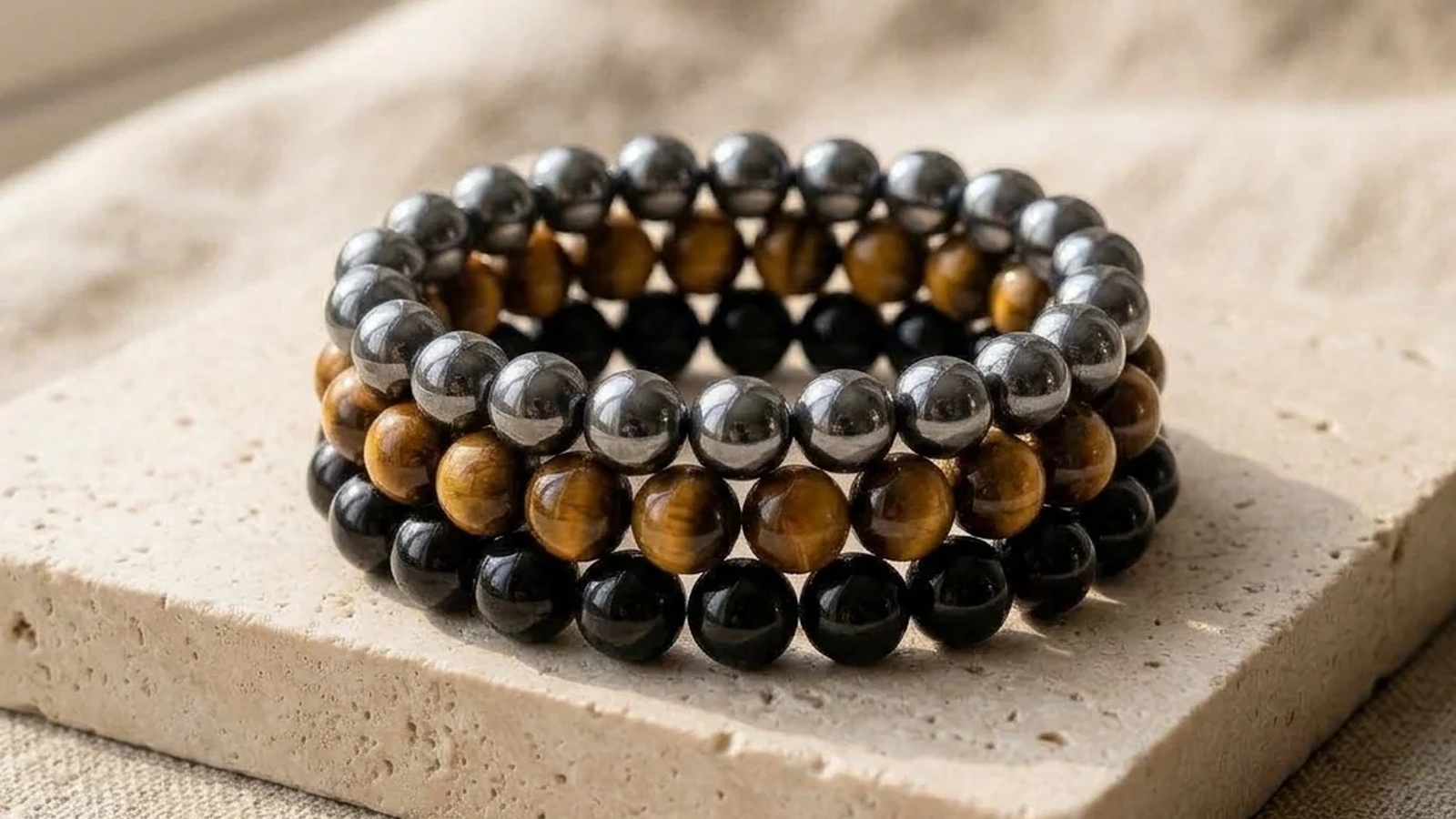
Table of Contents
- The 10-Second Executive Summary
- What Is Obsidian? A Simple Definition Anyone Can Understand
- How Obsidian Forms: Volcanoes, Lava, and Rapid Cooling
- Why Obsidian Is Glass, Not Crystal
- Beyond Black: Obsidian Colors, Types, and Variations
- Obsidian vs. Similar Stones: How to Tell the Difference
- Step-by-Step Check: Is This Real Obsidian?
- Real-World Uses of Obsidian, from Ancient Tools to Modern Jewelry
- How to Choose and Care for Obsidian Jewelry and Home Pieces
- Obsidian Definition FAQ: Quick Answers to Common Questions
- What is obsidian made of and how does it form?
- Is obsidian a rock, glass, or crystal?
- What colors can obsidian be, and is it always black?
- What is obsidian used for in jewelry and everyday life?
- How can you tell real obsidian from fake or similar stones?
- A Final, Grounding Note
- Sources
Obsidian is a naturally occurring volcanic glass formed when viscous, silica-rich lava cools so rapidly that atoms cannot arrange themselves into mineral crystals. That single fact answers the core search question: obsidian is not a crystal and not a mineral species — it is an igneous rock that behaves like glass, with a Mohs hardness of roughly 5 to 5.5 and a smooth conchoidal (curved, glass-like) fracture. For readers comparing stones, this means obsidian scratches more easily than quartz yet takes a sharper edge than almost any natural material of its kind.
The 10-Second Executive Summary
- Direct Verdict: Obsidian is natural volcanic glass — an igneous rock, not a crystal and not a mineral. It is defined by rapid lava cooling, not by crystal structure.
- Composition: Predominantly silica (SiO2), typically around 70% or more in most volcanic glasses, with water content usually under about 1%.
- Mohs Hardness: Approximately 5–5.5 — softer than quartz (7) and hardened glass scratch tests should be interpreted with care.
- Key Physical Trait: Conchoidal fracture, producing razor-sharp edges; usually opaque to slightly translucent at thin edges.
- Best For: Everyday jewelry with protective settings, display and home pieces, and anyone seeking a grounded, honest black stone rather than a sparkly crystal.
- Buying Benchmark: Natural, un-dyed, untreated material — the Lumina Grade AAA Integrity Standard.
What Is Obsidian? A Simple Definition Anyone Can Understand
In plain terms, obsidian is a volcanic rock that cooled into glass rather than into crystals. Britannica defines it as an igneous rock occurring as natural glass, formed by the rapid cooling of viscous lava from volcanoes (Britannica). Because cooling happened too fast for mineral grains to grow, obsidian has no visible crystal structure — what you see is a smooth, glassy solid, sometimes with flow banding or tiny bubbles frozen in place.
This is why the word "obsidian definition" is often misunderstood. People expect a gemstone with a lattice, like quartz. Obsidian is closer to a natural version of the glass in a window: hard, brittle, glossy, and shaped by how it broke rather than how it grew. It is often described as a stone of protection in cultural and folk traditions, though those meanings are symbolic and personal, not scientific properties of the material.
How Obsidian Forms: Volcanoes, Lava, and Rapid Cooling
Obsidian forms at the margins of volcanic activity, where silica-rich lava reaches the surface and loses heat quickly. The chemistry matters: lava that is high in silica is viscous, meaning it flows slowly and resists crystal growth. When that thick lava is chilled — by air, water, or contact with cooler rock — the window for crystallization closes, and the melt solidifies as glass.
Three conditions tend to matter most:
- High silica content makes the melt viscous and slow to organize into crystals.
- Low water content keeps the melt from turning into pumice or frothy volcanic foam.
- Fast cooling locks the disordered atomic structure in place before crystals can form.
Because obsidian is a volcanic glass rather than a stable crystal, it is geologically young by rock standards. Over long periods, obsidian tends to devitrify — small crystals slowly begin to form within the glass — which is why truly glassy obsidian is often associated with relatively recent volcanic deposits. This also explains why obsidian is not classified as a mineral: it lacks a defined crystal structure and a fixed chemical formula in the way minerals do.
Why Obsidian Is Glass, Not Crystal
The distinction is structural. A crystal has an ordered, repeating internal arrangement of atoms; glass has a disordered, amorphous one. Obsidian's atoms are frozen in a jumbled pattern, so it fractures like glass rather than cleaving along crystal planes. That is the cleanest test of the definition: obsidian is a rock made of glass, not a crystal, even though it is sold alongside crystals in many shops.
Beyond Black: Obsidian Colors, Types, and Variations
Obsidian is most famous in black, but the material is not limited to one color. Variations arise from impurities, tiny inclusions, and the presence of gas bubbles or microscopic crystals.
- Black obsidian — the classic opaque glass, usually iron-rich and uniform.
- Snowflake obsidian — black glass with gray-white patches formed by clusters of tiny cristobalite crystals; a natural sign of early devitrification.
- Mahogany obsidian — brownish-red to reddish-black, colored by iron oxides.
- Rainbow or sheen obsidian — a surface iridescence caused by thin layers or inclusions that reflect light, sometimes linked to gas bubbles aligned in the glass.
- Golden sheen obsidian — a warm metallic shimmer along the surface, again a light-reflection effect rather than a precious-metal content.
It is worth being clear: color and sheen are optical and chemical features of the glass, not evidence of energetic properties. Sheen obsidian is beautiful because of how it interacts with light, and that is a fully sufficient reason to enjoy it.
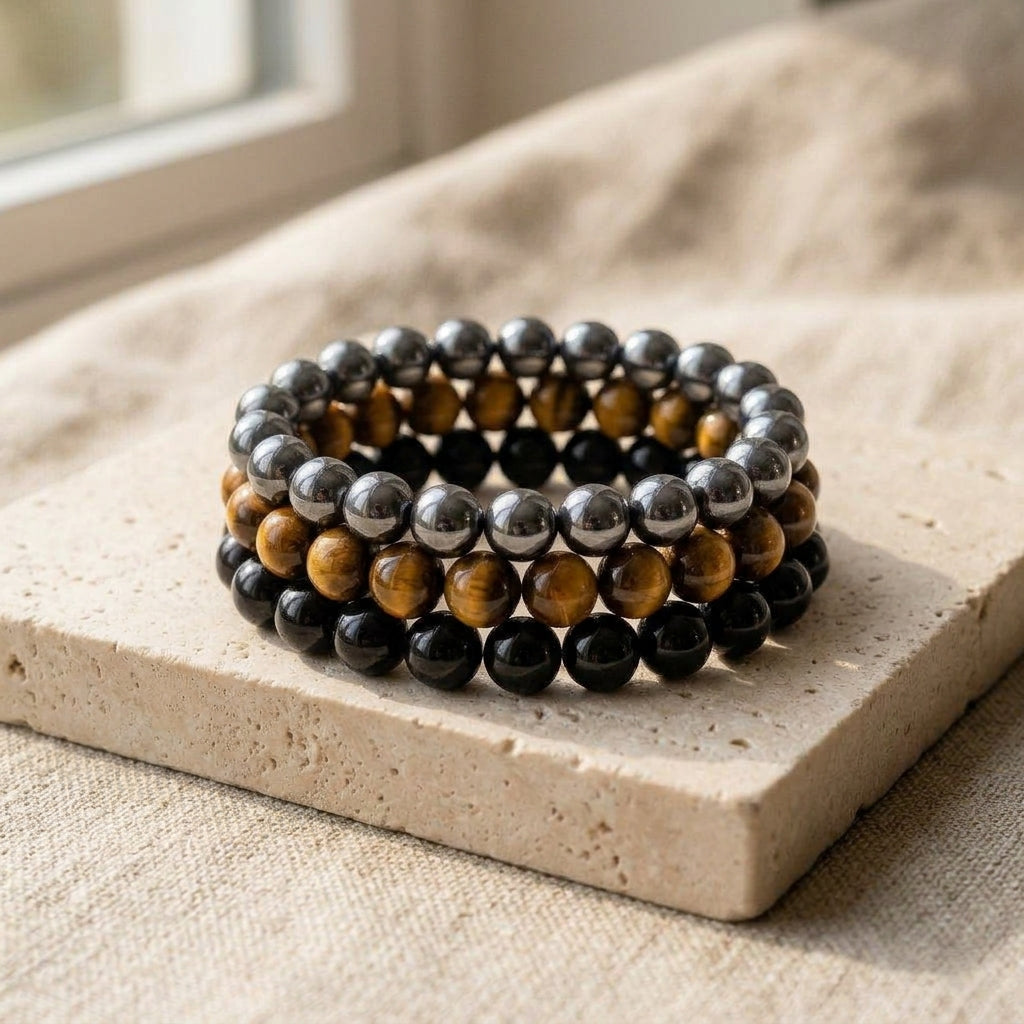
The Master Triple Protection Ritual Stack (Natural Tiger's Eye, Black Obsidian & Hematite)
Black obsidian is often worn as a grounding ritual piece for days that ask for steadier energy.
Shop This Authentic Piece →Obsidian vs. Similar Stones: How to Tell the Difference
Obsidian is frequently confused with black onyx, black tourmaline, and glass imitations. The differences are practical and observable.
| Feature | Obsidian | Black Onyx | Black Tourmaline | Man-Made Glass |
|---|---|---|---|---|
| Nature | Volcanic glass (rock) | Chalcedony (crystal) | Boron-silicate mineral | Artificial glass |
| Mohs hardness | ~5–5.5 | ~6.5–7 | ~7–7.5 | ~5–6 |
| Fracture | Conchoidal, glassy | Conchoidal but harder | Uneven, often striated | Conchoidal, may show bubbles |
| Typical look | Glossy, flow bands, occasionally snowflake patches | Very uniform, banded when dyed | Vitreous, often with fine striations | Too uniform, possible mold seams |
| Weight feel | Light for its size | Moderate to dense | Dense | Often lighter or oddly uniform |
Most fake "obsidian" on the market is simply manufactured glass, sometimes with dye, and occasionally treated or irradiated material sold without disclosure. Natural obsidian may show subtle flow banding, minute bubbles, and small irregularities; perfectly identical pieces are a warning sign rather than a reassurance.
Step-by-Step Check: Is This Real Obsidian?
- Look for flow banding or snowflake patches. Natural obsidian often shows subtle streaks or gray-white clusters; perfectly smooth uniform black with no variation is more typical of artificial glass.
- Inspect the fracture. Real obsidian breaks with a curved, shell-like conchoidal pattern. Chipped or cut edges should look glassy, not granular.
- Check for bubbles with care. A few tiny bubbles can occur naturally, but large, evenly spaced, or perfectly round bubbles suggest manufacturing.
- Test hardness thoughtfully. At Mohs ~5–5.5, obsidian is softer than quartz and can be scratched by it. If a "black obsidian" piece resists a quartz point easily, ask what it really is.
- Weigh the piece in the hand. Obsidian is relatively light for its volume compared to denser black stones.
- Ask about treatment. A reputable seller should confirm natural origin, no dye, no irradiation, and no chemical stabilization. That disclosure standard is what the Lumina Grade AAA Integrity Standard represents: natural, un-dyed, untreated material.
Applicable boundary: These checks help distinguish natural obsidian from glass and dyed imitations, but they are not a substitute for laboratory gemological testing, which is the only definitive method for unusual or high-value pieces.
Real-World Uses of Obsidian, from Ancient Tools to Modern Jewelry
Obsidian's sharp fracture made it a practical material long before it became a decorative one. Archaeological records consistently describe knapped obsidian blades and points used as cutting tools and weapons, because conchoidal fracture produces edges finer than steel in some cases. The same property makes it useful today in surgical-grade scalpel blades and precision cutting applications.
In modern jewelry and home décor, obsidian appears as polished cabochons, beads, tumbled stones, spheres, and carved objects. Its glossy surface and honest, grounded appearance suit minimal and sculptural designs. In cultural and personal traditions, obsidian is often associated with protection, grounding, and self-reflection — symbolic meanings that many wearers find meaningful, provided they are understood as cultural and personal associations rather than measurable effects on mood or body.
How to Choose and Care for Obsidian Jewelry and Home Pieces
Choosing well comes down to clarity of disclosure and appropriate setting design.
- Prefer protective settings. At Mohs ~5–5.5, obsidian chips more easily than quartz. Bezel settings and smooth cabochons wear better than exposed prongs and thin carved details.
- Ask for natural-origin confirmation. Look for a seller who states that the material is natural, un-dyed, and not irradiated. This is the core of the Lumina Grade AAA Integrity Standard.
- Match color to intent. Black for a classic, grounding look; snowflake for visual texture; sheen varieties for light-catching pieces.
- Avoid ultrasonic cleaners. Glassy material can be damaged by vibration and harsh chemicals; warm water, mild soap, and a soft cloth are the safer default.
- Store separately. Keep obsidian away from harder stones to prevent scratches.
These are practical care steps based on the material's physical properties. They are not medical or therapeutic recommendations.
Obsidian Definition FAQ: Quick Answers to Common Questions
What is obsidian made of and how does it form?
Obsidian is mostly silica (SiO2), and it forms when silica-rich, viscous lava cools so fast that crystals cannot grow, leaving a natural glass. Britannica describes it as an igneous rock occurring as natural glass formed by rapid cooling of viscous volcanic lava (Britannica).
Is obsidian a rock, glass, or crystal?
It is a rock made of glass — an igneous rock with an amorphous structure — and it is not a crystal. That is why it is not classified as a mineral, despite being sold alongside crystals.
What colors can obsidian be, and is it always black?
No, obsidian is not always black. It ranges from black to brownish-red (mahogany), gray-and-white patches (snowflake), and iridescent sheen varieties, with color and shimmer coming from impurities, inclusions, and light reflection.
What is obsidian used for in jewelry and everyday life?
It appears in cabochons, beads, polished spheres, and carved home pieces, and historically it was knapped into sharp blades and tools. In jewelry, it is best suited to protective settings because its Mohs hardness of roughly 5–5.5 makes it relatively easy to scratch or chip.
How can you tell real obsidian from fake or similar stones?
Check for natural flow banding or snowflake patches, a glassy conchoidal fracture, and a light weight for the size; be cautious of perfectly uniform pieces with mold seams or large round bubbles, which suggest manufactured glass. Asking for treatment disclosure under a natural-origin standard such as the Lumina Grade AAA Integrity Standard is the most reliable everyday safeguard.
A Final, Grounding Note
Obsidian asks us to hold two truths at once: it is scientifically simple — volcanic glass, cooled too fast to become a crystal — and culturally rich, carrying centuries of symbolic meaning around protection and reflection. Knowing the definition lets you enjoy both without mistaking one for the other. Choose natural, honestly disclosed material, care for it gently, and let its quiet, glassy depth speak for itself.
Sources
© 2026 Lumina Quartz. This article is for educational and informational purposes only and does not provide medical advice. Cultural and symbolic associations are presented as tradition, not as scientific claims.
Product Facts From the Current Catalog
These details come from the active Lumina Quartz catalog record checked on 2026-10-30. They are product-listing facts, not laboratory results or invented wear-test claims.
| Listed product | The Master Triple Protection Ritual Stack (Natural Tiger's Eye, Black Obsidian & Hematite) | Grade AAA Set // Lumina Quartz |
|---|---|
| Format | Bracelets |
| Listed price snapshot | 89.00 |
Price, availability, and options may change. Check the live product listing before choosing.