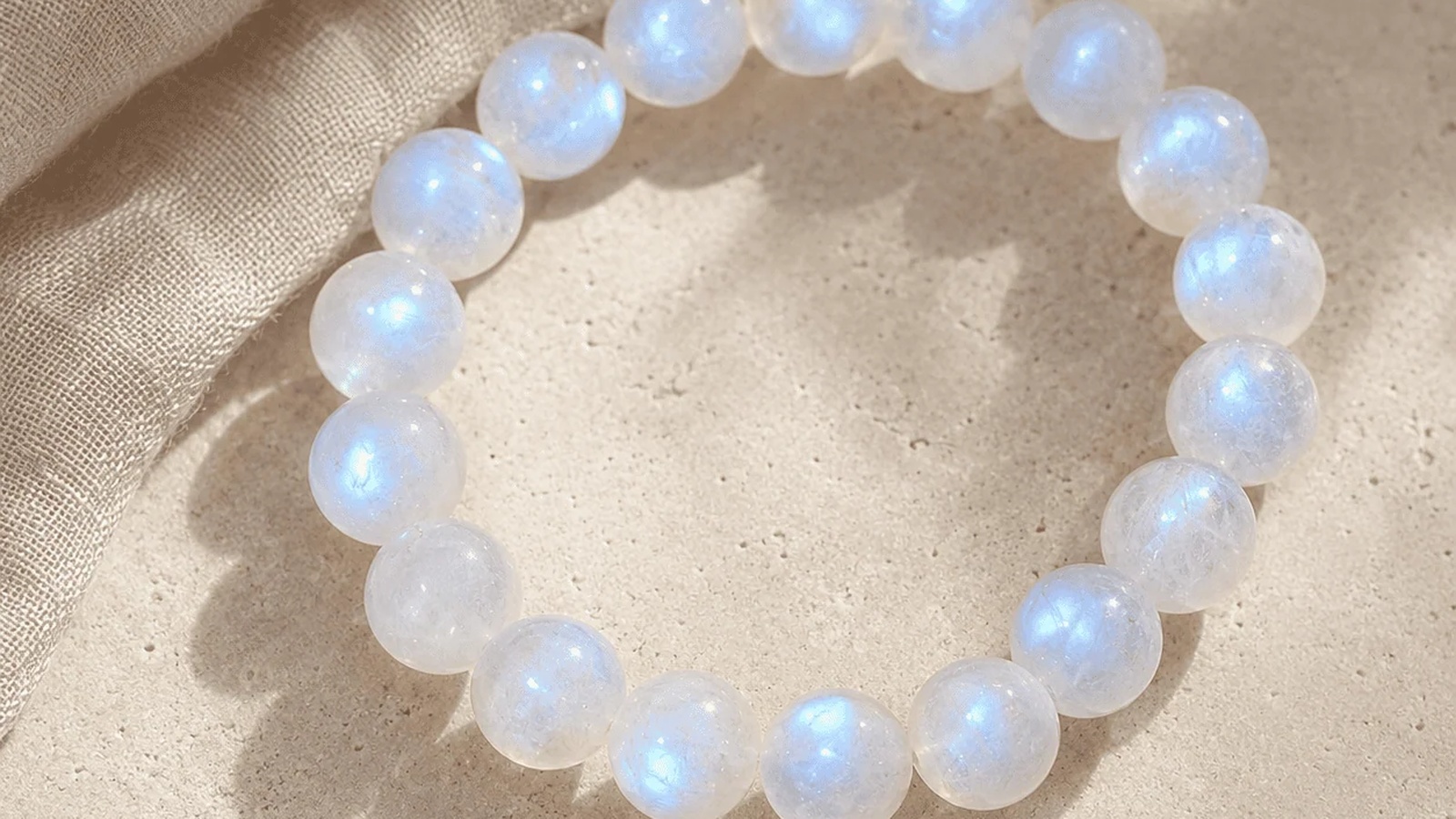
Rainbow moonstone is, in gemological terms, a light-bodied variety of labradorite feldspar that shows a multicolored adularescence—often called a blue or rainbow sheen—and it is sold and loved as "moonstone" in the jewelry trade even though it is not orthoclase moonstone. That single distinction answers most of the confusion behind the search: yes, it is real feldspar, and yes, the trade name is technically a misnomer. For everyday wear, choose pieces with a strong, even sheen visible in ordinary light, set in protective bezels or low-profile settings, at Mohs 6–6.5 so they are wearable but need conscious care.
10-Second Executive Summary / The Verdict Box
- Direct Verdict: Rainbow moonstone is a trade name for a light-colored labradorite feldspar with multicolored adularescence. It is a genuine natural gemstone, not a synthetic, and in the trade it is legitimately sold as moonstone.
- Mineral identity: Labradorite (plagioclase feldspar), not orthoclase moonstone.
- Mohs hardness: 6–6.5—fine for earrings pendants and occasional rings, but softer than quartz and prone to scratching and cleaving along cleavage planes.
- Signature optical effect: Adularescence—a floating billowy sheen—plus directional color flashes (blue, and often other spectral colors).
- Best everyday uses: Earrings, pendants, and low-profile or bezel-set rings; bracelets only with protective settings and mindful wear.
- Quality signal: Strong sheen visible from multiple angles in diffuse daylight, clean transparency, and a smooth domed cut that shows the flash without dead zones.
- Lumina Grade AAA Integrity Standard: Our benchmark for natural, untreated rough with no chemical filling, no irradiation, and no dye—because a light-bodied feldspar's beauty should come from the stone itself.
What Is Rainbow Moonstone? Labradorite, Moonstone & the Trade Name Explained
The gemological answer is clear: rainbow moonstone is a labradorite feldspar, typically from Madagascar, that displays a multicolored adularescence over a light bodycolor. The Gemological Institute of America explains that this material is known in the trade as rainbow moonstone "despite the fact that it's actually a variety of labradorite rather than orthoclase" (GIA, Moonstone Description). The Smithsonian holds specimens catalogued as "Labradorite (var. rainbow moonstone)," confirming the variety designation in a museum context (Smithsonian NMNH).
There is a second, gentler way to read the name. GIA's educational writing notes that to be called moonstone, a mineral's chemical composition matters less than the beauty of its adularescence (GIA 4Cs). In other words, "moonstone" functions as an optical description as much as a mineral one. When you buy rainbow moonstone jewelry, you are buying a light feldspar with a moonlit billow and, usually, a blue flash—sometimes joined by other spectral colors.
This matters practically. If a seller claims their rainbow moonstone is "orthoclase moonstone," the claim is imprecise. If a seller refuses to call it labradorite at all, they may be overselling. The honest framing—real labradorite, sold as rainbow moonstone—is the one to trust.
The Meaning and Symbolism of Rainbow Moonstone (Hindu Moonbeams, Lunar Lore & Modern Intentions)
Rainbow moonstone's cultural symbolism is layered. In Hindu tradition, moonstone is often associated with moonlight and the calm rhythm of lunar cycles, and it is commonly linked with intuition and receptive, reflective energy. In broader lunar lore, the stone's floating sheen has long been read as captured moonlight. These are cultural and symbolic associations, not physical properties—they may support a personal sense of calm or reflection, but they are not medical or psychological claims, and no stone is a treatment.
Modern wearers often gravitate to rainbow moonstone for a different reason: the sheen changes with angle. That shifting light can make the stone feel quietly alive, which is why people often pair it with intentions around clarity, gentleness, and new beginnings. Treat these as personal reminders rather than promises. A ring that reminds you to pause is a beautiful object doing legitimate emotional work; it is not regulating anything in your body.
What the symbolism genuinely shares with the geology is the theme of hidden light: a plain-looking pale stone that reveals color when turned. That is the truest "moonbeam" quality in the material—and it is observable, not mythical.
What Makes the Rainbow Sheen? Adularescence, Interference & Color Flashes
The sheen has a name: adularescence, the billowy, floating light that appears to glide beneath the surface as the stone moves. In feldspars it arises from light scattering and interference at microscopic internal boundaries. In rainbow moonstone specifically, that base sheen is often accompanied by directional color flashes—most commonly blue, sometimes broader spectral colors—because interference occurs at slightly different scales across the stone.
Two practical consequences follow. First, the effect is directional: a stone can glow blue at one angle and look dull at another. Second, the effect depends on daylight and diffuse light far more than on bright spotlights, so evaluate any stone in soft natural light before deciding. A strong sheen should be visible in ordinary daylight, not only under a jeweler's lamp.
The Smithsonian's collection notes describe rainbow moonstone's appeal in terms of "spectral colors" (Smithsonian American Women's History), which is a useful vocabulary for what you are looking for: a spectrum, not a uniform tint.

Moonstone Bracelet (Grade AAA Natural Gemstone)
A quiet bracelet for turning this intention into a small daily ritual.
Shop This Authentic Piece →Rainbow Moonstone vs. Blue Moonstone vs. Labradorite: A Comparison Table
| Feature | Rainbow Moonstone | Blue Moonstone (orthoclase) | Labradorite (typical) |
|---|---|---|---|
| Mineral group | Plagioclase feldspar (labradorite variety) | Orthoclase feldspar | Plagioclase feldspar |
| Body color | Light, often near-white or slightly translucent | Light to near-colorless, semi-translucent | Typically darker: gray, dark gray, near-black |
| Sheen character | Multicolored adularescence with frequent blue plus other flashes | Classic billowy blue sheen | Bold directional flash, often blue, green, or gold on a dark body |
| Trade naming | Sold as "moonstone" though gemologically labradorite | Sold as "moonstone" in the strict sense | Sold as labradorite or spectrolite |
| Everyday wear fit | Very good in earrings, pendants, low-profile rings | Good, similar care needs | Good, dark body hides wear less well than light stones |
Use the table as a decision aid, not a purity test. All three are genuine feldspars. The real questions are whether the seller names the material accurately and whether the sheen is strong enough to justify the price. A light-bodied stone with a faint, patchy flash is a weak buy; a well-proportioned dark labradorite with a vivid flash is an excellent one.
How to Choose Quality Rainbow Moonstone Jewelry (Color, Clarity, Cut & Setting)
Quality in rainbow moonstone is judged mostly by the optical effect, because the body color is intentionally pale and the material is usually semi-translucent. Look for a sheen that is strong, even, and visible from multiple angles in daylight. Color flashes that appear on the face of the stone rather than only at its edge are generally more desirable. Clarify is secondary but still matters: excessive internal fractures scatter light and can dull the sheen, though a light, lightly included body is normal for the material.
Cut is where good jewelry separates itself. A well-domed cabochon or a carefully oriented faceted stone places the sheen across the visible face rather than dead-center under the setting. For a faceted stone, check that the flash is present on the table, not just the crown edges. For a cabochon, rotate the piece slowly and watch whether the billow travels smoothly.
Setting decisions are durability decisions. Because feldspar is relatively soft and has cleavage, protective settings—bezel, low-profile prongs, gallery rails—serve a moonstone better than tall open prongs that expose the girdle. Under the Lumina Grade AAA Integrity Standard, we look for natural, untreated rough with no chemical filling, no irradiation, and no dye; for a light-bodied stone, treatment is often unnecessary, and transparency about treatments is a quality signal in itself.
Everyday Styling: Rings, Necklaces, Earrings & Bracelets for Daily Wear
Rainbow moonstone's everyday role depends on the jewelry type. Earrings and pendants are the easiest daily choices because they rarely knock against hard surfaces; a bezel-set pendant or a simple stud pair lets the sheen do the work without exposing the stone to risk. Rings are the most common everyday piece and also the most vulnerable: keep the profile low, choose a protective setting, and wear it on a finger that is not the most active—many people find the ring finger or middle finger safer than the index finger.
Bracelets deserve a note of caution. Wristwear contacts desks, keyboards, doorframes, and other hard objects, so a moonstone bracelet works best in a snug protective setting and with the awareness that feldspar will chip before steel will. If you love the look, consider a bracelet with smaller, well-protected stones rather than one large exposed cabochon.
Styling-wise, the pale body and blue flash pair naturally with silver, white gold, and muted warm metals. Because the sheen is subtle in flat light, pieces tend to read as elegant and quiet—an everyday companion rather than a statement piece. That is exactly the role the material suits.
Care and Durability: Cleaning, Storage & Protecting Your Rainbow Moonstone Jewelry
Feldspar sits at Mohs 6–6.5, which means it is soft enough to be scratched by quartz dust, hardened glass, and everyday abrasives, and it has cleavage planes that make sharp knocks a real risk. The care routine follows directly from that. Clean with lukewarm water and mild soap, using a soft cloth or brush; avoid ultrasonic and steam cleaners, which are commonly advised against for porous or cleavage-prone gems, and avoid household chemicals and long soaks. Dry gently and completely.
Storage is half the battle. Keep moonstone pieces in their own soft pouch or a compartment away from harder stones—diamond, sapphire, quartz—which can scratch it in a shared jewelry box. Remove rings and bracelets before housework, gardening, or gym sessions. For everyday wear, a simple habit works well: put the jewelry on last, after makeup and hair products, and take it off first at the end of the day.
If a stone ever loosens in its setting, stop wearing it until it is re-tightened. A feldspar with any play in the prongs is at risk of chipping at the edge.
Buying Checklist: Authenticity, Treatments, Synthetics & Ethical Sourcing
Rainbow moonstone is not typically synthesized in the way ruby or sapphire is, but glass imitation and dyed or coated material do appear in the market, so inspect with a checklist rather than a vibe. Step one: ask the seller to name the material accurately. A good seller will say something like "natural labradorite feldspar with multicolored adularescence, traded as rainbow moonstone" rather than dodging the question. Step two: examine the sheen in daylight. The billow in genuine feldspar moves as you rotate the stone; painted or coated imitations tend to look flat or surface-level, and glass may show bubbles or a uniformly waxy look with no direction-dependent flash.
Step three: ask about treatments. Inquire specifically about filling, dyeing, irradiation, and coating, and expect clear answers. Step four: check the stone-setting interface—a protective setting is a sign the maker understands feldspar. Step five: ask about origin and sourcing practices; Madagascar is the commonly cited source for this variety, and a seller who can speak to their supply chain with specifics is worth more trust than one who cannot.
Finally, hold the piece to the Lumina Grade AAA Integrity Standard: natural, unenhanced rough where possible; no chemical filling; no irradiation; no dye. If a listing is vague about treatments, treat the vagueness as information.
Quick FAQ: Top Questions About Rainbow Moonstone Jewelry
What is rainbow moonstone—is it really moonstone or labradorite?
It is really a light-bodied labradorite feldspar; "rainbow moonstone" is a trade name. Gemologically it is not orthoclase moonstone, but it is legitimately sold as moonstone because the trade name describes its adularescence.
What does rainbow moonstone mean and what healing properties is it associated with?
It is often associated with lunar symbolism, intuition, and calm reflection, and may support a personal sense of grounding. These are cultural and symbolic associations, not medical properties or proven physical effects.
How can you tell real rainbow moonstone from glass or synthetic imitations?
Look for a moving billowy sheen with directional color flashes that shift as you rotate the stone in daylight. Glass often looks flat or shows bubbles, and fake coatings tend to sit on the surface rather than inside the stone.
Sources
- GIA — Moonstone Description
- GIA 4Cs — Moonstone: A Gem to Celebrate the Moon
- Smithsonian National Museum of Natural History — Labradorite (var. rainbow moonstone)
- Smithsonian American Women's History — Labradorite (var. rainbow moonstone)
© 2026 Lumina Quartz. This guide is educational. Gemstone symbolism and personal intention uses are cultural associations, not medical advice. Always confirm treatments and sourcing with the seller before purchase.