The Complete Everyday Guide to Raw Fluorite: Meaning and Uses
Table of Contents
- The 10-Second Executive Summary
- What Is Raw Fluorite? (Calcium Fluoride Explained)
- Raw Fluorite Meaning and Metaphysical Properties
- Focus, Clarity and Order
- Color-by-Color Associations (Purple, Green, Blue, Rainbow)
- Common Uses of Raw Fluorite in Everyday Life
- Home and Desk Display
- Meditation and Energy Work
- Crafting, Tumbling and Jewelry-Making
- How to Choose Quality Raw Fluorite (Color, Zoning, Fluorescence, Origin)
- Raw Fluorite Selection Checklist
- How to Tell Real Raw Fluorite from Fakes and Treated Stones
- Raw vs. Polished or Tumbled Fluorite
- How to Care For and Clean Raw Fluorite
- Frequently Asked Questions
- What is raw fluorite and what is it used for?
- What does raw fluorite mean spiritually or metaphysically?
- How can you tell if raw fluorite is real or fake?
- Closing Thoughts
- Sources
Raw fluorite is the unpolished, natural form of calcium fluoride (CaF₂) — a cubic-system mineral that forms in cubes and octahedra and is most often used for display, meditation, tumbling, and specimen collecting rather than for everyday jewelry. Its practical appeal is color: fluorite appears in purple, lilac, golden-yellow, green, blue, pink, colorless, brown, red, and black, and raw pieces often show several of those colors banded together in one stone (Mindat).
The 10-Second Executive Summary
Direct Verdict: Raw fluorite is a soft, colorful calcium fluoride mineral best valued as a display, meditation, and tumbling stone — not as a daily-wear gemstone.
- Composition: Calcium fluoride (CaF₂).
- Mohs Hardness: 4 — soft and fragile by gemstone standards.
- Crystal System: Cubic; most often cube and octahedron habits.
- Color Range: Purple, lilac, golden-yellow, green, colorless, blue, pink, champagne, brown, red, black.
- Best Used For: Home and desk display, meditation focal objects, tumbling stock, and collector specimens.
- Poorly Suited For: Rings, bracelets, and other high-impact everyday jewelry.
- Grading Note: Lumina Grade AAA Integrity Standard (natural, untreated material with no chemical resin-filling and no irradiation or dye treatment) does not change fluorite's hardness — it confirms authenticity and integrity only.
What Is Raw Fluorite? (Calcium Fluoride Explained)
Raw fluorite is calcium fluoride, a mineral that crystallizes in the cubic system and most often forms as cubes and octahedra (Smithsonian National Museum of Natural History). "Raw" means it has not been cut, faceted, or polished into a finished shape — you are holding the mineral as it grew, or as it was broken from a larger specimen.
Its Mohs hardness of 4 is the single most important practical fact about it. The Smithsonian notes that fluorite is sometimes faceted as a gemstone, but mainly for collectors, because the stones are too soft and fragile for most jewelry. That one sentence should shape almost every buying and use decision you make with raw fluorite.
Raw Fluorite Meaning and Metaphysical Properties
In crystal and metaphysical traditions, raw fluorite is often associated with focus, mental order, and clarity of thought. These are cultural and personal-reminder associations, not mineral properties — no physical or clinical effect is implied or supported here. Treat the meaning section as a lens for how people use the stone, not as a claim about what it does to the body or mind.
Focus, Clarity and Order
Raw fluorite is often used as a visual anchor for focus: its internal banding and zoning give the eye something structured to rest on. Many people keep a small raw piece on a desk and use it as a cue to return attention to one task. That is a behavioral reminder pattern, not a chemical one.
Color-by-Color Associations (Purple, Green, Blue, Rainbow)
Fluorite's color associations vary widely by tradition and by seller, and should be held loosely. The colors themselves, however, are geologically real and varied (Mindat). Common working associations include:
- Purple / lilac fluorite: most often associated with reflection, quiet study, and inward focus.
- Green fluorite: often associated with renewal, learning, and steady progress.
- Blue fluorite: frequently associated with calm, clear expression, and considered decision-making.
- Rainbow / multi-band fluorite: often associated with integration — holding several perspectives at once.
These are symbolic frameworks. They may support a personal practice; they do not constitute treatment or therapy.
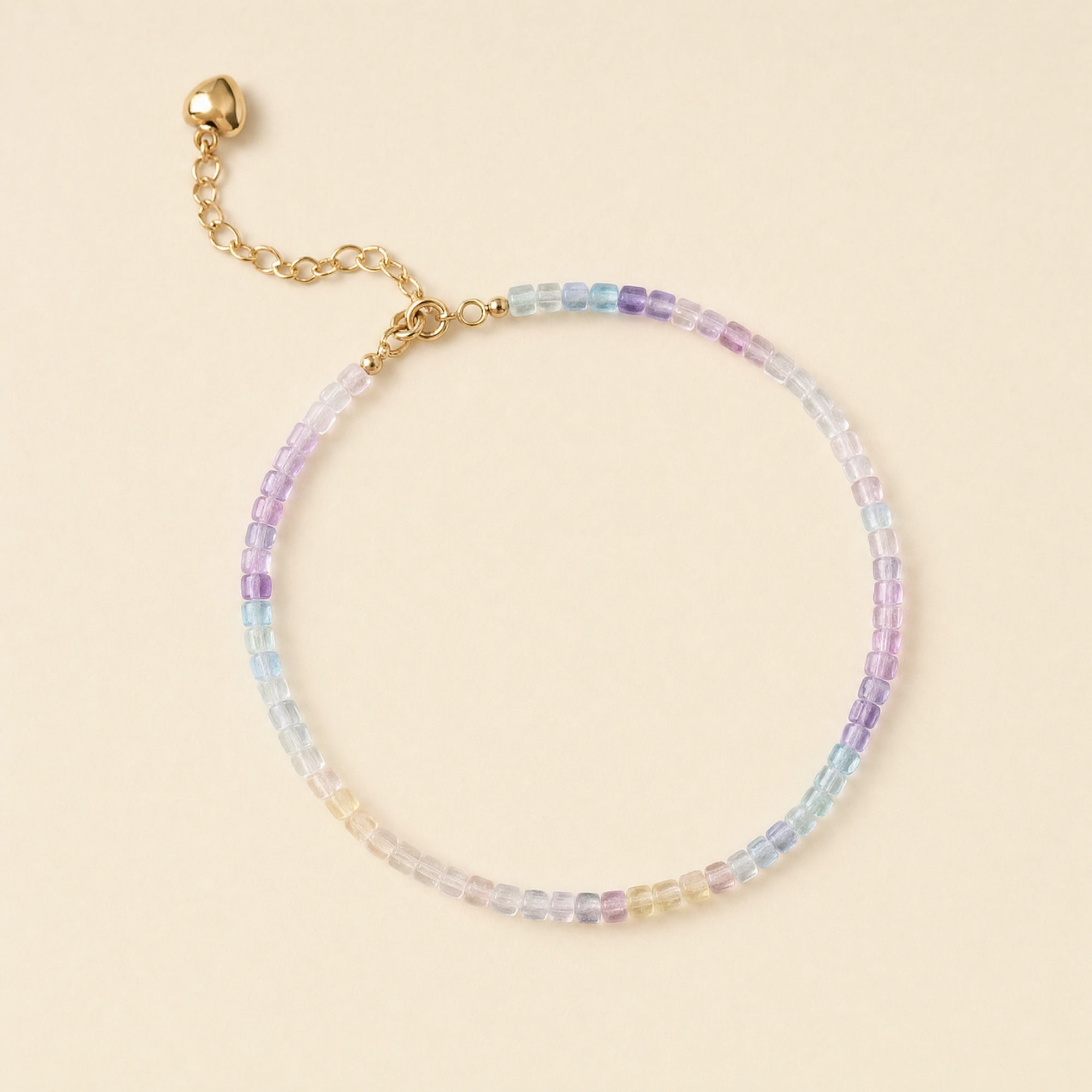
Fluorite Bracelet
A quiet bracelet for turning this intention into a small daily ritual.
Shop This Authentic Piece →Common Uses of Raw Fluorite in Everyday Life
Home and Desk Display
Raw fluorite's most natural role is display. Because it is soft (Mohs 4), it is better placed on a shelf, windowsill, or desk than in a pocket with keys. Display pieces let you appreciate the color zoning and, in some specimens, daylight fluorescence. Avoid prolonged direct sunlight on saturated purple pieces if you want to protect color over time.
Meditation and Energy Work
Raw pieces are often chosen for meditation because their irregular form and internal architecture give the eye and hand something to attend to. Hold a palm-sized piece, or place a smaller one in your line of sight. If you practice energy work, fluorite is often used as a focal or grounding object within that framework.
Crafting, Tumbling and Jewelry-Making
Tumbling is one of the best uses for raw fluorite — with an important caveat. Fluorite tumbles readily and takes a fine polish, but it is softer than the grit sequence used for harder stones, so it should be run in its own batch or with other soft materials. In jewelry, fluorite is safe in pendants, earrings, and bezel settings that are protected from impact; it is a poor choice for rings and bracelets, where it will chip and abrade.
How to Choose Quality Raw Fluorite (Color, Zoning, Fluorescence, Origin)
Quality in raw fluorite is judged differently from cut gemstone quality. Because you are buying the natural structure, zoning is a feature rather than a flaw — but the criteria still need to be applied honestly.
Raw Fluorite Selection Checklist
Use this ordered checklist when evaluating a raw fluorite piece. Each step is specific to fluorite and should be completed before purchase.
- Judge zoning as structure, not defect. Look for clean, distinct color bands or cubes. In raw fluorite, sharp geometric zoning is a sign of natural crystallization; cloudy, uniform filler is not.
- Match color to intended use. Saturated purple and rainbow banding show best on display; simple green or blue material is a practical tumbling choice.
- Look for internal clarity zones. Clear-to-translucent areas alongside cloudy bands are typical of natural fluorite and help confirm it is not a uniform synthetic block.
- Test for fluorescence only as a secondary clue. Some fluorite glows under UV — the name comes from this property — but absence of fluorescence proves nothing, since not all material fluoresces.
- Confirm treatment status. Ask directly whether the piece has been resin-filled, dyed, or irradiated. The Lumina Grade AAA Integrity Standard describes natural, untreated material: no chemical resin-filling, no irradiation, and no dye. Apply the same questions to any seller's stock.
- Verify origin claims as claims, not guarantees. Ask for the stated locality (e.g., China, Mexico, England, Illinois) and treat it as reported information unless documentation is offered.
- Inspect physical condition. Check corners and edges for chips — raw fluorite cleaves and chips easily at Mohs 4.
How to Tell Real Raw Fluorite from Fakes and Treated Stones
Fluorite is imitated less often than high-value gems, but dyed, resin-filled, and glass substitutes do circulate. A few checks, done together, are more reliable than any single test.
- Hardness check (careful): Fluorite sits at Mohs 4. A steel point will scratch it; it will not scratch glass. Never test on a piece you intend to keep — use a hidden edge.
- Cleavage and fracture: Fluorite shows distinct octahedral cleavage. A clean, flat break at an angle is a positive natural sign; conchoidal, glass-like fracture suggests glass or quartz.
- Color bleeding: Dye concentrates in cracks. Check fracture lines with a loupe — bright color pooling along cracks indicates treatment.
- Weight and feel: Fluorite is relatively dense for its size; glass substitutes often feel lighter or warmer to the touch.
- Resin detection: Filled stones can feel slightly "plastic" or show a waxy surface sheen under strong light. Ask for untreated confirmation aligned with a standard such as Lumina Grade AAA Integrity Standard.
- Price reality check: Large, perfectly clear, deeply saturated blocks at very low prices are a warning sign; natural raw material usually shows some clouding or zoning.
Note that purple material is sometimes heat-treated for color. Treat any unusually uniform, deeply saturated piece with caution until treatment status is confirmed.
Raw vs. Polished or Tumbled Fluorite
The difference is form and function, not quality. Raw fluorite preserves natural crystal faces, zoning, and matrix, which makes it better for display and study. Tumbled or polished fluorite smooths the surface and edges, which reduces chipping risk and makes the color easier to see, but it also removes the natural geometric structure. Because both forms share the same Mohs 4 hardness, neither is suited to high-impact jewelry. Choose raw for visual and collector value; choose tumbled for handling, pockets, or craft projects.
How to Care For and Clean Raw Fluorite
Care is where softness matters most. Keep raw fluorite away from hard stones in storage, and wrap or pad specimens individually. Clean with lukewarm water and a soft cloth only — avoid ultrasonic cleaners, steam, and harsh chemicals, all of which can damage a soft, cleavable mineral. Dry thoroughly, since moisture trapped in cracks can harbor residue. For display, keep pieces out of prolonged direct sun to protect color, and avoid bump-prone spots where edges may chip.
Frequently Asked Questions
What is raw fluorite and what is it used for?
Raw fluorite is unpolished calcium fluoride, a Mohs 4 mineral most often used for home display, meditation focal pieces, tumbling, and specimen collecting — not for everyday rings or bracelets.
What does raw fluorite mean spiritually or metaphysically?
It is often associated with focus, clarity, and mental order, with color-specific symbolism for purple, green, blue, and rainbow banding. These are cultural and personal-reminder associations, not physical or therapeutic effects.
How can you tell if raw fluorite is real or fake?
Combine checks: it should scratch with steel at Mohs 4, show octahedral cleavage rather than glassy fracture, and have color zoning rather than dye pooling in cracks. Ask directly about resin-filling, irradiation, and dye treatment.
Closing Thoughts
Raw fluorite rewards a patient, practical approach. Hold it as a colorful, structurally beautiful mineral — soft enough to teach care, vivid enough to keep your attention. If you value clarity in a stone, choose clarity honestly: inspect zoning, ask about treatment, and let a standard like Lumina Grade AAA Integrity Standard guide your questions. The beauty is in what the earth actually made.
Sources
- Mindat — Fluorite: Mineral information, data and localities
- Smithsonian National Museum of Natural History — Fluorite
© 2026 Lumina Quartz. This article is for general information only and is not medical or therapeutic advice. Metaphysical associations are cultural and personal, not scientific claims.
Product Facts From the Current Catalog
These details come from the active Lumina Quartz catalog record checked on 2026-11-12. They are product-listing facts, not laboratory results or invented wear-test claims.
| Listed product | Fluorite Bracelet – Organized Focus |
|---|---|
| Format | Bracelet |
| Listed price snapshot | 39.99 |
Price, availability, and options may change. Check the live product listing before choosing.