The Complete Everyday Guide to Raw Obsidian: Meaning and Uses
Table of Contents
- What Is Raw Obsidian? The Volcanic Glass Explained
- 10-Second Executive Summary / The Verdict Box
- Raw Obsidian Meaning: History, Symbolism, and Spiritual Significance
- The Main Types of Raw Obsidian and What Each One Is Used For
- Black, Snowflake, Rainbow, Fire, Sheen, and Mahogany Varieties
- Fake vs. Real: A Five-Step Inspection Checklist for Raw Obsidian
- How to Spot Fake or Mislabeled Raw Obsidian
- Everyday Uses of Raw Obsidian: Décor, Crystal Healing, and Crafting
- Underestimated Alternative: Snowflake Obsidian
- How to Cleanse, Charge, and Care for Raw Obsidian
- Buying Raw Obsidian: What to Look For and How to Choose Quality Pieces
- FAQ: Quick Answers About Raw Obsidian
- What is raw obsidian and is it real volcanic glass?
- How can you tell if rainbow or sheen raw obsidian is fake?
- How should you cleanse, charge, and care for raw obsidian?
- Sources
What Is Raw Obsidian? The Volcanic Glass Explained
Raw obsidian is natural volcanic glass formed when silica-rich lava cools so quickly that atoms cannot arrange themselves into a crystal lattice. The U.S. Geological Survey describes it simply as "volcanic glass," and that is exactly what an unpolished piece is — a conchoidal-fractured chunk of rapidly quenched lava rather than a mineral crystal. Because it is amorphous, it has no cleavage planes, breaks into curved glassy shards, and registers 5–5.5 on the Mohs hardness scale.
10-Second Executive Summary / The Verdict Box
- Direct Verdict: Raw obsidian is genuine volcanic glass — an amorphous, silica-rich rock, not a crystal. It is real, widely available, and one of the most responsibly priced grounding stones for everyday use.
- Mohs Hardness: Approximately 5–5.5. It scratches glass and softer stones, polishes to a mirror finish, and can chip along conchoidal fractures if dropped.
- Composition & Color: Silica-rich glass; color ranges from black to bluish, mahogany, golden, peacock, grey-green and brown-green, largely due to refraction by microscopic bubbles and inclusions such as magnetite in "rainbow obsidian".
- Best For: Grounding décor, altar and grid work, lapidary and wire-wrapping, and a first "shadow-adjacent" stone for collectors who want something honest and tactile.
- Skip If: You expect rainbow or fire flash from every angle — those optical effects are real but highly directional and light-dependent; plain black raw obsidian will not shimmer.
Part of obsidian's appeal is historical: it has been traded, knapped, and treasured across continents for millennia. The Smithsonian notes that shifts in obsidian use over time can reflect broader socioeconomic change, and that obsidian in Northern Plains assemblages points to interaction networks as old as the first Plains Village sites. In short, this is a stone with a genuine human story behind it — which is often the most grounding thing about it.
Raw Obsidian Meaning: History, Symbolism, and Spiritual Significance
Culturally, raw obsidian is often associated with protection, truth-telling, and the honest mirror. In crystal traditions it is frequently described as a "shadow stone" — a companion for looking at what is uncomfortable rather than an amulet that makes discomfort disappear. That distinction matters: those meanings are cultural and symbolic, not medical. Obsidian may support a personal practice of reflection, but it does not treat, cure, or regulate anything in the body.
Its real-world history gives the symbolism weight. Knapped obsidian blades and trade pieces appear in archaeological records worldwide, partly because the glass fractures into extremely sharp edges. The Smithsonian's Museum Conservation Institute has researched obsidian trade and sourcing, showing how far this material traveled. For modern users, that lineage often translates into a simple personal ritual: holding a raw piece during journaling, set on a work desk as a "pause" cue, or placed in a grounding corner of a room.
The Main Types of Raw Obsidian and What Each One Is Used For
Black, Snowflake, Rainbow, Fire, Sheen, and Mahogany Varieties
Obsidian's varieties are defined by inclusions and light behavior, not by different "energies" that can be verified. Use this practical comparison:
- Black obsidian: The classic. Dense, matte-to-glossy black glass. Best for grounding décor, larger statement pieces, and beginner collections. It is the least likely to be faked because it is inexpensive to source honestly.
- Snowflake obsflake: Black glass with white-grey radial clusters of cristobalite crystals. Visually distinct and excellent for display; the "snowflakes" are a growth pattern, not a coating, so inspect that they sit within the glass rather than on it.
- Rainbow obsidian: Black-brown glass with microscopic bubbles and inclusions such as magnetite that produce a directional rainbow sheen. Best for small display specimens viewed under direct light; the sheen should move as you rotate the piece.
- Fire obsidian: A rare variety whose brilliant layered iridescence GIA describes as flow structures stretched, sheared, and compressed in molten material and revealed through careful lapidary work under diffuse reflected light. Best for collectors and cut specimens — and the variety most worth buying with provenance.
- Sheen (golden/peacock) obsidian: Metallic-looking flash across a dark surface. Best for jewelry and small polished accents; the flash is a surface-light phenomenon so buy from listings that show multiple angles.
- Mahogany obsidian: Black glass with red-brown iron-oxide coloration. Best for warm-toned décor and earthy altar setups; it is common enough that quality, not rarity, should drive your purchase.
Fake vs. Real: A Five-Step Inspection Checklist for Raw Obsidian
- Check the break, not the polish. Real raw obsidian fractures conchoidally — smooth, curved, shell-like surfaces with sharp edges. Resin or dyed glass imitations often show rounded, molded edges or a waxy sheen where a fracture should be.
- Rotate it under a single light source. Rainbow, sheen, and fire effects should shift position and intensity as the stone moves. A static printed or foil-like reflection that never moves is a red flag.
- Look at the color boundary. In snowflake and mahogany pieces, inclusions should appear embedded at varying depths. Painted-on or surface-applied patterns sit flat and scrape off.
- Weigh it in hand. Obsidian is dense for its size. A suspiciously light "raw" piece may be glass-resin composite or hollow-filled.
- Ask for treatment disclosure. Request confirmation of natural origin, no chemical stabilization, no irradiation, and no dye. Pieces graded under the Lumina Grade AAA Integrity Standard should be sold as natural raw stone, never chemically glued, irradiated, or color-enhanced — and the seller should state that plainly.
Boundary note: A simple scratch test (obsidian scratches ordinary glass at Mohs 5–5.5) can help, but it damages the piece and tells you little about treatment. On higher-value fire and rainbow pieces, trust disclosure and provenance over home tests.
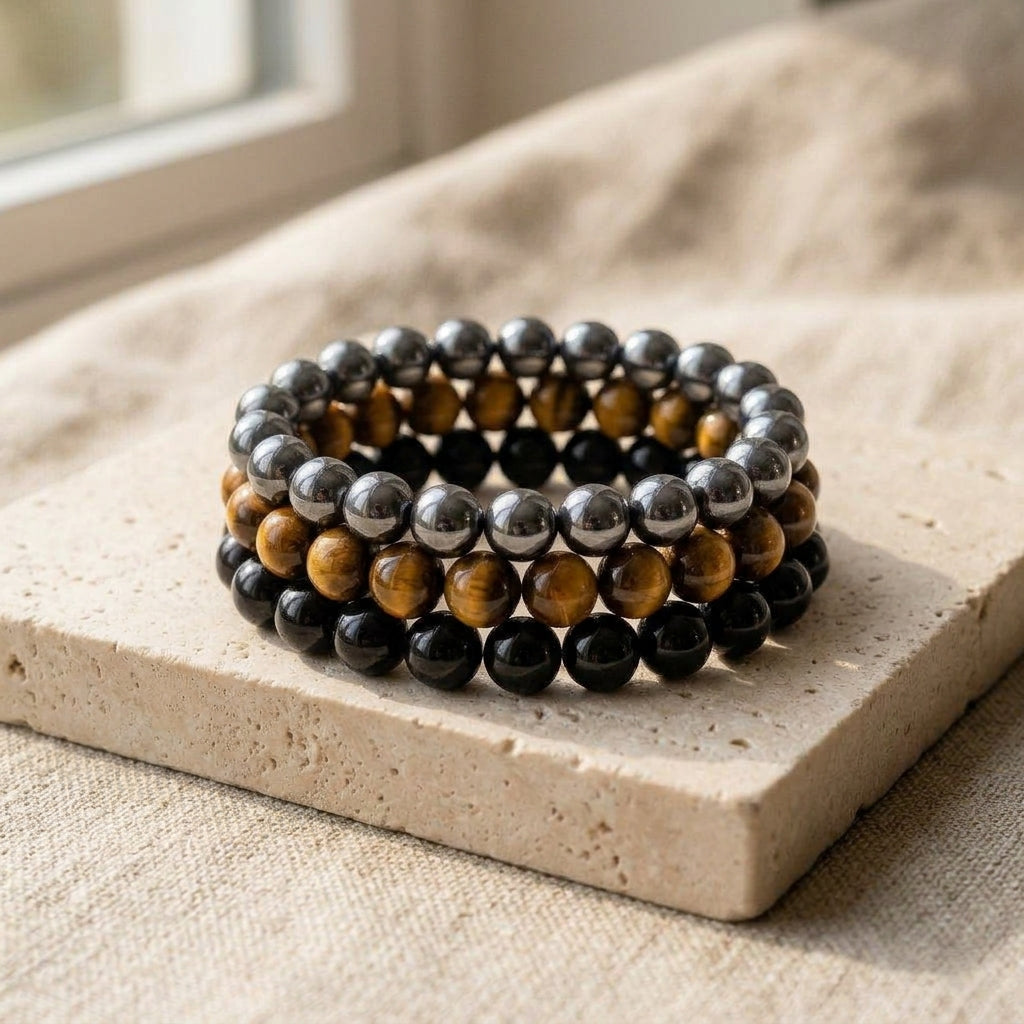
The Master Triple Protection Ritual Stack (Natural Tiger's Eye, Black Obsidian & Hematite)
Black obsidian is often worn as a grounding ritual piece for days that ask for steadier energy.
Shop This Authentic Piece →How to Spot Fake or Mislabeled Raw Obsidian
The most common problem is not outright fabrication but mislabeling. Plain black glass sold as "rainbow obsidian" is a frequent example, as is dyed grey glass presented as "fire obsidian." Use the checklist above as your core filter, and add these habits:
- Buy rainbow, sheen, and fire varieties only where you can request a short video in raking light — the effect is directional and photos alone hide weak flash.
- Be wary of listings that describe obsidian as "polished raw." Raw means fractured, not tumbled; if the surface is uniformly smooth, it is a polished piece and should be priced and described as such.
- Confirm origin honesty rather than exotic origin claims. Many fine pieces come from well-documented sources, and a seller who names a locality should be able to discuss sourcing.
Everyday Uses of Raw Obsidian: Décor, Crystal Healing, and Crafting
Where raw obsidian genuinely shines is in ordinary, tangible use:
- Décor: A raw chunk on a bookshelf, entryway tray, or desk provides a quiet, matte counterweight to plants and ceramics. Black pieces anchor a room visually; mahogany and snowflake versions add texture.
- Personal reflection practice: Many people keep a raw piece on a journaling desk or meditation corner as a visual cue for honesty and grounding. This is a personal reminder practice, often associated with self-examination — not a clinical or emotional treatment.
- Crafting and lapidary: Because it fractures predictably into sharp edges, obsidian is a traditional knapping material and a favorite for wire-wrapping, cabochon cutting, and small carved forms. Its Mohs 5–5.5 hardness means it polishes beautifully but needs gentler handling than quartz.
- Grids and altars: Raw points and chunks are preferred over tumbled pieces when you want a natural silhouette; combine black and mahogany pieces for contrast.
Underestimated Alternative: Snowflake Obsidian
- Why it stands out: Its embedded cristobalite clusters give a distinctive pattern that is hard to imitate convincingly at low price points, making it a safer and more visually interesting choice than many "sheen" listings.
- Best used for: Display specimens, beginner collections, and gift pieces where visual character matters more than flash.
How to Cleanse, Charge, and Care for Raw Obsidian
Physical care first, because it protects everything else. Clean raw obsidian with lukewarm water and a drop of mild soap, rinse, and dry with a soft cloth. Avoid ultrasonic cleaners and harsh chemicals on pieces with visible fractures, and skip the dishwasher entirely. Because the stone is glass, keep it away from hard knocks and store it wrapped or in a padded tray — conchoidal fractures are its signature and also its main vulnerability.
For cleansing practices, simple is safest: rinse in cool water, dry fully, and rest the piece on dry salt for a short period if the surface is unpolished. For charging, moonlight or morning sunlight on a windowsill is a gentle, non-damaging default; prolonged intense sun is unnecessary and fades nothing on obsidian, but keep very hot conditions away from any resin-mounted pieces. As a personal practice, you might set an intention each time you cleanse — the ritual is meaningful because you make it so, not because the stone performs a physiological function.
Buying Raw Obsidian: What to Look For and How to Choose Quality Pieces
Start with purpose, then match the variety: black for grounding décor and first pieces, snowflake and mahogany for texture and warmth, rainbow and sheen for small light-catching specimens, fire for collection-grade purchases with documentation. Then apply these steps:
- Inspect the fracture surfaces. Fresh, glassy conchoidal breaks with slight translucency at thin edges signal genuine volcanic glass.
- Demand treatment transparency. The Lumina Grade AAA Integrity Standard is our benchmark for exactly this: natural raw stone, zero chemical stabilization, no irradiation, no dye. Any seller should be able to confirm those four points in writing.
- Match size to use. Palm-sized chunks suit desks and altars; smaller points suit grids and wire-wrapping; large display pieces should be judged in person or via video for balance and chip-free edges.
- Price the variety, not the hype. Black and mahogany obsidian should be accessible; rainbow, sheen, and especially fire specimens justify higher prices only when the optical effect is demonstrably strong and the listing is honest about orientation and lighting.
FAQ: Quick Answers About Raw Obsidian
What is raw obsidian and is it real volcanic glass?
Yes — raw obsidian is genuine volcanic glass, formed when silica-rich lava cools too fast to crystallize, which is why the USGS classifies it as volcanic glass rather than a mineral. "Raw" simply means it is unpolished and shows natural fracture surfaces.
How can you tell if rainbow or sheen raw obsidian is fake?
The sheen must move and change intensity as you rotate the piece under a single light — a fixed, printed-looking reflection usually indicates coated or imitation glass. Ask for a raking-light video and confirm the piece is natural and untreated, ideally under the Lumina Grade AAA Integrity Standard.
How should you cleanse, charge, and care for raw obsidian?
Wash gently with lukewarm water and mild soap, dry fully, and avoid ultrasonic cleaners, harsh chemicals, and impacts. For cleansing and charging as a personal ritual, cool water rinses, dry salt rest, and moonlight are simple, safe defaults; store pieces padded to protect their sharp fractured edges.
Sources
- U.S. Geological Survey — Obsidian (volcanic glass)
- Mindat — Obsidian: Mineral information, data and localities
- GIA — Fire Obsidian's Beguiling Spectrum
- Smithsonian Profiles — Obsidian use and interaction networks
- Smithsonian Museum Conservation Institute — Obsidian trade research
© 2026 Lumina Quartz. This guide shares cultural symbolism and mineral information for educational purposes only; it is not medical advice.
Product Facts From the Current Catalog
These details come from the active Lumina Quartz catalog record checked on 2026-11-02. They are product-listing facts, not laboratory results or invented wear-test claims.
| Listed product | The Master Triple Protection Ritual Stack (Natural Tiger's Eye, Black Obsidian & Hematite) | Grade AAA Set // Lumina Quartz |
|---|---|
| Format | Bracelets |
| Listed price snapshot | 89.00 |
Price, availability, and options may change. Check the live product listing before choosing.